Living in a Korean Apartment: How Every Part of It Works
You have the keys, or more likely the door code, and the flat looks like any other flat. Then the floor gets warm when you expected a radiator, the bathroom floor is wet after every shower, and something on the wall beeps for no reason you can see.
A Korean apartment is not hard to live in. It is just built on a different set of systems, and nobody hands you the manual. This is that manual, one part at a time: what each thing is, what usually goes wrong with it first, and where to find the full fix when it does.
The short version
| Part of the flat | What surprises people | When it goes wrong |
|---|---|---|
| Front door | No key. A keypad that runs on AA batteries | Dead keypad · Beeping |
| Heating | Hot water pipes under the floor, not radiators | Hot water comes and goes · No hot water at all |
| Bathroom | The whole room gets wet. There is a drain in the floor | Blocked sink · Blocked toilet |
| Kitchen | Gas hob with its own valve, food waste goes out separately | Hood filter cleaning · Trash rules |
| Air | Humid summers, dry winters, condensation in between | Mould · Aircon cleaning |
| Walls | Concrete. Drilling is loud and needs permission | See below |
| The building | A management office that does more than you think | Who fixes what |
The front door: a keypad, not a key
Almost every Korean flat has a digital door lock (도어락, doeorak). You open it with a code, sometimes a card or fingerprint, and it locks itself when the door closes.
Three things to know in the first week:
- Change the code on day one. The previous tenant, the agent and the cleaner may all know it. The manual is usually a sticker inside the battery cover, and the change takes two minutes.
- It runs on batteries, usually four AA cells behind a cover on the inside. When they get low it plays a warning tune for weeks before it dies. Change them when you hear it, not later.
- If the batteries die with you outside, there is a pair of contacts on the bottom of the outer keypad for a 9V battery. Hold one there and the keypad wakes up. That trick, and what a locksmith costs when it fails, is in our dead keypad guide.
A lock that beeps at you while it still works is a different problem, and most of the time it is telling you the door did not close properly. The door lock beeping guide goes through each warning. Inside doors lock too: if a bedroom door locks behind you, start here, and if you are stuck on the inside of one, here.
The heating is in the floor
Korean homes are heated by ondol (온돌): hot water runs through pipes under the floor, and the whole floor becomes the radiator. It is why Koreans take their shoes off, sit on the floor and often sleep close to it.
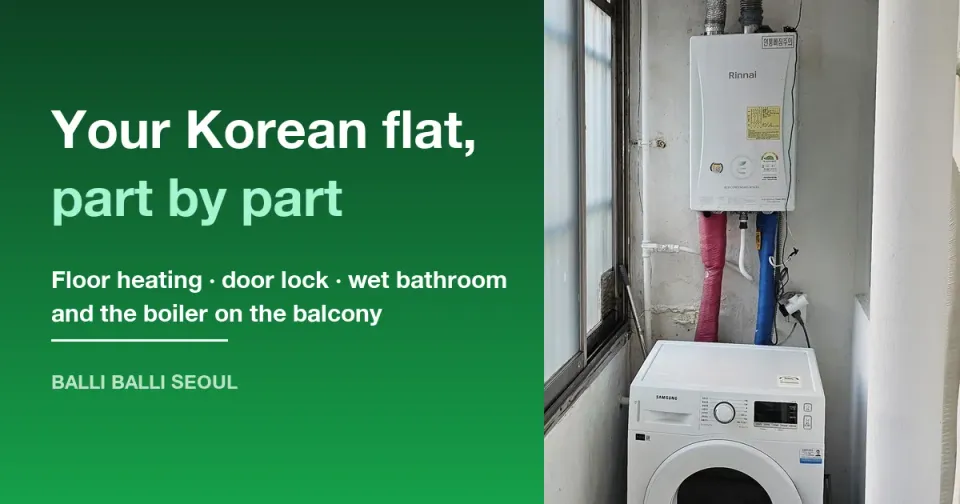
The heat and the hot water come from one gas boiler (보일러, boileo), usually mounted on a wall in the utility area or on the balcony. You control it from a small panel on a wall inside the flat. The buttons vary by brand, but the words are the same:
| On the panel | What it means |
|---|---|
| 난방 (nanbang) | Heating on |
| 온수 (onsu) | Hot water only, no heating |
| 외출 (oechul) | “Going out” — keeps a low heat so pipes don’t freeze |
| 예약 (yeyak) | Timer: heats for a set time, then rests |
Do not switch the boiler off completely in winter, even when you travel. Use 외출 instead. A flat that goes cold for a week in January can freeze the pipes on the balcony, and that repair is far more expensive than the gas.
Floor heating is slow. It takes an hour or more to warm a cold room, so it works better left low and steady than turned up and down. The winter gas bill is where you will see the difference.
When the hot water starts coming and going, the cause is usually one cheap part rather than the whole boiler. A real repair receipt we have is about ₩80,000 all in (as of 2026), against ₩1,045,000 for a full boiler replacement. Read the hot water guide before anyone quotes you for a new one.
The gas has to be opened for you
Most flats in cities run on city gas (도시가스, dosi gas). When you move in, the gas is often shut off at the meter, and it has to be opened by the regional gas company, not by you. They send someone to open it and do a short safety check. Book it before your first night, because it is also your heating and your hot water.
The cooker has its own small valve on the pipe beside it, the 중간밸브 (junggan valve). If the hob will not light, check that lever first. It is the most common “broken cooker” call that turns out to be nothing.
The bathroom is a wet room
There is usually no separate shower tray. The whole bathroom floor is tiled, it slopes towards a floor drain, and the shower, sink and toilet all share the space. Water on the floor after a shower is normal.
What that means day to day:
- Bathroom slippers sit at the door so you are not walking on a wet floor in socks.
- The floor drain has a trap and a hair catcher. It needs clearing every few weeks or it starts to smell. It lifts out and washes in a minute — here is how.
- Run the fan, or leave the door open, after every shower. A wet room with no air is where the black mould on the silicone comes from. Once it is in the silicone, wiping stops working — this is what a proper bathroom clean involves.
The sink and toilet block for the usual reasons. Most sink blockages clear with a ₩2,000 tool from Daiso (guide), and most toilets clear with a ₩3,000 plunger (guide). A plumber for a standard clog usually costs ₩70,000–120,000 in Seoul (as of 2026). If the quote is far above that, read what happened to one of ours before you agree to anything.
A dripping tap is usually a cartridge, a part of about ₩5,000–15,000 that you can change yourself (guide).
The kitchen: the hood filter and the food waste
Two things catch people out.
The range hood filter above the hob collects grease, and in a rental it has often not been cleaned since the last tenant. It slides out and washes in hot water. Do it in the first week and every couple of months after.
Food waste does not go in the general trash. It goes out separately, in its own bags or into a shared bin that you pay for by weight with a card, depending on the building. Getting the streams wrong can mean a fine. The trash guide has the four streams and the bulky-waste sticker process for furniture. If the pile has got ahead of you, there is a pickup option.
Kitchens and floor drains are also where cockroaches come in. What your building already pays for, and what a visit costs when it is not enough, is in the pest control guide.
The balcony is a utility room
In most flats the balcony is closed in with windows and works as a utility room. The washing machine is often there, the boiler may be there, and it is where the laundry dries. Many older rentals have no tumble dryer, so a drying rack on the balcony is standard; newer flats increasingly have a dryer stacked or set beside the washer, often right under the boiler.
Two cautions:
- In a hard freeze, the washing machine’s water and drain pipes can freeze because the balcony is not heated. Buildings post notices when a cold snap is coming. Leave the balcony door slightly open on those nights.
- The aircon’s outdoor unit (실외기, siroegi) is often on the balcony or just outside it. Keep it clear, and don’t dry laundry in front of it.
Many apartment balconies also have a light partition wall (경량칸막이) between your balcony and your neighbour’s. It is built thin on purpose so it can be broken through in a fire. Find it when you move in, and don’t block it with storage.
The air: humid summers, dry winters
The Korean climate does most of the damage in a flat, and it does it slowly.
- The rainy season (장마, jangma), roughly late June into July, is when everything gets damp. A dehumidifier and daily airing make a real difference.
- Winter brings condensation on cold windows and walls, especially on the north side and behind furniture pushed against outside walls.
Both end in mould, and in a Korean flat it often grows where you cannot see it. Check behind the baseboard — ideally before you sign, and if not, now.
The aircon is usually a wall unit. Its filters should come out and be washed every couple of weeks in summer. A proper strip-down clean of a wall unit runs about ₩60,000–90,000 (as of 2026), and the best time for it is when summer ends, not when it starts (why). Korea charges electricity in tiers, so July and August are where the summer bill jumps.
The walls are concrete
Most apartment walls are solid concrete under the wallpaper. Hanging a shelf means a hammer drill, which is loud enough that your whole floor will hear it, and in a rental it needs the landlord’s agreement first.
Before you drill:
- Look for no-drill (무타공, mutagong) versions of what you want to hang. Curtain rails, shelves and towel bars all come in tension or adhesive versions.
- For pictures and light things, small pin hooks that go into the wallpaper layer hold more than you would expect and leave a tiny hole.
- Ask in writing before anything permanent. The landlord may agree happily, and then it is not a deposit argument when you leave.
The wallpaper itself is usually the landlord’s to renew between tenants — but only if you ask before you sign.
Noise travels down
Floor noise (층간소음, cheunggan soeum) is the most common neighbour dispute in Korean apartments. Concrete floors carry footsteps, dropped things and chairs straight into the flat below.
Indoor slippers, a rug where you walk most and felt pads on chair legs solve most of it. Avoid running the washing machine late at night. If a complaint comes, it usually comes through the management office rather than a knock on the door.
The office downstairs
If your building has a management office (관리사무소, gwalli samuso), it is the most useful place in the building, and most foreign tenants never go in. It handles the common areas, the water supply, building-wide heating problems and parcel rooms, and it is paid for by the management fee already on your bill.
Read that fee before you sign. It can cover cleaning, security, the lift, sometimes water, and it varies a lot between buildings (what to look for). For anything inside your flat, the office will usually tell you whose job it is even when it won’t do it. The full map of which trade fixes what, and the line between your bill and your landlord’s, is in our handyman guide.
Water coming through the ceiling is its own case, with its own question of who pays — start here.
Keeping it clean
Korean flats are small, which makes them quick to clean week to week and surprisingly hard to clean properly. The range hood, the balcony, the aircon and the bathroom silicone all collect what a quick wipe misses.
- Every week: what a weekly housekeeper does, and what it costs, is a good checklist even if you do it yourself.
- Once or twice a year: a deep clean. In a cluttered flat the sorting has to come first, and it helps to know what actually comes apart and how the day runs.
- The soft things: sofas and mattresses hold more than they show — whether a clean is worth it.
- When it has outgrown the cupboards: Korea has a whole trade for that, 정리수납 (jeongni sunap).
Your first week, in order
- Photograph everything before you unpack: walls, floors, the bathroom silicone, the window frames. It settles the deposit argument later (how). If the flat was left dirty, a move-in clean is easiest before the furniture arrives.
- Change the door code.
- Book the gas opening, then learn the boiler panel.
- Find the water shut-off valve and the gas valve, before you need them.
- Clean the hood filter and the floor drain trap.
- Ask the management office for the trash days, the parcel room and the office’s phone number.
- Set up the internet, and read this first if you are offered a three-year contract.
Before you sign, and when you leave
This guide starts at the front door, but most of the expensive mistakes happen before it or after it.
- Finding a place: every route and who it suits, renting without an ARC yet, and what a goshiwon is really like.
- At the viewing: what the deposit and the fee tell you, and the mould check behind the baseboard.
- At renewal: the step foreign tenants miss.
- Moving out: a small load on a 1-ton truck, what a fair moving quote looks like, and the move-out clean that protects your deposit.
The Korean part
None of this is complicated. What makes it hard is that every step above ends in Korean: the gas company’s booking line, the boiler panel, the notice taped in the lift about the cold snap, the office desk with no English, and the call to the right trade when something does break.
Stuck on one of them? Send us a photo on KakaoTalk — or WhatsApp if that is easier — the panel, the notice, the thing that stopped working. We’ll tell you what it says, whose job it is and what it should cost, in English.
Get it sorted
If something in the flat has stopped working, send us a photo and a line about what is happening on KakaoTalk (or WhatsApp). We will tell you which trade it belongs to, whether the building office should be handling it for free, and roughly what it should cost. If it is one of the jobs we arrange, we book it in Korean and stay in the chat until it is done.