Water Leaks in a Korean Apartment: Who Pays, and What to Do
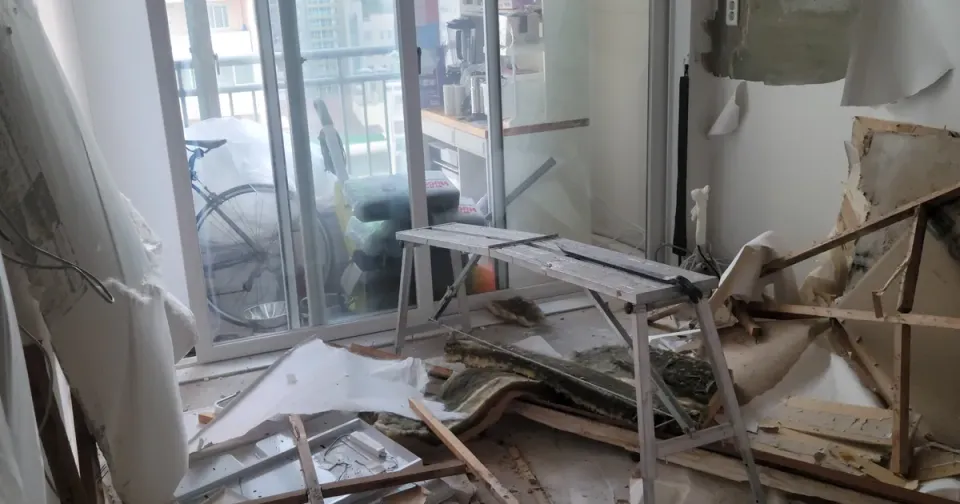
Water in a Korean apartment is not a rare disaster. Between our own home and my mother’s, we have been through it six times — twice as the household with water coming through the ceiling, twice as the household suspected of causing it, once in a newly built villa, and once in a new apartment we visited that was already staining.
One of those is still unresolved years later. The stain is still on her ceiling.
So treat this as what it is: a thing that will probably happen to you at some point, and one where knowing the framework in advance saves a lot of money and a lot of shouting.
It rarely announces itself. It starts like this — a faint brown tidemark at the edge of a ceiling, easy to explain away:
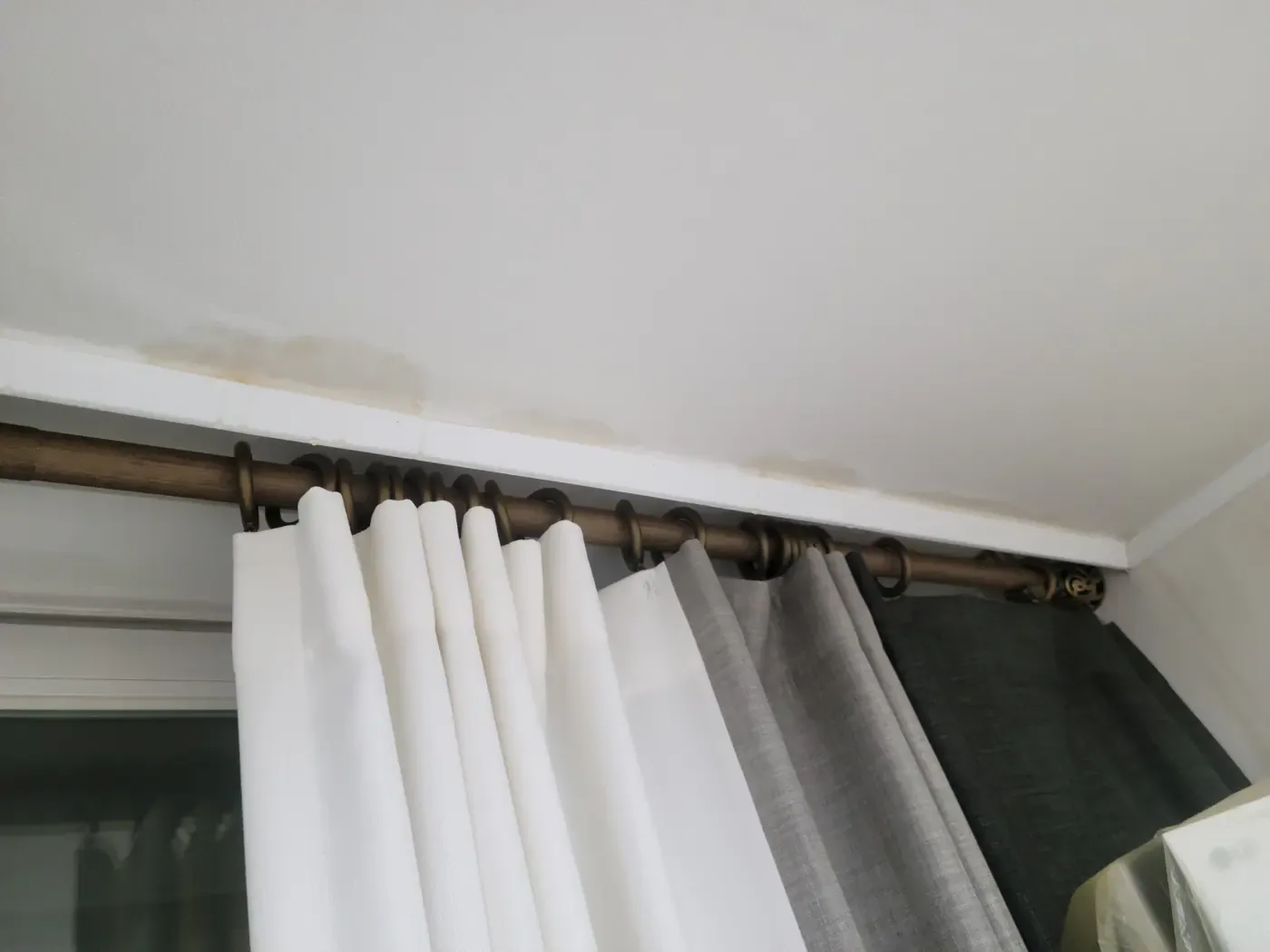
Week one. Easy to tell yourself it’s nothing · ⓒ @BalliBalliSeoul
Then it doesn’t stop:
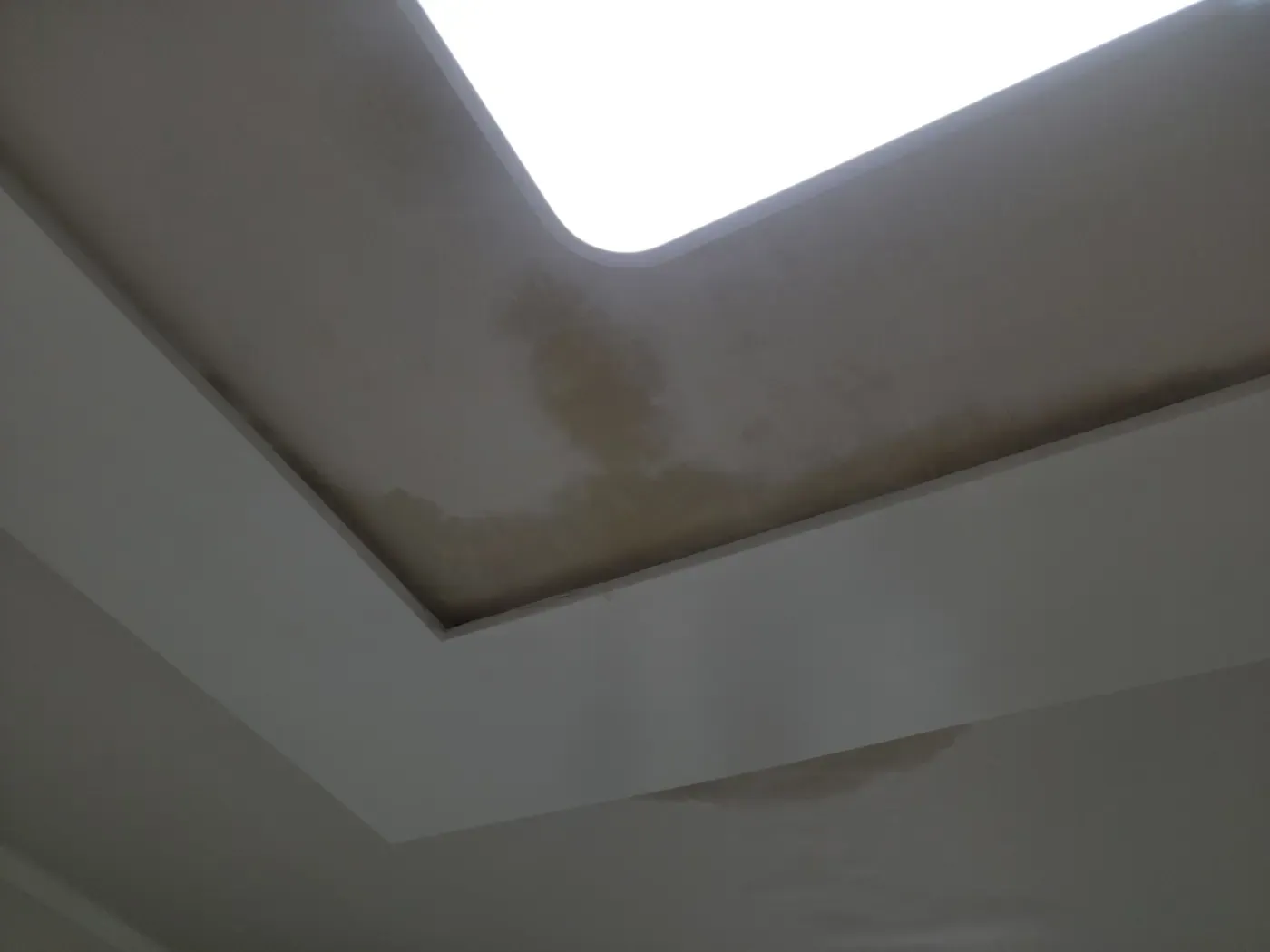
Three weeks later, same ceiling · ⓒ @BalliBalliSeoul
First: who is responsible?
If you are not yet sure this is a plumbing job at all, start with who to call for what in a Korean flat — it sorts symptoms by trade.
This is the question everything hangs on, and Korean practice splits it three ways.
| Where the water comes from | Usually whose problem |
|---|---|
| The unit above yours — their pipe, their bathroom, their waterproofing | That household |
| Shared building plumbing — risers, mains, roof, exterior walls | The building (관리사무소 / the owners’ association) |
| Your own unit’s pipework | You — or your landlord, depending on cause |
The split that catches foreigners out is the second one. If the failure is in the building’s shared parts (공용부분) rather than inside one apartment (전유부분), it is not a fight between two neighbours at all — it goes to the management office, and the building pays.
Which is exactly what happened to us the second time. Water was appearing downstairs, everyone assumed it was ours, and we opened up our own bathroom to prove otherwise:
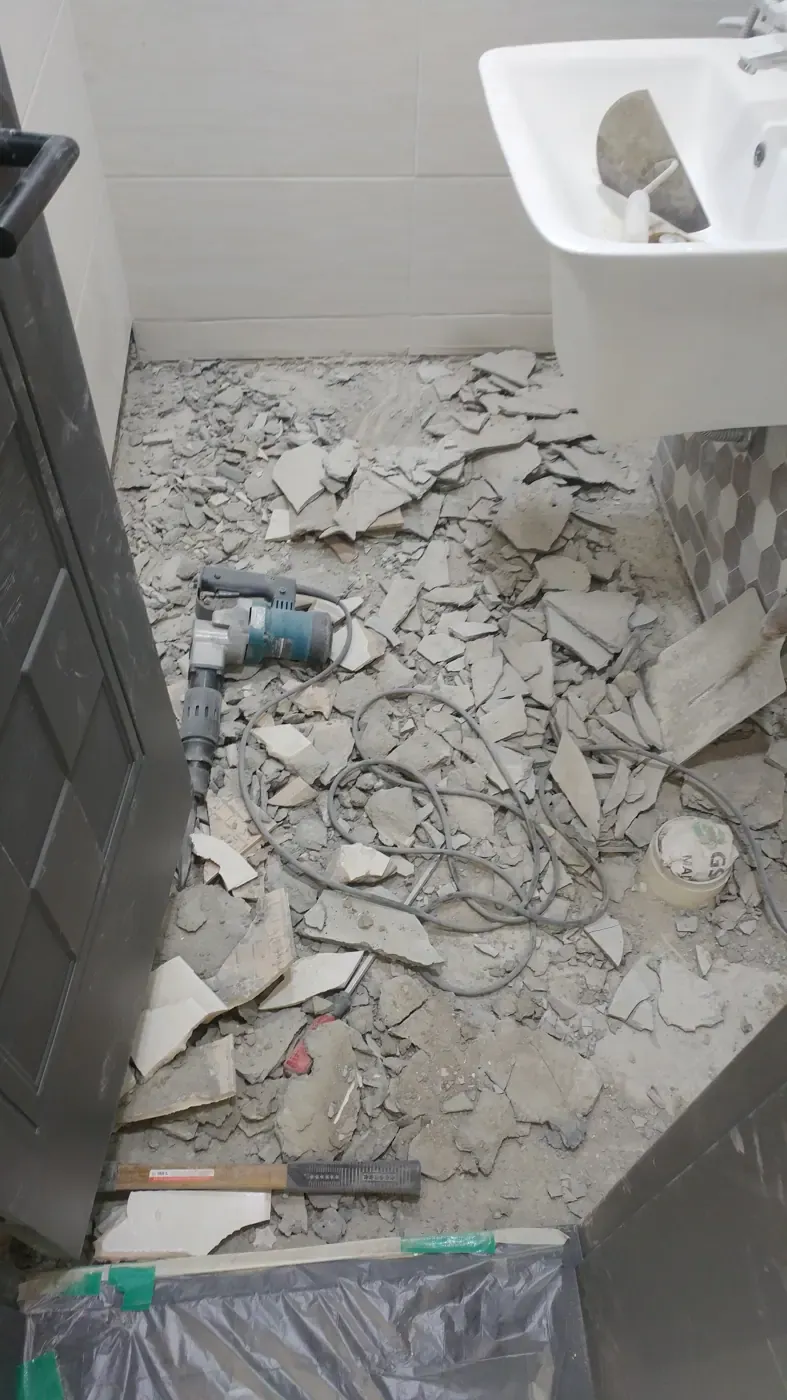
Finding a leak often means destroying the room it might be in · ⓒ @BalliBalliSeoul
It turned out to be a building defect. We had already demolished a bathroom to find that out.
The lesson: get the management office involved before you start opening walls, because if it’s shared plumbing, the cost isn’t yours and the diagnosis isn’t your job.
The insurance nobody checks
Here is the single most valuable thing in this article, and most foreign residents have never heard of it.
일상생활배상책임보험 — “daily life liability insurance” — covers damage you accidentally cause to other people, including water damage to the apartment below you.
The reason so few people know they have it: it isn’t sold as a standalone policy. It’s a rider bolted onto something else — accident cover, children’s cover, and very often 화재보험, which translates as “fire insurance” and is the ordinary home policy here.
That name is the trap — in both directions.
A fire policy does not cover water damage by itself. What it can carry is one or both of these optional riders, and whether you have them depends entirely on what was ticked when the policy was taken out:
| Rider | What it covers |
|---|---|
| 일상생활배상책임 (liability) | Damage you cause to someone else — the flat below |
| 급배수시설 누출손해 (water damage) | Your own property, when your plumbing fails |
So neither assumption is safe. “I only have fire insurance, so I’m not covered” may be wrong. “I have fire insurance, so I’m fine” may also be wrong.
The only answer is to read the rider list on the policy schedule, or ring the insurer and ask whether those two are attached. Ten minutes, once, before anything goes wrong.
Three caveats before you assume it solves everything:
- The property normally has to be named on the policy, and the insured has to live there — or own it and rent it out.
- There’s an excess. A claim doesn’t pay out at face value, so small leaks may not be worth claiming.
- As a foreign tenant you probably don’t hold a Korean policy at all. That doesn’t end the conversation — your landlord may, and so may the building. Ask both.
And if you’re the one being blamed: ask the other side whether they have it. Two insured households arguing is a much shorter conversation than two uninsured ones.
Why the repair takes so long in summer
Our worst experience was the ceiling. Water came down from the flat above, the plasterboard sagged, the cornice pulled away from the wall — and eventually part of the living room ceiling came down.
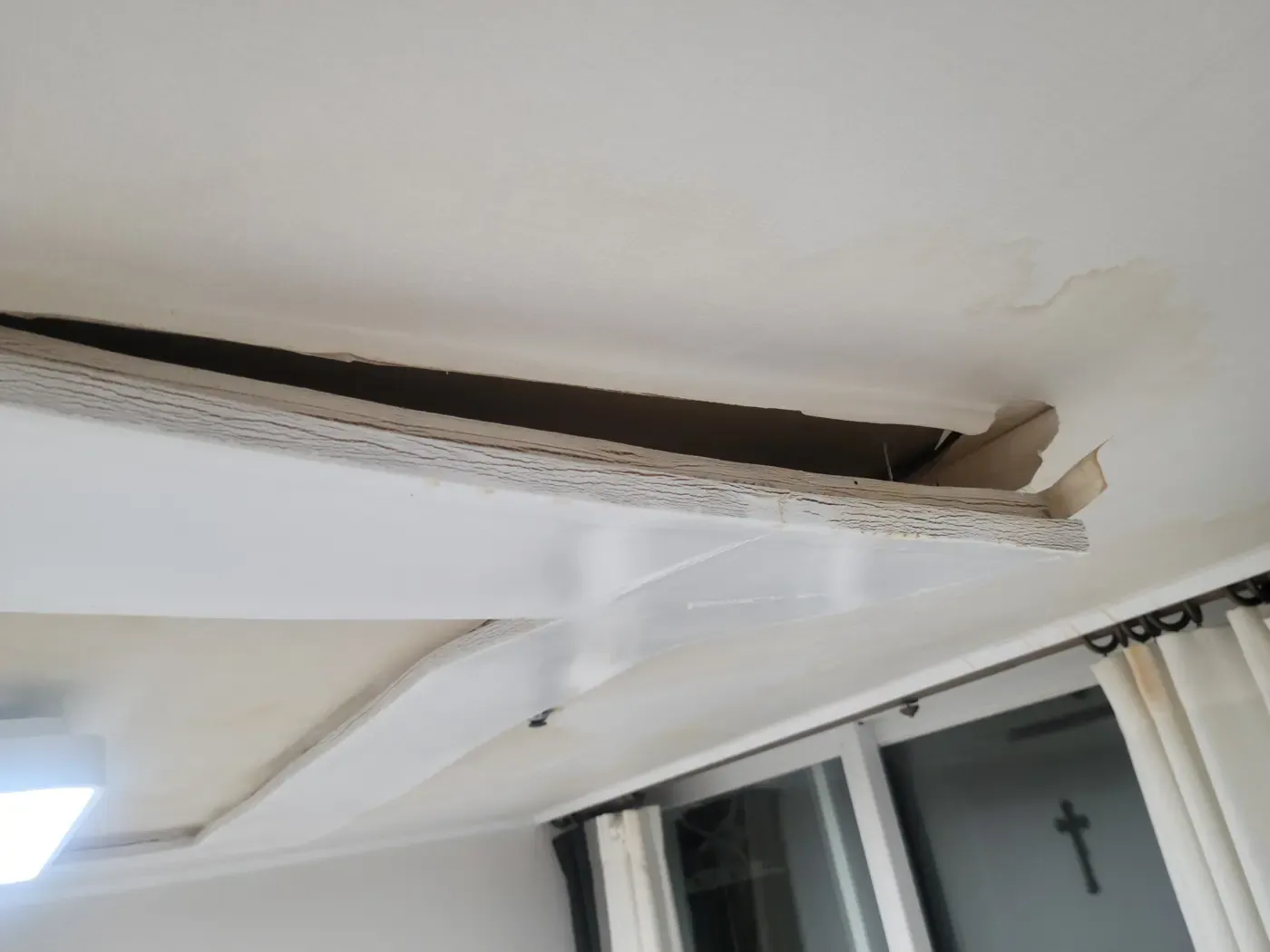
When the moulding lets go, the board above it is already saturated · ⓒ @BalliBalliSeoul
We lost the sofa, moved the television, and lost the room for a month. Not because nobody would come — because it was monsoon season, and the work physically could not be done.
Fixing it meant taking the entire ceiling out:
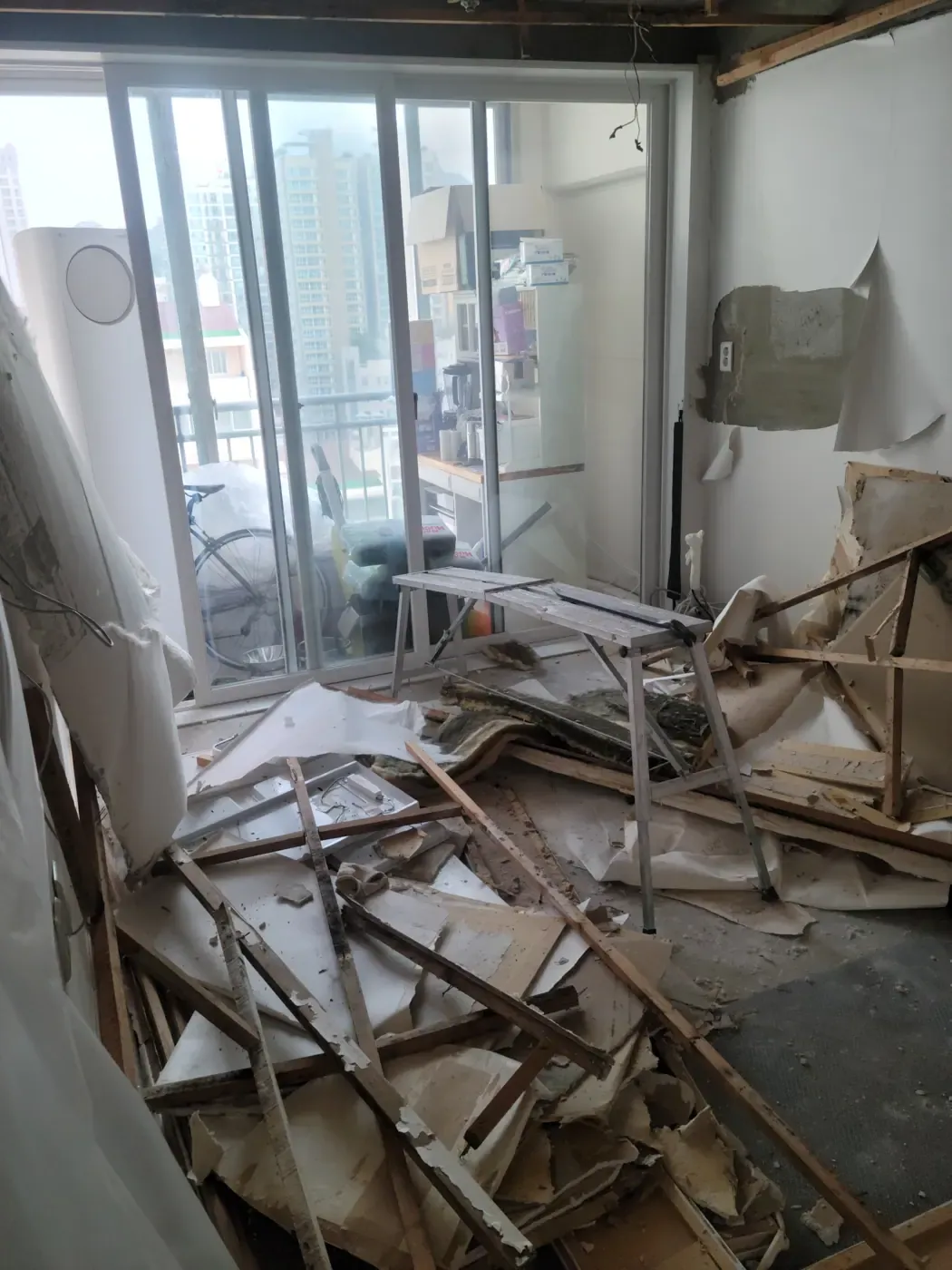
You don’t patch a soaked ceiling. You remove it · ⓒ @BalliBalliSeoul
And this is why. The insulation above the ceiling had been wet long enough to turn black:
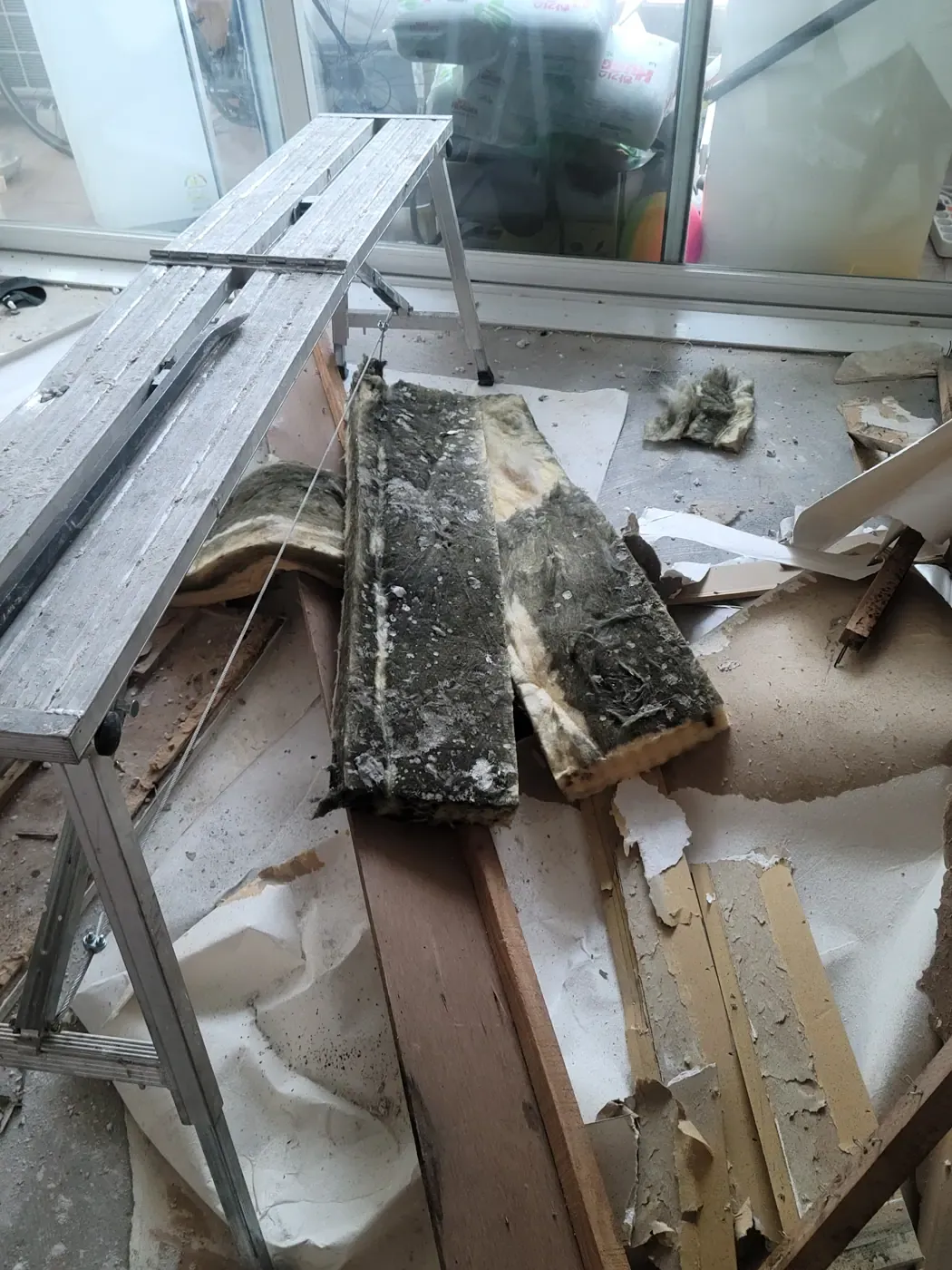
This was sitting over the living room · ⓒ @BalliBalliSeoul
That is the real argument against “just repaint it”. Water that reaches insulation stays there, and what grows in it is not something a coat of paint contains. Everything soft came out, back to bare concrete:
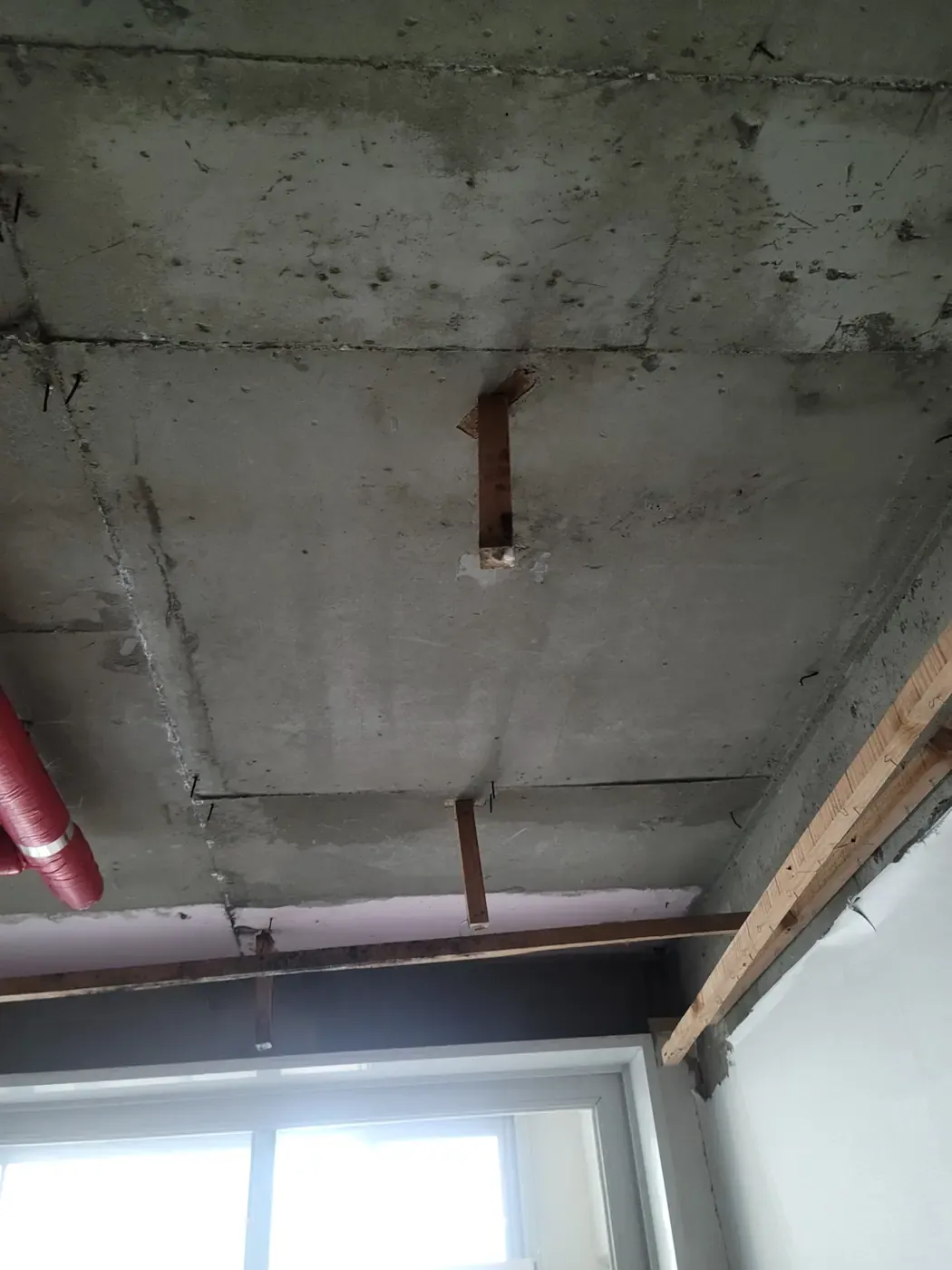
Bare slab — the point you have to reach before rebuilding · ⓒ @BalliBalliSeoul
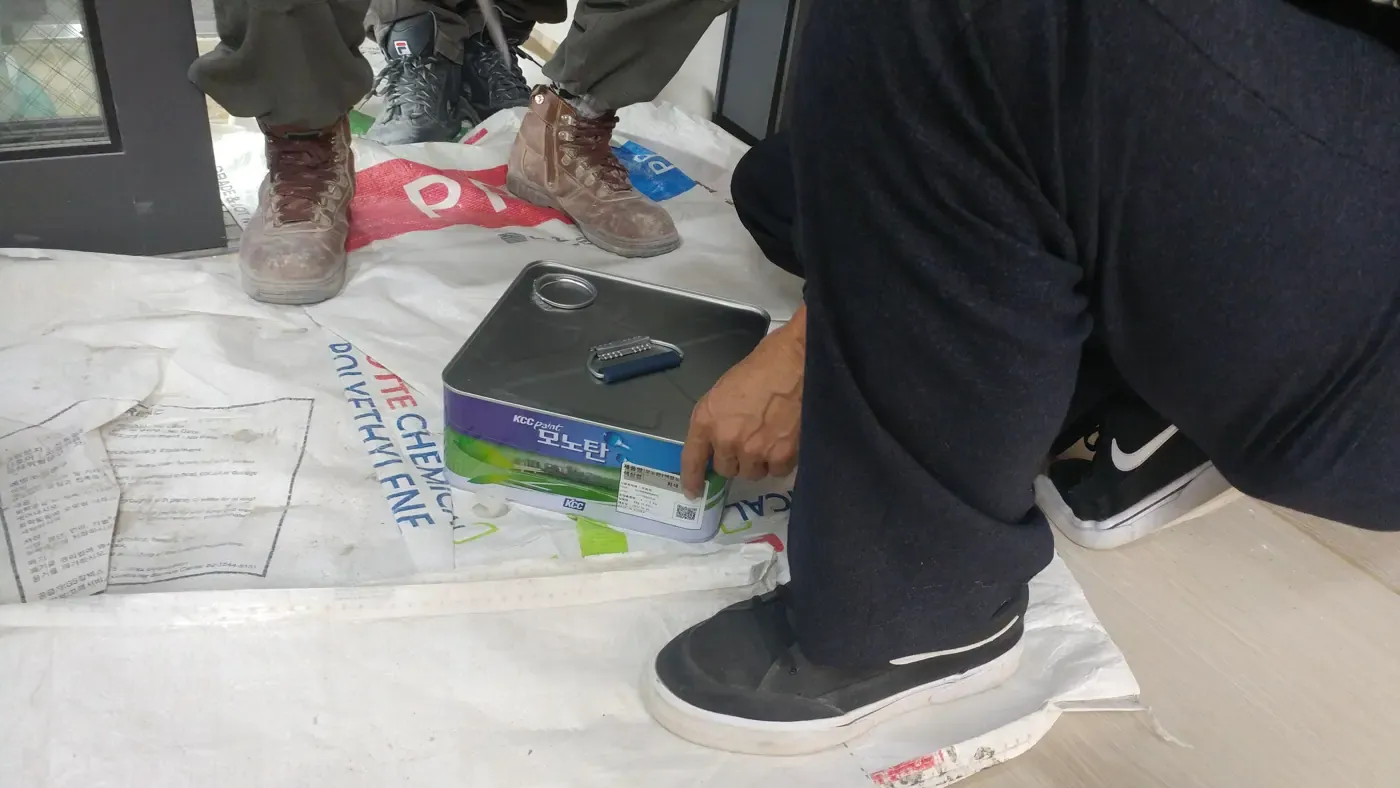
Waterproofing is a coating, and coatings need to cure · ⓒ @BalliBalliSeoul
This is the part nobody explains when they tell you to “wait until the rain stops”. Waterproofing and paint are chemical cures, not just drying. In high humidity they don’t set properly, so a contractor who cares will refuse to apply them — and a contractor who doesn’t will hand you a repair that fails again next year.
The full sequence, from our own bathroom, ran over the better part of a week: demolition, then drying, then a new screed and waterproofing layer, then tiling on top.
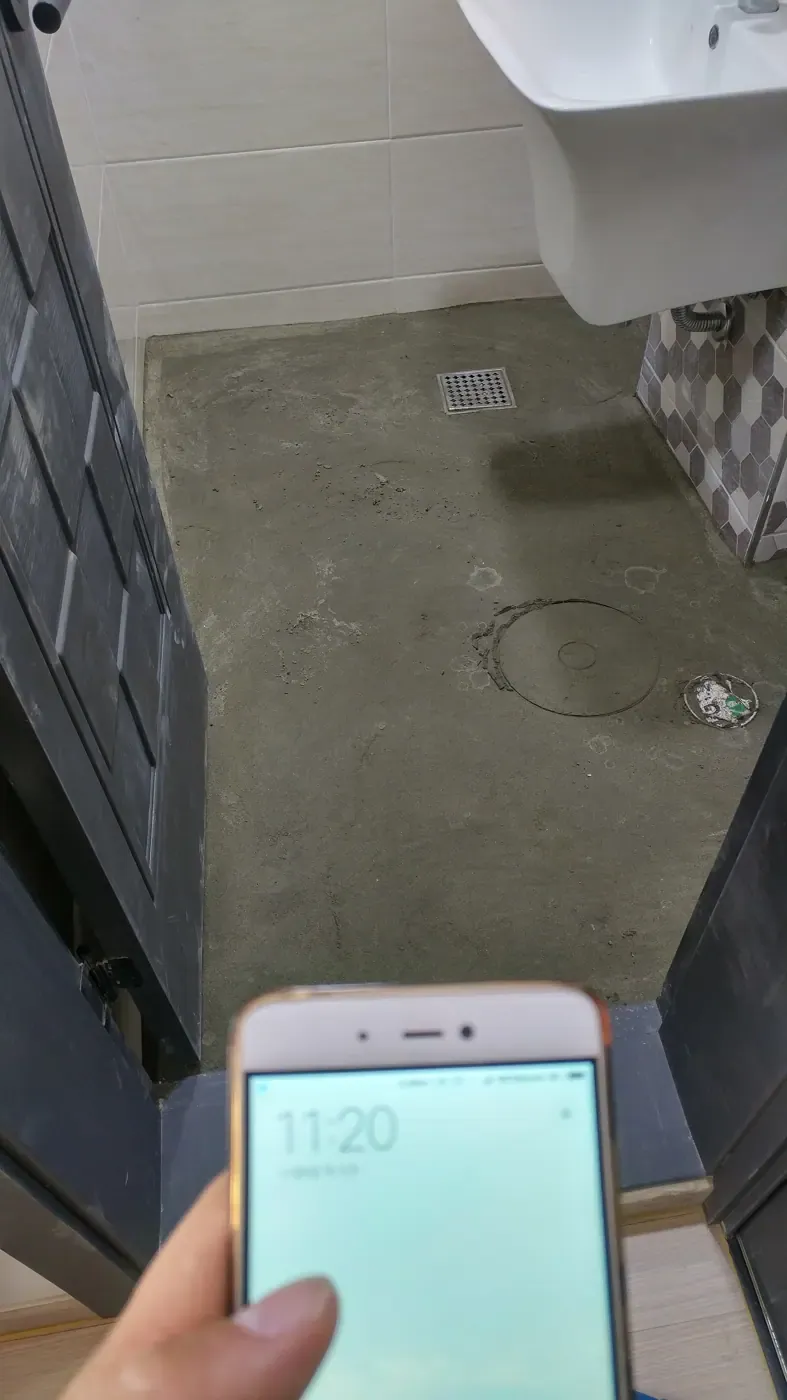
Bare screed and a drain — this stage is the actual repair · ⓒ @BalliBalliSeoul
Plan for days, not an afternoon, and expect the schedule to move if it’s raining.
Before you tear anything up: leak detection
There is a step between “there is water somewhere” and “we removed your floor”, and it has its own trade: 누수탐지 — leak detection, using thermal imaging and acoustic equipment to find the failure point without opening everything.
It costs money. It costs dramatically less than demolishing the wrong room. If a contractor’s first suggestion is to start breaking tiles, ask whether detection has been done.
“New build” is not a safe answer
A thing foreigners assume and Koreans don’t: a new building is not a low-risk building. Defects show up in the first years, which is precisely when a new-build leak happens. We’ve seen it in a newly built villa we lived in and in a new apartment we visited that was already showing stains.
The important consequence is that the responsible party changes entirely. If the building is still young, this may be a construction defect — the builder’s problem under Korea’s defect liability rules, not your neighbour’s and not yours.
- In an apartment complex, that runs through the management office and the owners’ association, and there is a formal defect-dispute process at national level.
- In a villa, it is far harder in practice: small developers wind up, change names, or simply stop answering.
⚠️ Defect liability periods differ by building component and the rules change, so check the current terms for your building rather than trusting any article, including this one.
When the other side simply doesn’t fix it
Now the part that guides tend to skip, because it has no tidy ending.
You can be completely right about liability and still be stuck. In my mother’s case the flat above hers caused the damage, never repaired it, and the stain is still there — years on, exactly like the one in the photographs at the top of this article, except hers never got the month of demolition that fixes it. That’s not a rare outcome. It’s the normal outcome when someone decides to wait you out.
The escalation ladder, in order:
- Management office first. They can inspect, rule on whether it’s shared plumbing, and apply pressure a neighbour can’t ignore as easily as they can ignore you.
- Document everything from day one — photos with dates, video of active dripping, every message. This is the whole ballgame if it ever goes further.
- Ask about their liability insurance, as above.
- 내용증명 — content-certified mail. A formal letter, delivered with an official record that it was sent and received. It changes the tone of a conversation more than its content does.
- Legal routes exist beyond that — small claims and free legal aid bodies among them — but the terms and eligibility change, so get current advice rather than acting on a blog post.
⚠️ We are not lawyers and this is not legal advice. It’s the sequence we’ve watched play out, twice.
What to do in the first hour
If water is coming in right now:
- Photograph and film it, with something showing the date. Your phone does this automatically; use it.
- Call the management office (관리사무소) before you call anyone else. If the building is at fault, this is already their job.
- Move what can be moved and put a bucket under the rest. Electronics first.
- Don’t agree to pay for anything until the source is established. The unit that looks guilty often isn’t.
- Bulky items that get ruined — sofas, mattresses — can’t just go out with the rubbish; they need an official disposal sticker.
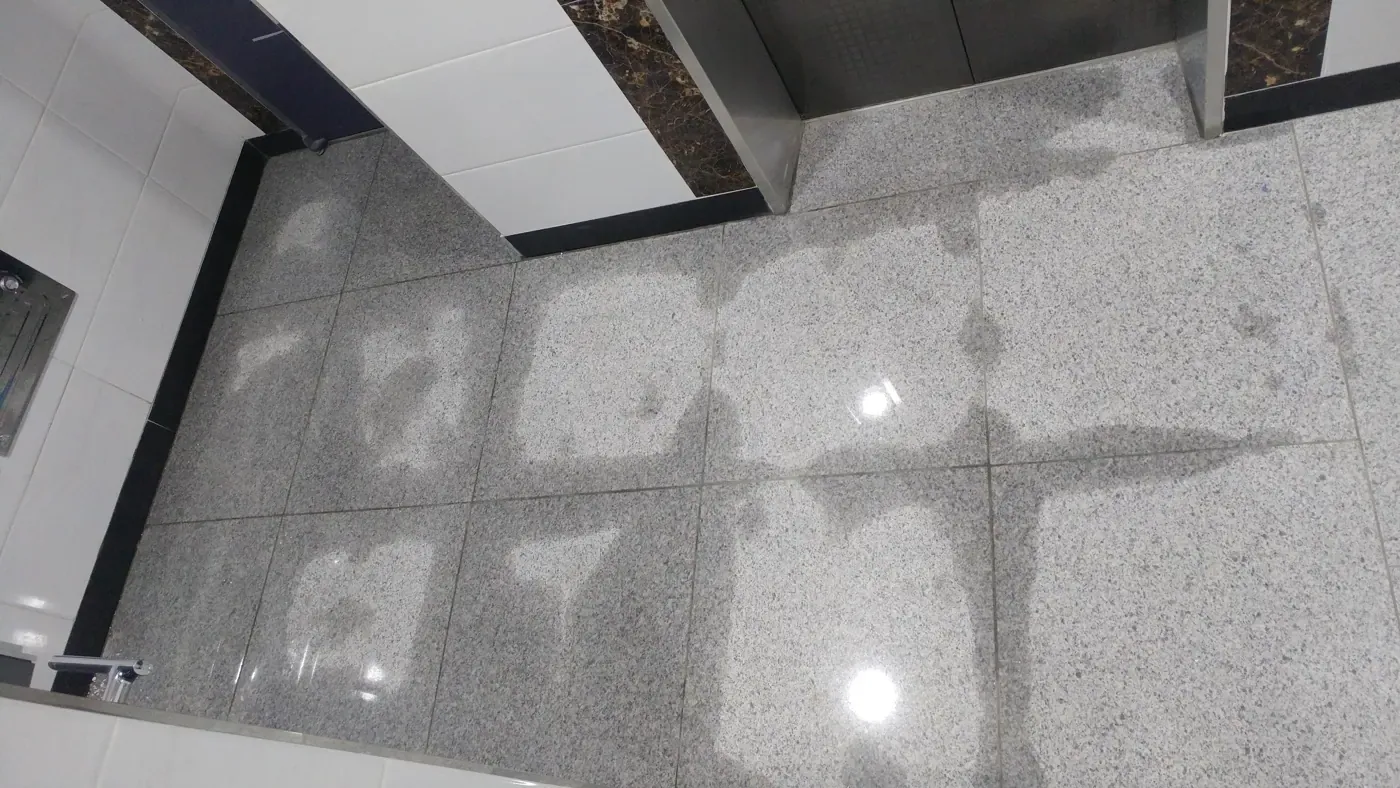
When it reaches the shared corridor, it stops being a private argument · ⓒ @BalliBalliSeoul
Is it actually a leak?
Before you escalate to the management office, rule out the smaller problems that produce similar-looking water:
- A slow, spreading damp patch at the bottom of a wall, with no pipe above it, is usually condensation rather than a leak — and it has its own tell
- Water pooling around a drain is a blockage, not a leak, and often a job you can finish yourself
- A dry drain you never use is the opposite problem — the water seal has evaporated and the pipe is now an open route in for everything that lives in it, which is a pest call, not a plumbing one
- A tap or shower head that will not stop dripping is a washer, not a plumber’s callout
- Hot water that comes and goes is the boiler, not the pipework — ask about the valve first
Everything else — a stain on a ceiling, water crossing between units, anything that reaches a shared corridor — belongs in this article.
The Korean part
Everything above happens in Korean, at speed, with people who have strong opinions: the management office, the neighbour, the detection company, the contractor’s quote, the insurer’s claim form. It is the single most stressful admin experience we’ve had in this country, and we speak the language.
That’s the gap we exist for. Through our plumbing service we arrange the trades and confirm the price in writing before anyone starts; through our anything-else concierge service we make the calls, sit in the meetings, and translate what the management office is actually telling you.
Get it sorted
Water where it shouldn’t be? Message us on WhatsApp with photos — we’ll tell you who to call first, what it’s likely to cost, and make the Korean calls if you want us to. Asking costs nothing — you pay only for the work you book.
The one-line version: management office before neighbour, photos before argument, check whether you already have liability insurance, find the leak before you break anything — and don’t expect waterproofing to cure in the rain.