No Hot Water at All in Korea? Check the Valves First
It is seven in the morning, the shower is cold, and the little box on the wall is either dark or showing something you cannot read.
Before you look up boiler repair, check the valves. A surprising share of “the boiler is broken” turns out to be gas or water that is not reaching it, and the last time this happened to us the cause was embarrassingly simple: the water valve under the boiler was closed. Nothing was broken. Nothing needed paying for.
First: is it only the hot water?
One gas boiler in a Korean flat does two separate jobs — 난방 (nanbang), the floor heating, and 온수 (onsu), the hot water at the taps. Which of them is dead tells you where to look.
| What is happening | What it usually means |
|---|---|
| No hot water and no heating | Gas or power is not reaching the boiler |
| Heating works, no hot water | Check the water inlet valve first. Only then suspect the inside of the boiler |
| Hot water comes and goes | A different symptom with a different cause — see hot water coming and going |
| No water at all, hot or cold | Not the boiler. Building supply or a stopcock |
That last row is worth thirty seconds. Run a cold tap. If nothing comes out of that either, the boiler was never the story.
Check the valves first — gas and water
If you have just moved in, do this before anything else. Valves get closed when a flat is emptied, cleaned or worked on, and nobody remembers to open them again. A boiler with a closed valve behaves exactly like a broken one.
There are two families of valve to check, and they are in different places.
The water valves, underneath the boiler
Look at the pipes running into the bottom of the unit. Each has a handle, and the same rule applies to all of them: handle parallel with the pipe is open, handle across the pipe is closed.
The one that strands people is the cold water inlet — the boiler cannot heat water it is not being given. Heating still works, the controller lights up, no fault code appears, and the taps stay cold.
The gas, in this order
1. Turn on the gas hob. If a burner lights, gas is reaching the flat. If it does not, the problem is upstream and no boiler engineer will help you.
2. Look at the middle valve. On the gas pipe near the boiler there is a small handle, usually yellow, and the same parallel-is-open rule applies.
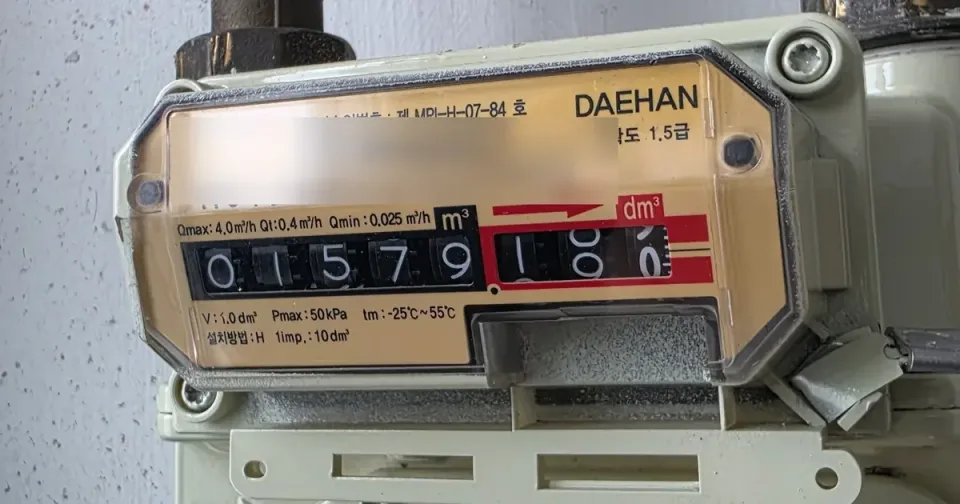
3. Watch the meter. Open a hot tap and look at your gas meter, normally in the same space as the boiler. The small red dm³ dial should start turning within a few seconds. If it sits still while the boiler is trying to fire, gas is not getting through.
4. Consider the safety cut-off. Korean domestic meters cut the supply automatically after certain events — a strong tremor, a suspected leak, or an unusually long stretch with no use at all, which catches people coming back from a month abroad. Resetting it is the supplier’s job, not yours and not a plumber’s.
5. Check whether the bill is paid. Supply gets suspended for non-payment, and if you moved in recently the account may never have been transferred into your name.
If you can smell gas, stop reading. Do not touch light switches or plug sockets, open the windows, leave, and call 119 from outside. The emergency numbers guide covers what to say. Gas work is not a DIY category and it is not something we arrange either.
Then check the power and the settings
The boiler needs electricity as well as gas. If the wall controller is completely dark, look for a plug behind or beside the unit and check your consumer unit for a tripped breaker.
If the controller is lit, two settings strand people:
- The mode dial. Korean controllers have positions for 실내 (room temperature), 온돌 (floor), and 온수전용 (hot water only). On the wrong setting in summer, the heating is off — which is fine — but a mis-set controller can leave you with nothing.
- The hot water temperature. It is set separately from the heating temperature, and it can be turned down far enough to feel cold.
If a fault code is showing instead, the codes and what they mean are in hot water coming and going, along with the two resets worth trying before anyone comes out.
In winter, suspect frozen pipes first
Below about −5°C, and especially in older buildings and on top floors, the culprit is usually not the boiler at all but a frozen pipe or a frozen condensate drain. The tell is timing: it worked last night and stopped overnight during a cold snap.
Do not use a naked flame on a pipe. Warm water on towels wrapped around the exposed section is the standard approach, and it is slow. If the boiler is throwing a code and the outside temperature explains it, waiting until midday is often the whole repair.
When to stop and call someone
Call once you have confirmed gas is arriving, power is on, and the settings are right — and it still will not produce hot water. At that point the fault is inside the unit, and inside the unit is not a place to experiment.
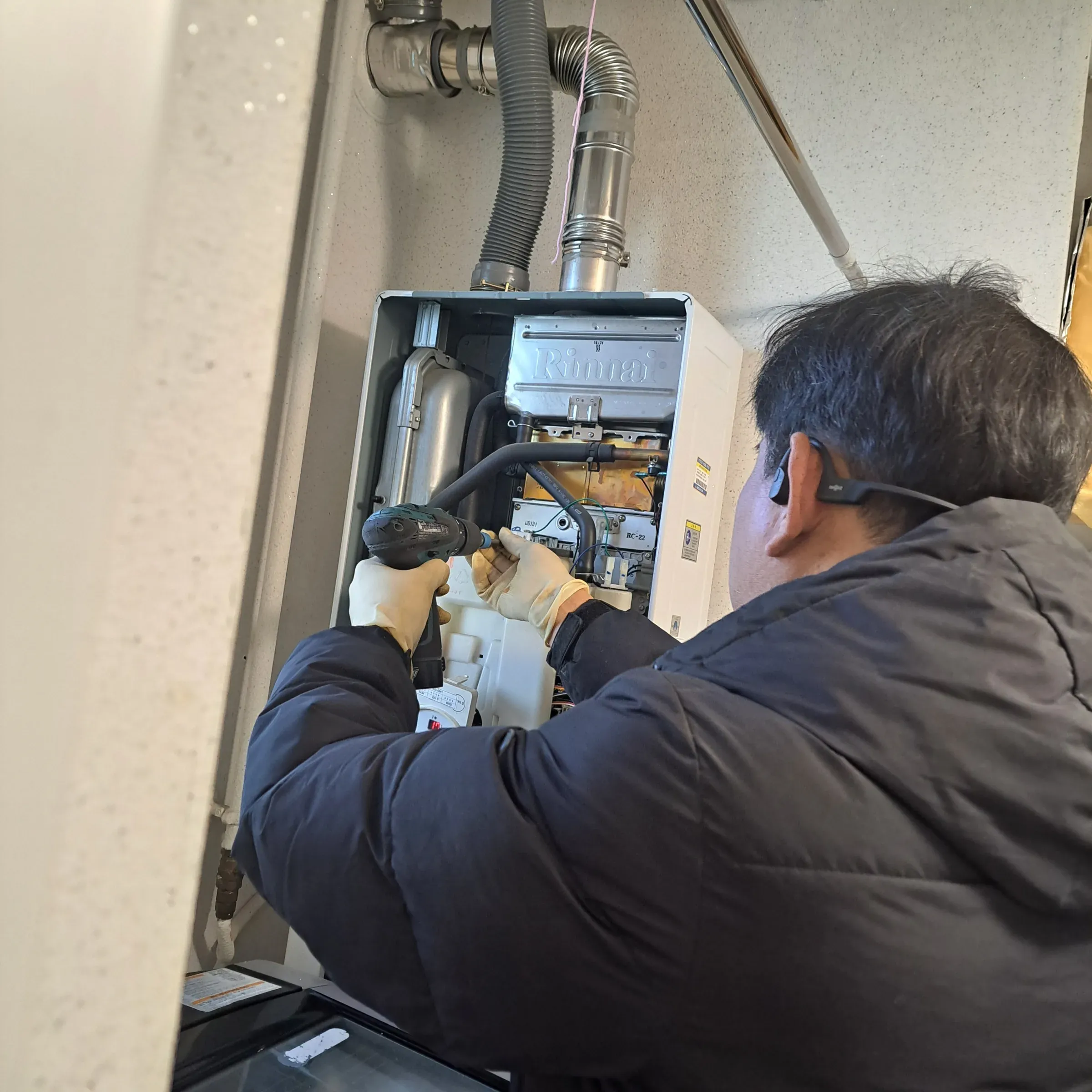
The cover comes off and it stops being a DIY job · ⓒ @BalliBalliSeoul
Also call, rather than investigate, if you find water under the boiler, if the flue pipe at the top looks loose or disconnected, or if the thing is making a noise it did not make last week.
Stuck on the Korean part? Send us a photo of the controller and the boiler on WhatsApp — we’ll tell you what the code means and whether this is a supplier call or an engineer call, in English. First answer is free.
Every brand has its own service line
There is no single national boiler helpline. The maker’s service number is printed on the front of the unit, usually on a sticker near the bottom, and the self-check and reset steps differ by brand — the button sequence that clears a code on one will do nothing on another.
| Brand | Printed service line |
|---|---|
| 경동나비엔 (Kyungdong Navien) | 1588-1144 |
| 린나이 (Rinnai) | 1544-3651 |
Those are the two we have on units in front of us as of 2026; other makers print theirs the same way. For anything on the supply side rather than the appliance — a meter reset, a suspended account, a smell of gas — the number you want is the city gas company’s, which is on the sticker on the meter itself. It differs by district, so the one on your meter is the right one, not the one from a search result.
Photograph the sticker before you need it. It is a great deal easier to read at your desk than crouched behind a boiler at seven in the morning.
What it costs in Seoul
Two numbers we have actually paid, as of 2026:
| Job | Cost |
|---|---|
| Call-out on its own | around ₩18,000 |
| A three-way valve replaced, all in | around ₩80,000 |
| A condensing boiler replaced, fitted, with VAT | ₩1,045,000 |
The gap between the middle row and the last one is the reason to insist on hearing what the fault actually is before agreeing to a replacement. A boiler under about eight years old is usually worth repairing.
If the heating is dead as well as the hot water and the manifold is accessible, it is worth a look at the zone valves before assuming the worst — a closed zone is not a broken boiler.
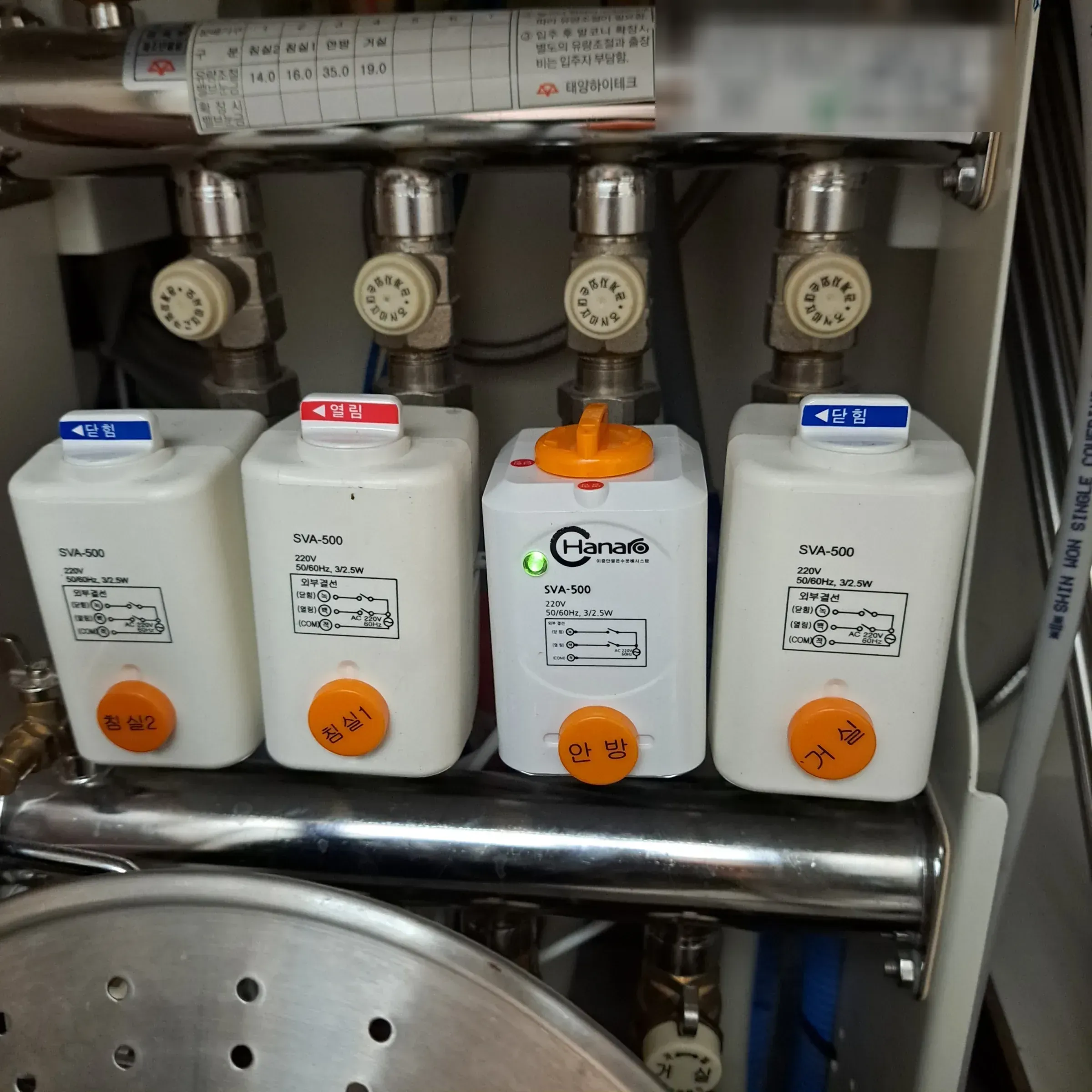
Each valve feeds one room, and each is marked 열림 (open) or 닫힘 (closed) · ⓒ @BalliBalliSeoul
Who pays — you or the landlord
The boiler is part of the flat’s fixed equipment, so repairs and replacement normally fall to the landlord rather than the tenant. What tends to land on you is anything caused by how the flat was used — the classic being pipes that froze because the heating was left fully off while nobody was home in January.
Two practical points. Tell the landlord on the day, in writing, with a photo — a message with a timestamp settles arguments that a phone call does not. And do not commission a replacement yourself and send the bill afterwards; agree who is instructing the work before it starts.
The Korean part
Four places this stalls for English speakers:
- Working out who to call. Gas supply is the city gas company, the meter is theirs too, and the boiler is a separate engineer. Calling the wrong one costs a day.
- The supplier’s phone line. Reset requests and supply questions go through a Korean call centre, and the number on the meter sticker is the right one to use.
- Describing the symptom. “No hot water” and “hot water that comes and goes” send an engineer out with different parts on the van.
- The landlord conversation. Who pays, and who instructs the work, is a negotiation that goes better in writing and in Korean.
Get it sorted
Check the valves under the boiler, run a hot tap and watch the meter, light the hob. Those checks take two minutes, they cost nothing, and they sort the “open a valve” cases from the “call the gas company” cases from the “call an engineer” cases. In a flat you have just moved into, start with the valves every time.
We make both of those calls in English and stay on it until someone is booked — and if it turns into a landlord conversation, that part is in Korean too. The plumbing page has the guide ranges.