Keypad Door Lock Dead in Korea? How to Get Back In
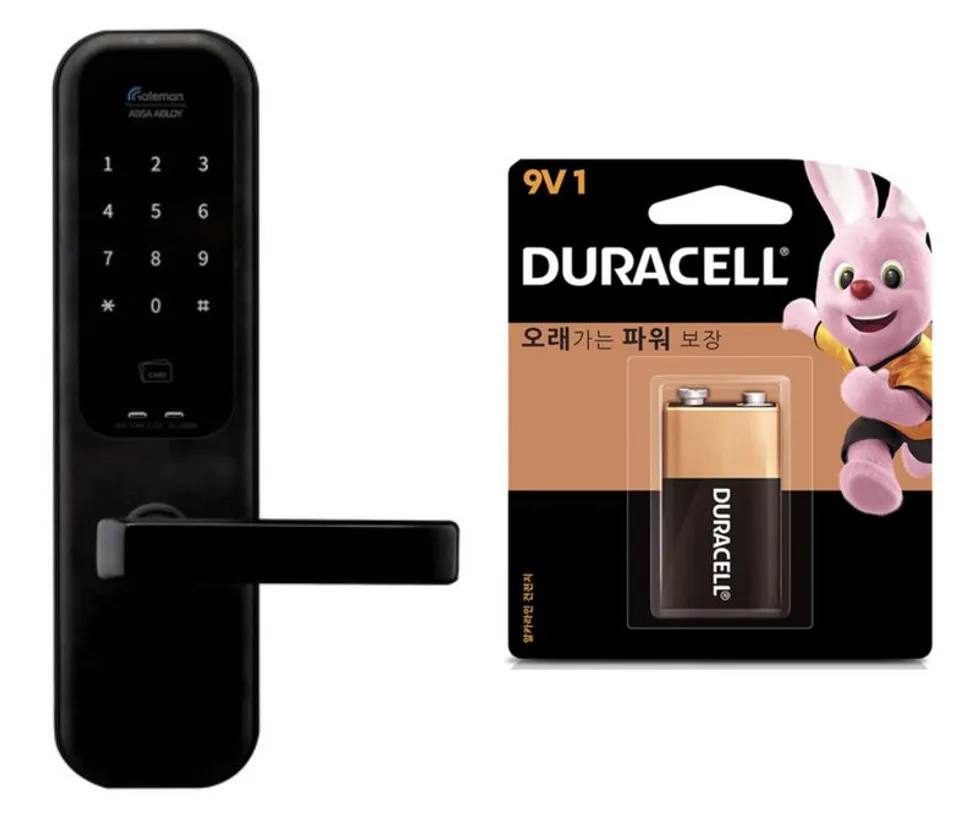
You’re standing outside your door in Seoul, pressing the keypad, and nothing is lighting up. Before you call anyone or start googling locksmiths, try the one trick that gets most people back inside in ten minutes — it costs about ₩2,000 at the convenience store downstairs.
Try this first
Check that it’s actually the battery
A dead battery looks like this: you touch the keypad and no lights come on at all, or the numbers flash for a second and immediately go dark. If the keypad lights up normally, this is not your problem and the battery trick will not help you. It is one of two other things:
- It beeps at you. That is the lock telling you something specific — what a beeping lock is telling you.
- It takes your code and simply does nothing — no beep, no error, no motor, just a door that stays shut. That failure is silent, which is exactly why it fools people into buying a battery they do not need. It is usually the door binding rather than the lock failing, and there is something you can do about it standing right there: you typed the right code and nothing happened.
The 9V battery trick
Almost every Korean digital lock (Samsung, Yale, Gateman, Hugel and the rest) has a hidden backup feature for exactly this moment: two small metal contacts on the outside of the lock, usually on the bottom edge or under a little cover, often marked “9V”.
- Go to the nearest convenience store and buy a 9V square battery — the chunky rectangular one with both terminals on top. While you’re there, grab a pack of AA or AAA batteries too; you’ll need them once you’re inside.
- Find the two round or oblong contacts on the lock’s outer body.
- Press the 9V battery against them and hold it there for 10–20 seconds. The keypad will wake up.
- Keep the battery pressed against the contacts and enter your door code as usual.
Once you’re in, slide open the battery cover on the inside unit — no screwdriver needed on most models — and replace all the internal batteries, not just some of them. Then leave the 9V battery somewhere you can reach without entering the apartment, like your mailbox. Future you will be grateful.
Ask the building for help
If the trick doesn’t work, or you can’t find the contacts, two people may be able to open your door without any tools: your landlord and, in most apartment and officetel buildings, the security office. Many buildings keep a master registration for their locks. It’s free, and it’s the fastest option during daytime hours.
When to stop and call someone
🚨 Real emergency? Call 119 first — not us, not a locksmith. If a small child (or someone vulnerable) is locked inside alone, or you left the stove or gas running, dial 119 right now. Korea’s fire service opens doors free of charge in genuine emergencies and gets there faster than any locksmith ever will — and interpretation is available on the line. This is only for true emergencies; for everything else, 119 is the wrong number and the options below are yours. (Not sure which number does what? We laid out 112, 119 and the rest, including the fact that you can text them.)
Stop poking at the lock and get a professional involved if any of these is true:
- The keypad lights up and beeps normally but the door won’t open — that’s usually a worn motor or clutch inside the lock body, not a power problem.
- You never knew the code (new move-in, sublet, or a code someone else set).
- There’s a physical key snapped off inside an old-style cylinder.
- You’ve entered the wrong code repeatedly and the lock is now in tamper alarm mode, flashing and refusing input.
Forcing a digital lock yourself tends to turn a ₩50,000 opening into a full lock replacement. A good locksmith opens non-destructively first, and drills only as a last resort — if someone proposes drilling as the first step, ask why before agreeing.
What it costs in Seoul
Typical ranges in central Seoul, as of 2026:
| Work | Typical cost (as of 2026) |
|---|---|
| Lockout opening — keypad lock | ₩50,000–100,000 |
| Keypad repair (motor, keypad module) | ₩50,000–120,000 |
| Full digital lock replacement (unit included) | ₩120,000–250,000 |
| Code reset + fresh batteries after moving in | ₩30,000–60,000 |
Two things to know about how pricing works here. First, out-of-hours work costs more. A 3 a.m. lockout is not priced like a Tuesday afternoon, and nights, weekends and public holidays carry a call-out surcharge. That part is normal. What is not normal is the price you hear on the phone differing from the price at the door. The fix is the same either way: get the number confirmed in writing before anyone is dispatched. When we arrange a locksmith through our English-speaking locksmith service, the surcharge is already inside the quote you accept in the chat — ask and you get the figure for your hour, not a range.
Second, a legitimate locksmith in Korea will ask you to prove you live there before opening the door — photo ID plus something tying you to the address, like a lease, mail, or your landlord confirming by phone. That’s not bureaucracy; it’s the only thing standing between your front door and anyone who claims it’s theirs. Have your ID ready and treat the check as a good sign.
The Korean part
This is where most non-Korean speakers get stuck, even after doing everything above correctly.
- The phone call. Neighborhood locksmith shops (열쇠집, yeolsoe-jip) rarely speak English, and most jobs are arranged by phone in Korean — explaining your situation, your lock brand, and negotiating a time.
- The address. Korean addresses are given in a different order than Western ones, and getting one digit of the 동/호 (building/unit number) wrong sends the locksmith to the wrong door.
- The verification. Explaining in Korean that your proof of residency is an English-language lease or a foreign ID adds another layer of confusion.
- Airbnbs. For short-term stays, the locksmith needs authorization from your host — which means someone has to reach the host, in Korean, and relay the situation accurately.
If you’d rather not fight through that at 11 PM in a hallway, that’s the part we do. You describe the problem in English with a photo of the lock; we handle every Korean conversation — the locksmith, the verification, the host if it’s an Airbnb — and report back in your chat. And if your problem turns out to be something other than the lock, our anything-else concierge service covers the weird ones too.
Get it sorted
Locked out right now? Send a photo of your lock and your address on WhatsApp — we’ll tell you whether the 9V trick will work, and if not, arrange a locksmith with a fixed quote, in English. Asking costs nothing — you pay only for the work you book.
One more thing for next time: Korean locks warn you before the battery dies. Depending on the model, the inside unit’s light turns from green to red, the keypad tones change, or the lock plays a short melody when you lock up. When your lock starts singing at you, change the batteries that week — it’s a ₩5,000 errand that saves a ₩50,000 evening.