How to Throw Away Trash in Korea Without Getting Fined
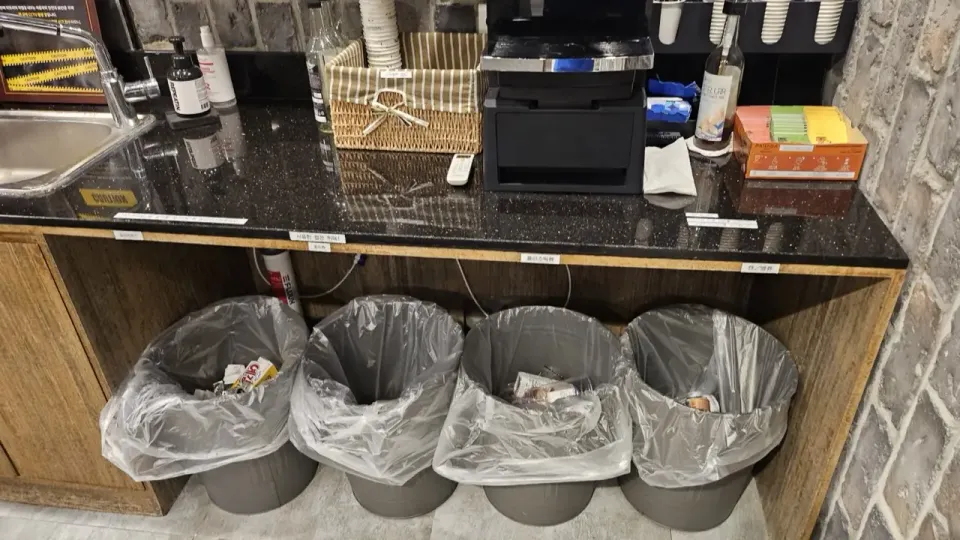
Somewhere in your first month in Korea, it happens: your trash bag comes back. Maybe it’s still by the door with a sticker scolding you in Korean, maybe a neighbor or the building office had words. Korea takes garbage seriously — it’s sorted into four separate streams, two of them are legally mandatory, and getting it wrong carries actual fines. Here’s the whole system, once and for all.
The four streams
1. General waste (일반쓰레기) goes only in your district’s official pay-per-volume bag (종량제 봉투, jongnyangje bongtu). Buy them at any convenience store or mart counter — they’re kept behind the register, so ask. Two rules: bags are district-specific (a Mapo bag doesn’t work in Gangnam), and a regular black plastic bag on the curb is exactly what gets you fined.
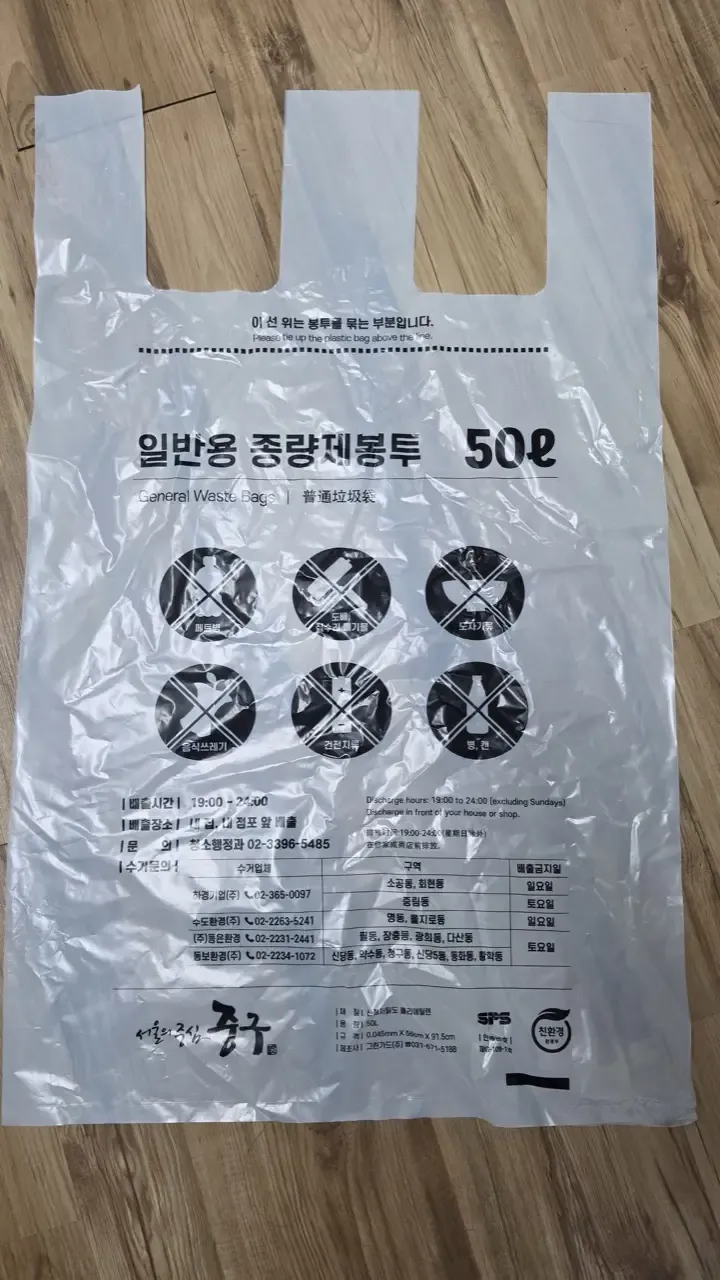
This is the bag to buy · ⓒ @BalliBalliSeoul
This is what you’re asking for at the counter — a 50L general-use bag from Jung-gu. Handily, the bag itself is the rulebook: the crossed-out icons show what can’t go in (food waste, batteries, bottles and cans…), and the fine print gives the district’s put-out hours — here, 7 p.m. to midnight, in front of your own building. Common sizes run 10L to 75L; 20L is the sweet spot for most one-person apartments.
2. Food waste (음식물쓰레기) — separating it is not optional. Korea recycles food waste into animal feed and biogas, so it never goes in the general bag. Depending on your building, it goes in a dedicated food-waste bag, a communal bin you unlock with an RFID card that weighs and charges you, or a paid sticker on a small bucket. The food-waste bags (음식물 봉투) are sold at the same neighborhood mart and convenience store counters as the general ones — ask for them by name, and again, buy them in your own district. The counterintuitive part: things animals can’t eat are not food waste — bones, big shells, eggshells, tea bags and fruit pits generally belong in the general bag. When in doubt, ask us or your building office.
3. Recycling (재활용) is free, but sorted by material: paper, cardboard (flattened), plastic, PET bottles (labels peeled, caps separate in many buildings), glass, cans, and film/vinyl as its own category. Rinse containers first — dirty recycling gets rejected. Apartment complexes usually run a designated recycling evening once a week at the communal station; villas and one-rooms put sorted bags curbside on set nights.
4. Bulky waste (대형폐기물) — furniture, mattresses, appliances, anything that won’t fit in a bag — has its own official process. More on that below, because it’s the one that catches everyone. If the item in question is a mattress or a sofa, it’s worth pricing the alternative first: having it cleaned costs less than you’d think, and in a furnished rental the thing you’re about to sticker probably isn’t yours.
If it’s a whole flat’s worth — a move-out, a clear-out, or an estate to empty — that stops being a sticker job and becomes a van and two people. That’s what our cleaning and moving services are for.
The fines are real
Illegal dumping — general trash in the wrong bag, food waste mixed in, furniture quietly left by the curb — is an actual offense, with fines commonly starting around ₩100,000 and climbing for repeat cases (as of 2026). Residential areas have CCTV pointed at known dumping spots, and building offices do check bags. This isn’t a “nobody really cares” rule.
District offices spell it out on posters like this one from Dongdaemun-gu: ₩50,000 for tossing cigarette butts or tissues, ₩100,000 for mixing recyclables into the general bag or putting trash out on the wrong day/place, ₩200,000 for dumping without the official bag (especially food waste), and up to ₩500,000 for hauling stuff out by car or cart. It also shows the typical put-out window — collection-day evenings, 6–9 p.m., in front of your own building.
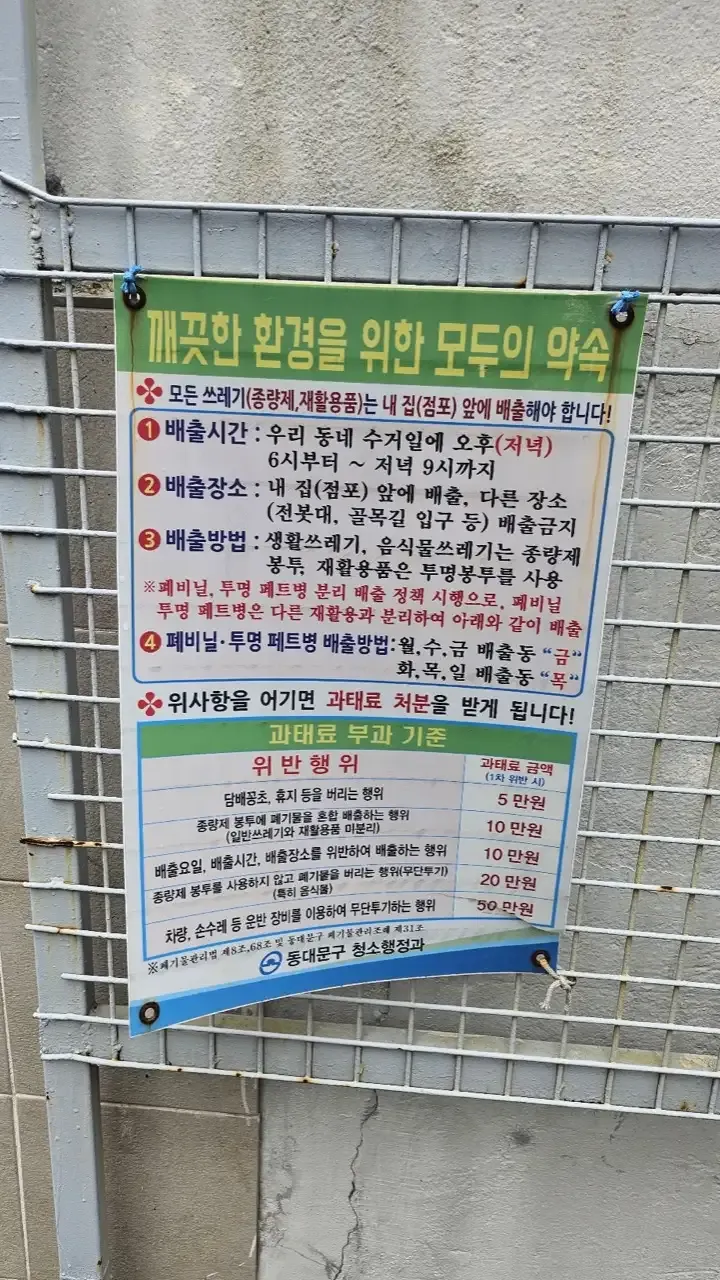
A district fine schedule · ⓒ @BalliBalliSeoul
Bulky waste: the official process
You can’t just haul a bookshelf to the curb. The legal route:
- Report it to your district office (구청) — every district runs an online declaration system, and most now take reports through an app or website where you select the item type and size.
- Pay the disposal fee — set by item: small furniture runs a few thousand won, wardrobes, sofas and large appliances more (fees vary by district and size).
- Print or write the sticker/receipt number and attach it to the item.
- Put it at the designated spot (usually beside the building’s recycling area) on the scheduled date.
The app most Seoul districts plug into is Ppaegi (빼기) — you pick the item, pay in-app, and get a reservation number instead of a paper sticker. Here’s what a filed report looks like:
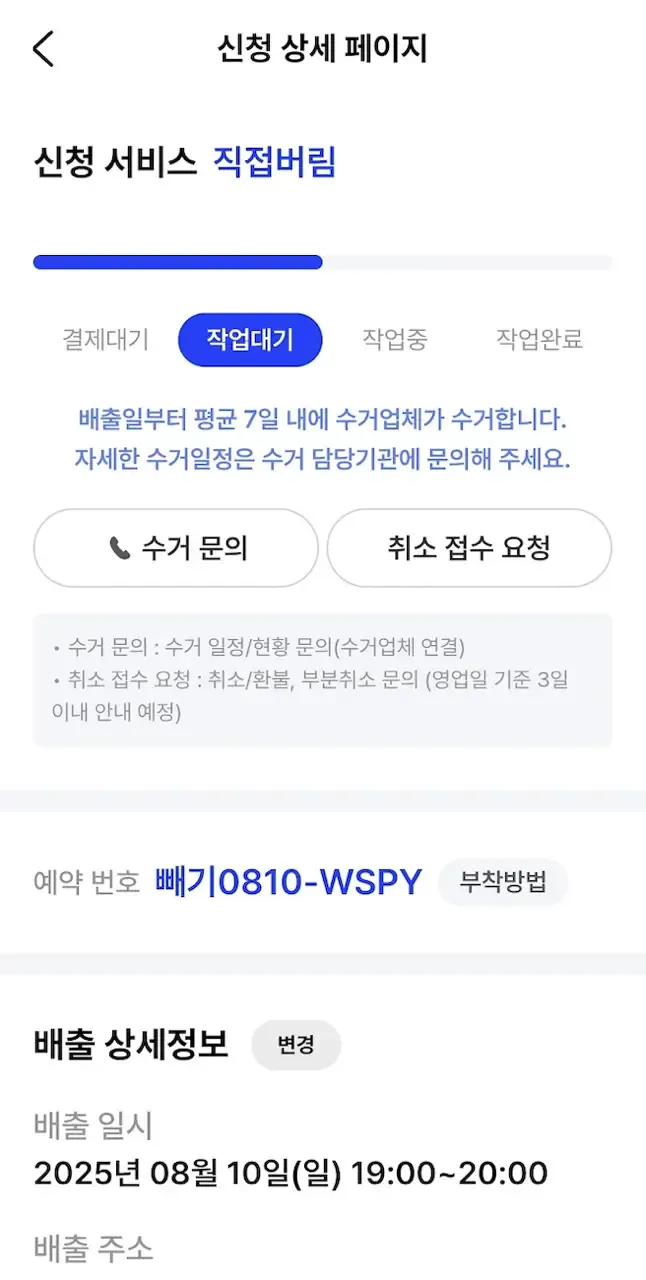
A filed report in the Ppaegi app · ⓒ @BalliBalliSeoul
Note the fine print on that screen: pickup happens on average within 7 days of your chosen put-out date — the app is Korean-only, which is exactly the kind of thing we file for you.
No internet or the site defeated you? The local community service center (주민센터, jumin-senteo) handles the same declaration in person — bring the item’s details and pay there.
Two timing notes. Declarations aren’t instant — districts assign a pickup date, so if you’re moving out, file several days before your move, not the morning of. And your building may have its own rules about where bulky items wait for pickup, so a quick word with the building office (관리사무소) saves an argument.
Before you pay to throw furniture away, though: if it still works, Koreans sell or give it away on secondhand apps first — one person’s disposal fee is another’s free pickup. Worth an hour’s try.
The Korean part
Every step of this system speaks Korean: the district’s declaration website, the item-category dropdown menus, the 주민센터 counter, the building’s recycling-night rules, the RFID card registration for food waste. And the rules genuinely differ by district and even by building — which is why expat forums are full of contradicting advice.
If a move-out is what brought you here, the disposal is only half of it. The other half is the deposit — and the argument over it is won or lost with the photographs you took on the day you moved in, repeated from the same angles on the way out.
This is a thing we handle constantly, especially around move-outs. Through our moving help service, we file the bulky-waste declaration for you, get the sticker sorted, and coordinate the haul-out — and for everything else (which bag, which bin, which night, what your specific building expects), our anything-else concierge service answers in plain English.
Get it sorted
Moving out, or staring at a wardrobe you can’t legally throw away? Send us a photo on WhatsApp — we’ll tell you what it costs to dispose of, file the district report for you, and arrange muscle if you need it. Asking costs nothing — you pay only for the work you book.
And the one-line version to keep: general waste in the district bag, food waste separate, recycling rinsed and sorted, big stuff reported first. Follow that and your trash will never come back to haunt you.