Aircon Cleaning in Korea: Do It When Summer Ends
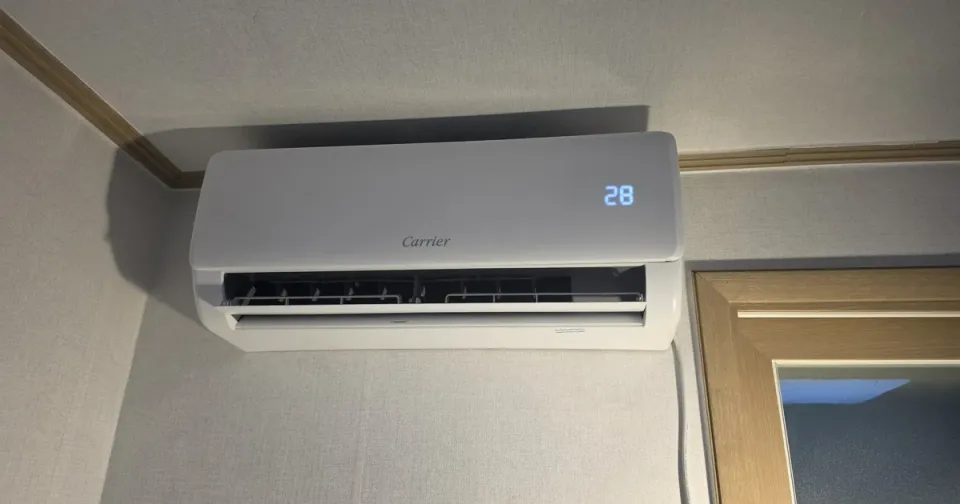
Summer is over. The machine that ran every night since June is about to be switched off and not thought about again until next May.
That is the moment worth catching. All summer it smelled faintly of a damp towel for the first thirty seconds — you noticed, it faded, you forgot. That smell is water: cooling pulls moisture out of the air, it condenses on the cold metal inside the unit, and if it never dries it grows things.
Now do the arithmetic on the off-season. A unit switched off wet in September sits wet for eight months, in a sealed plastic box, in a room nobody ventilates in winter. Whatever is in there in September is what greets you in May, with a winter to develop.
The end of summer is not a leftover time to deal with this. It is the right time, and this article is about why, and about what the job actually is.
The filter is yours
Open the front panel — it hinges upward on most wall units — and there are one or two mesh filters that slide out. This part is designed for you to do.
Rinse them under a tap, no detergent needed, and let them dry completely before they go back. A damp filter reinstalled is the problem you were trying to solve. In a Korean summer, once every two weeks is a reasonable rhythm.
If the airflow has been getting weaker and the room takes longer to cool, a blocked filter is the first thing to rule out, and it costs nothing to check.
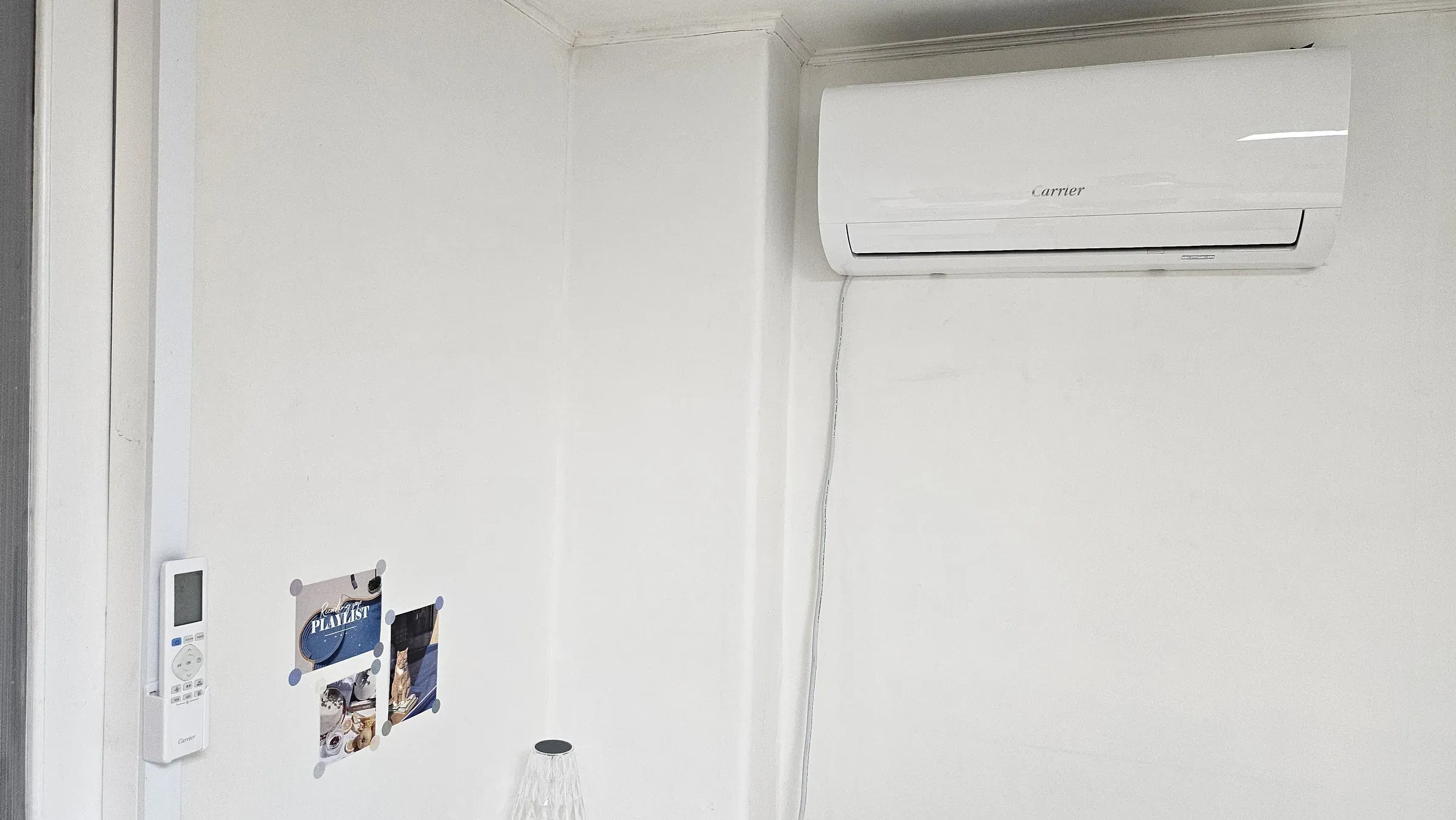
The filters live behind the front panel, and they slide straight out · ⓒ @BalliBalliSeoul
Everything past the filter is not
Behind the filter is the heat exchanger — a dense block of aluminium fins — and behind that a long barrel fan, and under both a drain tray. That is where the smell actually lives, and none of it is reachable without taking the machine apart. Which is why no amount of ordinary cleaning touches it — this sits outside what a regular housekeeper does, and always has.
People try. A can of aircon spray through the vents is sold everywhere and mostly moves the problem deeper, because whatever it dissolves drips into the drain tray and stays there.
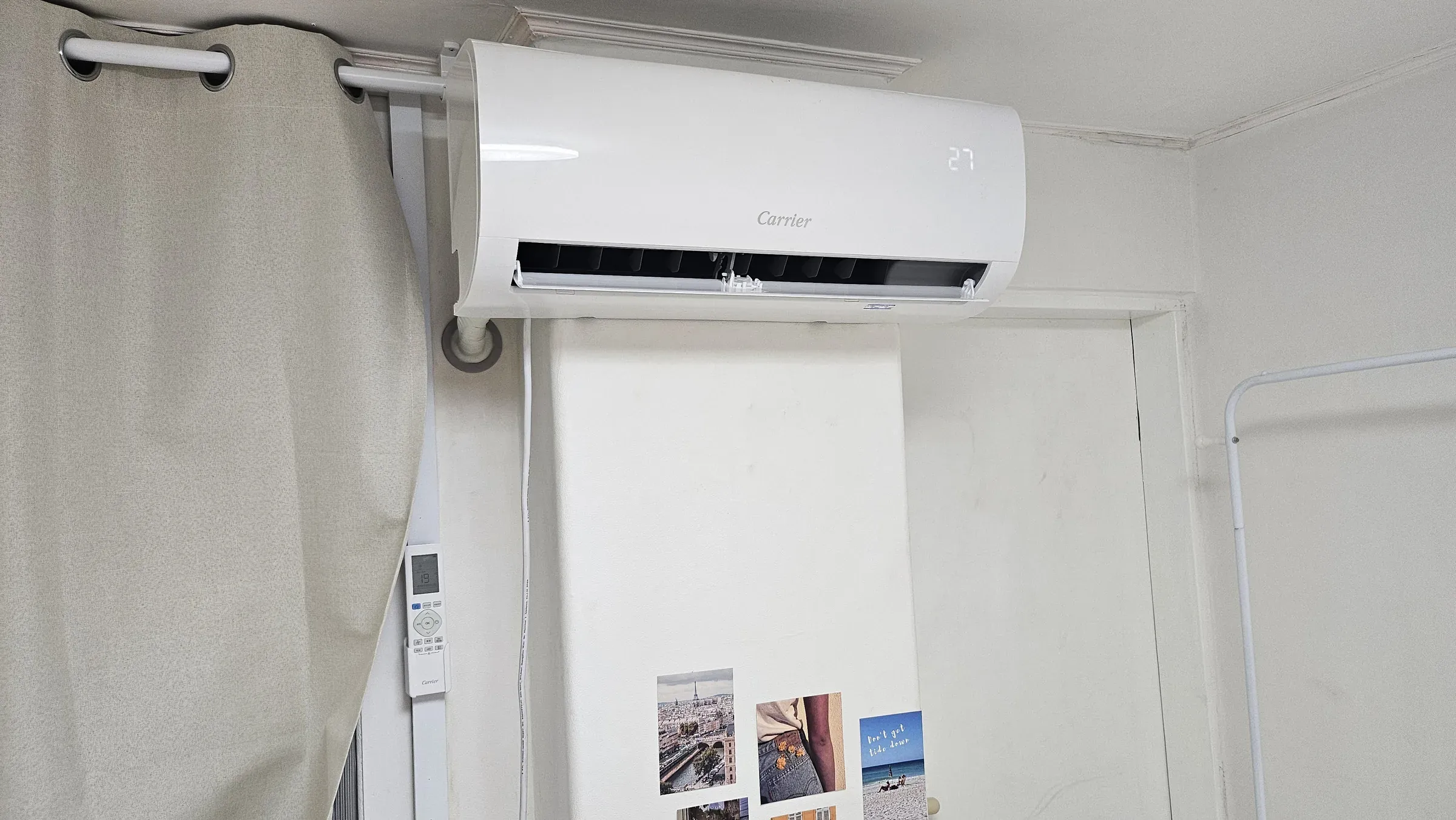
Past the louvres it is fins and a fan, and they do not rinse · ⓒ @BalliBalliSeoul
Why the shoulder season is the whole point
Two separate reasons, and they stack.
The machine gets a proper rest. A clean in July buys you six weeks before the unit is running hard again. A clean in September means it goes into eight months of standstill dry and empty rather than damp — which is the difference between a machine that smells next May and one that does not. Nothing you do in July gets you that.
And it is the cheaper, faster half of the year. Everyone books in June and July. Those months have the longest wait and the least negotiable price — the discounts that run the rest of the year quietly disappear when the queue is full. Late spring and the end of summer are when you get a date within days and a crew that is not rushing to the next job.
If you are reading this in August with a smell already, the order is: rinse the filter, run fan mode after every session, and book the strip for September. The smell is unpleasant, not urgent — and waiting a few weeks gets you a better job for less money.
분해청소 or 간단청소 — this is the distinction that matters
Korean cleaners offer two different jobs and quote them as if they were the same product. Ask which one you are being sold.
| 간단청소 (simple clean) | 분해청소 (full strip) | |
|---|---|---|
| What happens | Cover off, filter washed, fins sprayed and wiped | Casing, fan and drain tray removed from the wall bracket |
| The barrel fan | Not reached | Taken out and washed separately |
| Drain tray | Wiped if visible | Removed and cleaned |
| Water used | Cloth and spray | Pressure washer, with a bag hung to catch runoff |
| Does the smell come back | Usually, within weeks | Not for a season or two |
If the complaint is a smell rather than dust, 간단청소 is not the job you want. The smell is coming from the fan and the tray, and a clean that never reaches them is a clean you will pay for twice.
The tell on the day is the plastic. A full strip means a large bag or sheet hung under the unit to funnel dirty water into a bucket. If nobody is hanging plastic, nobody is stripping anything.
The type of unit changes the job
Not all aircon cleaning is the same size of job, and quotes that ignore this are quotes that get revised on the day.
- 벽걸이 (wall-mounted) — the standard case, and the quickest.
- 스탠드 (floor standing) — the tall cabinet units in living rooms. More panels, more time.
- 천장형 / 시스템 (ceiling cassette) — mounted in the ceiling, usually needs two people and sometimes access above the panel.
Tell whoever you are asking which type you have, how many units, and send a photo. It is the single thing that makes a quote hold.
If the unit is being done as part of a move, say so separately: a whole-flat deep clean almost never includes the inside of the aircon unless you ask for it.
What it costs
Aircon cleaning is priced per unit and by type, not by the hour, and a full strip costs meaningfully more than a wipe-down because it is a different amount of work. Guide ranges as of 2026:
| Unit type | 간단청소 (wipe) | 분해청소 (full strip) |
|---|---|---|
| 벽걸이 wall-mounted | ₩40,000–60,000 | ₩60,000–90,000 |
| 스탠드 floor standing | — | ₩100,000–150,000 |
| 2-in-1 (stand + wall unit sold as a set) | — | ₩150,000–220,000 |
| 천장형 / 시스템 ceiling cassette | — | ₩100,000–170,000 |
Two things get added on top. Heavy mould or smell often carries a high-pressure sanitising or anti-microbial coating option, commonly ₩20,000–30,000 per unit. And the outdoor unit, a call-out fee, or unusually bad contamination are usually quoted separately.
Look at the wall-mounted row again. The gap between a wipe and a strip is roughly ₩20,000–30,000 — which is small enough that paying twice for the wrong one is the expensive outcome, not the strip.
Before you agree to anything, get three things in writing: which of the two jobs it is, the price per unit for your type, and whether the quote covers the outdoor unit as well. That last one is a common gap.
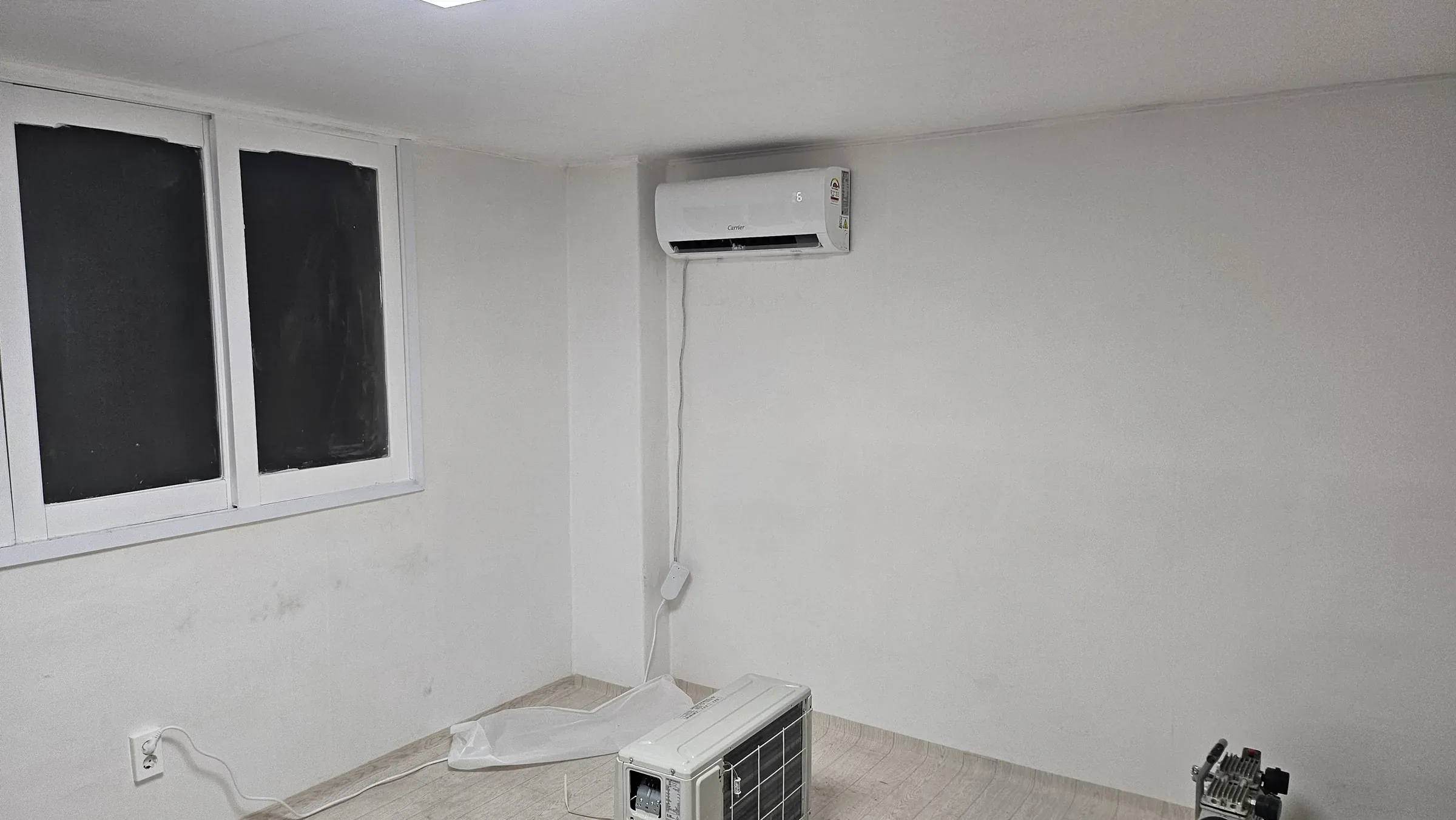
Both halves of one aircon, before the second one goes outside · ⓒ @BalliBalliSeoul
That photograph is worth a second look, because it is the thing people forget. An air conditioner is two boxes, not one. The half you look at every day is indoors; the half that sits in the weather, collects leaves and dust and traps heat against a wall, is the one you never see — and the one a quote will quietly leave out.
Who pays — you or the landlord
The aircon is usually the landlord’s fixture, so a fault — it will not cool, it leaks water into the room, it trips the breaker — is a repair question and normally theirs.
Routine cleaning is different. It is maintenance arising from ordinary use, and it tends to land on the tenant, which is why the filter habit is worth having. Where it gets argued about is a unit that was already filthy when you moved in — and that is a good reason to photograph it on day one, along with everything else worth photographing.
Stop it coming back
The reason the smell returns is that the machine is switched off wet.
Run 송풍 (fan mode) for ten to twenty minutes after you finish cooling, especially the last time you use it each day. It dries the fins and the tray, and it is the difference between cleaning once a year and cleaning twice.
The one that matters most is the last session of the year. Whatever moisture is inside the unit when you shut it down in September is sealed in there until you turn it on again. Ten minutes of fan mode on that final evening is the cheapest maintenance in this article — and the one nobody remembers, because by then you are thinking about jackets rather than aircon.
Two more things worth doing: keep the drain hose sloping downward and unblocked, because standing water in the line is its own smell, and if the unit is also throwing damp into the room, check whether you have a mould problem that is not really the aircon.
The Korean part
- Asking for the right job. 분해청소 and 간단청소 are different words for different work, and getting the wrong one is how people end up cleaning twice.
- Describing the unit. Type, count, and whether there is a ceiling panel involved.
- The landlord question. Whether this is maintenance or a repair is a conversation, and it goes better in writing.
- Checking the work. Ask to see the runoff water. A full strip produces a bucket of it, and you will not need it explained.
Not sure which one you are being quoted? Send us a photo of the unit on WhatsApp — we’ll ask the question in Korean and come back with a price per unit for the job you actually want. First answer is free.
Get it sorted
Rinse the filter, run fan mode after cooling, and if the smell is already there, book a full strip rather than a wipe. Those three moves cover almost every version of this.
And if the season is turning as you read this, that is the timing, not a coincidence. Book it now, run fan mode on the last warm evening, and the machine spends the winter dry.
We arrange it in English, confirm which job is being quoted before anyone is booked, and stay on it afterwards. The cleaning page has the guide ranges for the rest of the house.