Locked Inside a Room in Korea: How to Get Out
Almost everything written about locked doors in Korea assumes you are standing outside one. The pinhole in the handle, the card trick, the locksmith at the door — all of it is written for someone in a corridor.
This is the other one. You are inside, the handle is turning and doing nothing, and the emergency release is on the wrong side of the door.
It happened to me last weekend, in one of our own houses. Here is the honest version of it, because it is more useful than a tidy one.
I had my phone. I had signal. My wife was outside the building. There were windows I could have opened and called down from. I was never, at any point, in the slightest danger, and it took thirty minutes to get out.
I panicked anyway.
I was not frozen, either. I tried things — the postcard trick from a childhood memory, a mental inventory of what in the room was heavy enough to break a door with. Both of those were sensible. I was still rattled the entire time, and it still took thirty minutes.
That is the part worth writing down: being rattled and being capable are not opposites, and you will be both.
I make content for a living, and I did not take a single photograph of any of it. That is why there are none in this article. If you want a measure of what a stuck door does to a person, it is a better one than a picture would have been.
So the first thing this article does is the thing nobody did for me.
First, the only question that matters
Is anyone in danger?
If there is fire or smoke, if you can smell gas, if someone in the room is hurt or cannot answer you, or if there is a child or a baby involved:
Call 119. Now. Let them open the door however they need to.
They will break it if they have to, and that is the correct outcome. A door is a few hundred thousand won. Do not sit behind one doing arithmetic. If you cannot speak, 119 takes text messages, and both 119 and 112 have interpreters — the details are in Korea’s emergency numbers.
Everything below this line is for the other situation: you are fine, nothing is on fire, and you simply cannot get out of a room.
What 119 actually does when you text them
Here is the real exchange, because it settles three things people wonder about and one they never think to ask.
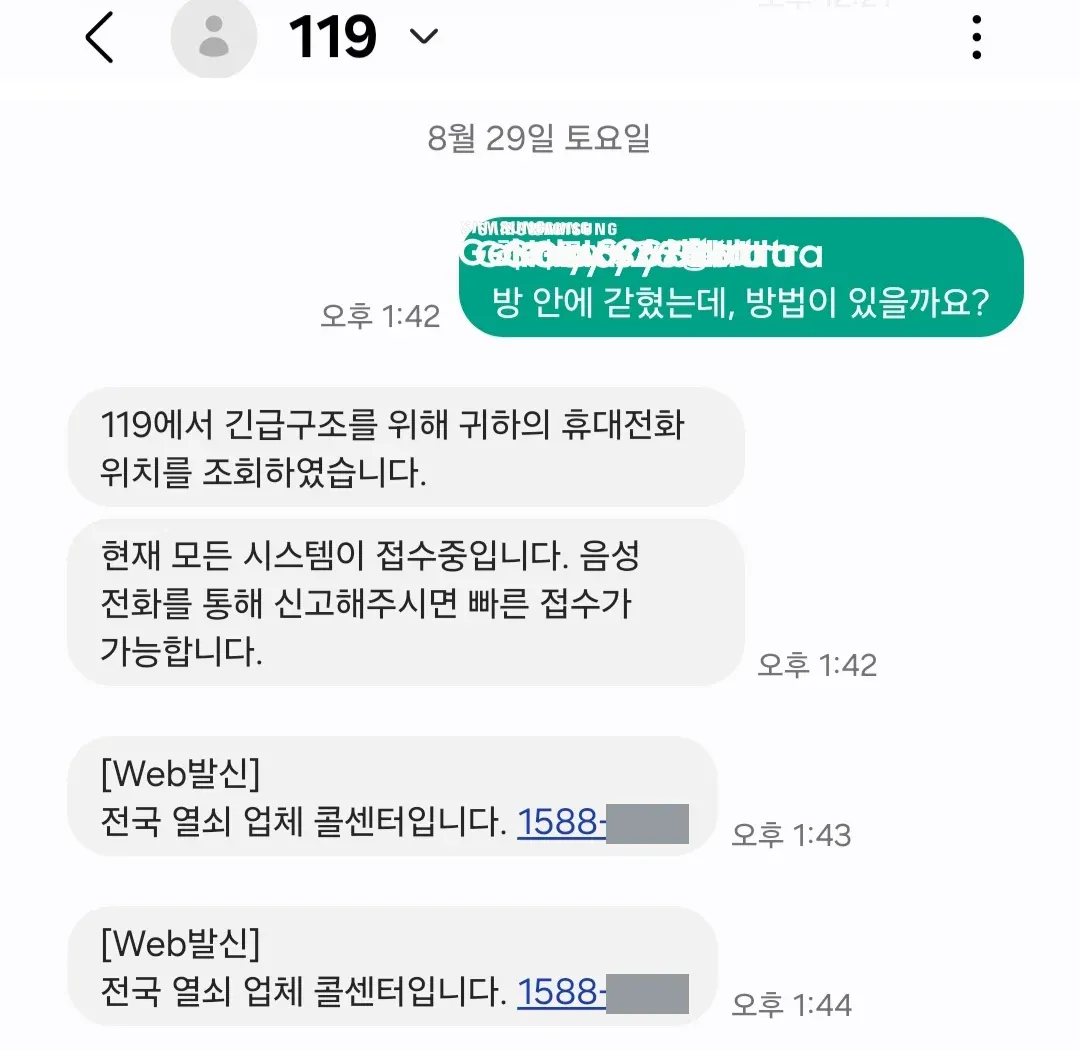
119, Saturday 29 August. The message went out at 1:42pm. Between it and the 1:43 reply, a person from 119 rang back. We have removed the locksmith’s last four digits — it is not a company we know anything about, and we do not pass on referrals we have not checked.
Texting 119 works. It is the channel for when you cannot speak — or, as here, when you can speak perfectly well and are too rattled to want to.
They find you without being told where you are. 119에서 긴급구조를 위해 귀하의 휴대전화 위치를 조회하였습니다 — 119 has queried your mobile phone’s location for emergency rescue. That lands before a human has answered anything, and it means the worst case is already covered: if you stop replying, they know where to come. If you are stuck somewhere you could not describe in Korean anyway, that by itself is a reason to send the message.
But they would rather you rang. The next reply says so outright — all systems are currently taking reports; reporting by voice call allows faster intake. Text is the fallback, not the front door. If you can talk, talk.
And then the phone rang. This is the part the screenshot cannot show, and it is the part that matters most: a person from 119 called back, within a minute of the message.
On that call I told them I was standing the request down. Nobody made that decision for me and nobody argued me out of it. I was safe, and I said so.
And they helped anyway. Having just been told they were not needed, they gave me the number of a national locksmith call centre over the phone — and then sent it by text, twice, at 1:43 and 1:44, so I had it in writing rather than scribbled on whatever was to hand.
That is the opposite of what people expect from an emergency number they have decided not to bother. 119 did not brush me off. I stood it down, and they made sure I was left with somewhere to go.
So the useful thing to know is not that 119 will turn you away. It is this: text them and they will ring you, so keep the phone in your hand. What happens next is a conversation with a person, and you are part of it.
Had it been a real emergency they would have come, and they would have opened the door however they needed to — which for a hollow wooden leaf in a wooden frame means breaking it, and replacing it afterwards. A new door, a new frame if the frame goes with it, and a carpenter.
So the money is real, and the decision about it is yours.
Here is the trap in it. I had the fire service on the phone and told them to stand down — not because I had weighed the risk and found it low, but because I did not want to pay for my own door. I was safe, and standing it down happened to be the right call. That is not the reasoning I used. The reasoning I used was that doors are expensive.
Everybody does that arithmetic. You will do it too. The problem is that it is the exact same sentence in a person’s head whether there is smoke under the door or not, and it is a fine reason to wait when you are safe and a lethal one when you are not.
So decide the safety question first, on its own, before the money question exists. If the answer is that someone is in danger, the door is not part of the decision.
You almost certainly have more than you think
Panic narrows what you can see, and the first casualty is the list of things already in your pocket. Before you touch the handle again, name them out loud:
- Your phone, and whether it has signal. Most of these end here.
- Who is within earshot. In the building, in the flat, on the other side of the wall. Somebody thirty seconds away beats a locksmith forty minutes away.
- A window. Not to climb out of — to call down from. A shout to the street is a perfectly good way to reach a person, and in a Korean neighbourhood at almost any hour there is somebody in it.
- Time. Nothing about a stuck door gets worse while you think. That is what makes it different from every other emergency, and it is the single most calming fact available to you.
- The room itself, as a last resort. A chair, a desk, the steel rail of a clothes hanger, a bed frame. An interior door is a hollow leaf and a knob — it is not a vault, and a knob loses to a chair leg. You should not do this over an inconvenience, and you would be paying for it. But knowing it is there is what stops the word trapped from being true, and it is worth knowing before you need it. In a real emergency, with 119 too far away, that is a door and you are a person.
Then work the list in that order. The reason the half-hour above was a half-hour and not five minutes is that none of it got done first.
What to try from the inside
Interior doors in Korea fail in a small number of ways, and two of them you can do something about.
Work out whether the latch is moving. Turn the handle slowly and watch the edge of the door. If the latch retracts and the door still will not come, the door is jammed in the frame rather than locked — see the next section. If the handle turns limply and the latch does not move at all, the mechanism has failed and this is not something you will solve with technique.
Push and pull while you turn. A latch under sideways pressure from a swollen or dropped frame binds. Take the weight of the door off it — push the door firmly toward the frame, or pull it toward you — and turn the handle at the same time. This alone opens a surprising number of doors that feel locked. It is the same fault that makes a keypad lock take your code and do nothing.
If the handle has come off on your side, the square metal spindle it sits on is still in the door. Anything that grips it and turns it will work — pliers, a coin in the slot, a key shank. This is the one genuine self-rescue, and it depends entirely on the spindle still being there.
The two tricks you have heard of, and why neither works from in here
Everyone reaches for these first. Both are real, both are covered elsewhere on this site, and both are written for somebody standing in the corridor.
The pinhole is on the wrong side. On a Korean bedroom or bathroom door the emergency release is drilled into the outside face, because it exists so a parent can open a door a child has locked from within. From your side it is not there at all. Knowing that saves you ten minutes of running your fingers over a handle.
The card will almost certainly not work either — and this is the one that stings, because most people have a memory of opening a door with a plastic sheet as a child and assume the skill transfers.
Here is why it usually does not. A spring latch has one flat face and one sloped one. The sloped face points the way the door travels as it shuts, so a card slid into the gap can ride up it and push the latch back. That slope is only reachable from the side the door opens away from.
So look at which way your door swings. If you have to pull it toward you to open it, the slope is facing the corridor, and there is no card, postcard or plastic sheet that reaches it from where you are standing. Korean bedroom doors usually open into the room, which puts almost everyone who is stuck inside one on the wrong side of that slope. I spent part of my thirty minutes proving it with a postcard.
And if the handle itself has failed — the thing that put you in there — then the latch is not spring-loaded any more, it is jammed. At that point the slope does not matter, because nothing is going to push a seized latch anywhere.
The card is still worth knowing. It works, well, from the other side: the card trick and when it works.
Two things not to do
Do not climb out of the window — use it to shout. A Korean walk-up has no fire escape and no ledge worth the name, and the third floor of a three-storey house is a fall that kills people. Climbing out is genuinely the most dangerous idea available to you in that room, and it is the one that occurs to everybody at about the twenty-minute mark. Opening the same window and calling down to the street is one of the best, and it is free.
Do not attack the handle. Forcing a stuck mechanism turns it into a broken one, and a broken one is harder for the person who arrives to open. If it is not moving, leave it and spend the effort on reaching somebody.
Reaching someone when you are the one stuck
You will get out faster through a person than through the door.
- Anyone in the building. A neighbour with a screwdriver beats a locksmith with a van, because the neighbour is already there. This is how mine ended — thirty minutes, no damage, no invoice.
- The building office (관리실) if there is one, or the landlord.
- Us, or whoever manages your building, with a photo of the handle. Half of these turn out to be the push-and-pull above, which costs nothing and takes ten seconds to explain.
Say in the first message that you are on the inside. It changes everything about what gets recommended and how quickly, and it is the detail people leave out.
When you are the one outside the door
The mirror image happens more often than the real thing, and it is worth knowing how to check.
A resident of one of our houses called us because the bathroom door was locked and she could hear water running behind it at an hour when nobody was usually up. That is a reasonable thing to be alarmed by. It was somebody having a shower.
Knock and say your name before you assume the worst. If there is no answer and something sounds wrong — a fall, a tap that has been running far too long, no response from someone you know is in there — then it stops being a privacy question and 119 is the right call, before any locksmith.
What it costs, if it comes to a locksmith
A stuck interior door is at the cheap end of locksmith work when it opens without damage, and expensive the moment it does not. The guide ranges and the running log of real jobs are on our locksmith page. What moves the number is the same as ever: whether it opens without damage, the hour, and how far someone has to travel.
If the handle has to be replaced, the part is not the expensive bit. A standard interior handle set is a few tens of thousands of won at a hardware shop or online.
The thing we got wrong
We replace every door handle when we open a house. It is cheap, it is quick, and it is the sort of maintenance nobody notices.
In this house, one handle looked perfectly fine, so we left it.
That is the one that trapped somebody. A handle that looks fine tells you nothing about the spring inside it, and the replacement costs less than a single callout. We have gone back to no exceptions, and the reason is written above.
If you rent: a handle that sticks, feels loose, or turns further than it should is a repair request, not a quirk. Send it to your landlord in writing now, while it is still an inconvenience. It is much harder to have that conversation from the inside.
The Korean part
Being stuck in a room in a country where you do not speak the language is worse than the door deserves. You cannot explain the handle, you cannot describe the building, and the number you were given rings out in Korean.
That is the gap we sit in. Send us a photo of the handle from where you are standing. We will tell you whether this is the push-and-pull, and if it is not, we make the call, agree the price first, and stay on the chat until the door is open.
Get it sorted
If anyone is in danger, 119, and let them take the door.
If not: check whether the latch is moving, push and pull while you turn, and message somebody who is physically close before you message anybody with a van.
KakaoTalk is the easiest way to reach us, and WhatsApp works too. Say that you are on the inside. Asking costs nothing.