Hot Water Coming and Going? Ask About the Valve First
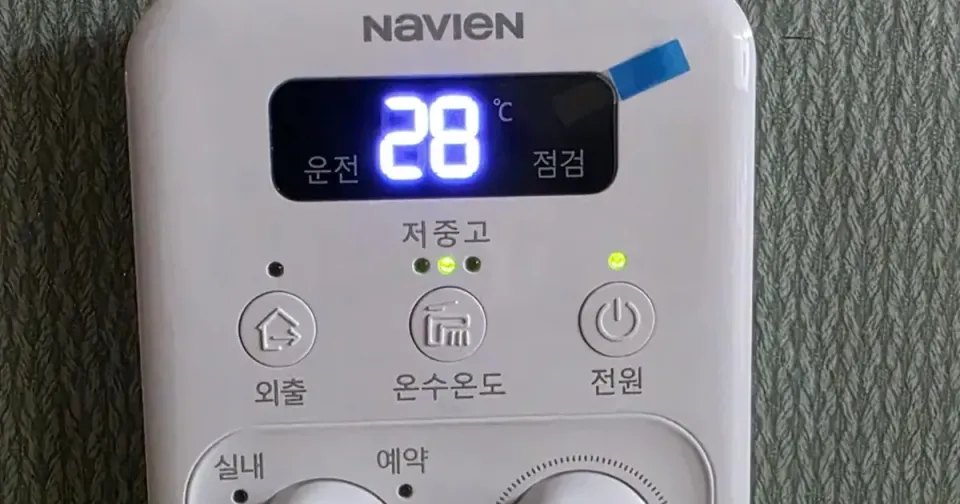
The shower runs hot, then lukewarm, then hot again. Or you get hot water in the kitchen but not the bathroom, or only after the heating has been on. Somebody tells you the boiler is old and you should replace it.
Maybe. But the symptom you’re describing usually points at one specific part that costs well under ₩100,000 to swap — and it’s worth knowing its name before anyone quotes you for a new boiler.
Getting nothing at all, rather than hot water that comes and goes? That is a different fault with a different first move — start with the valves, because a closed gas or water valve behaves exactly like a broken boiler.
First, what a Korean boiler actually is
If you’ve come from somewhere with a hot-water tank in a cupboard, the Korean setup is different in a way that matters.
One wall-mounted gas unit does two jobs: it heats water for your taps, and it heats water that runs through pipes under your floor — 온돌, the underfloor heating that Korean homes use instead of radiators. There’s no tank. Water is heated on demand.
That’s why the wall controller has modes that look strange at first:
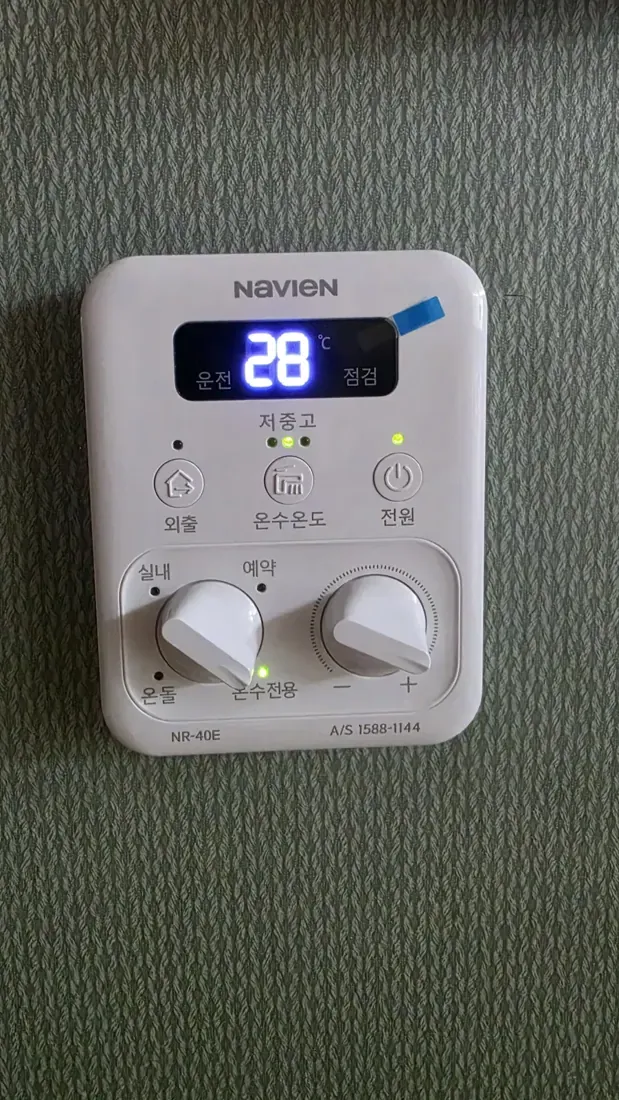
실내 · 온돌 · 온수전용 — the dial that confuses everyone · ⓒ @BalliBalliSeoul
| Mode | What it does |
|---|---|
| 실내 | Heat the room to a target air temperature |
| 온돌 | Heat the floor to a target water temperature |
| 온수전용 | Hot water only — no heating at all |
In summer, 온수전용 is the setting you want. And if your hot water has stopped entirely, check this dial before anything else — a boiler switched to a heating mode with the target already met may simply not be firing.
What the symptom tells you
Because one unit does both jobs, there’s a component whose entire purpose is to decide which job gets the hot water. When it starts failing, the symptoms are distinctive:
| What you’re seeing | What it usually means |
|---|---|
| Hot water comes and goes | The diverter valve (삼방밸브) |
| Hot water only while the heating is running | Same part |
| No hot water at all, heating fine | Same part, or the dial |
| No heat and no hot water, error code on the panel | A real breakdown — read the code |
| Water never gets properly hot, everywhere | Scale, ageing unit, or gas supply |
The part worth knowing: 삼방밸브
삼방밸브 — the three-way, or diverter, valve. Its whole job is to send the heated water either to your floor or to your taps, with the taps taking priority.
When it wears out it stops switching cleanly, and the result is exactly the complaint at the top of this article: hot water that comes and goes. It’s a known wear item — reports commonly put trouble starting somewhere around the five-year mark.
What a repair looks like on the bill. Korean repair invoices break into three parts, and one documented example ran:
| Line | Example |
|---|---|
| Call-out (출장비) | ~₩18,000 |
| Part (부품비) | ~₩50,000 |
| Labour (수리비) | ~₩12,000 |
| Total | ~₩80,000 |
Treat that as an illustration rather than a price list — brand, model and region all move it — but it establishes the order of magnitude. A diverter valve is a tens-of-thousands-of-won job, not a millions-of-won job.
The question to ask: if someone looks at intermittent hot water and immediately quotes you for a whole new boiler, it is entirely reasonable to say: “삼방밸브 확인해 보셨어요?” — have you checked the three-way valve? You are not being difficult. You’re asking the question a Korean tenant would ask.
When it really is the boiler
Sometimes the answer genuinely is replacement, and there’s a reasonably clear line.
- A domestic boiler lasts around 8–10 years. Manufacturers and Korea’s gas safety authority both point at that range as the window to start thinking about replacement.
- Past ten years, worn internals burn less cleanly. That shows up as rising gas bills — and, more seriously, as higher carbon monoxide output. This is the part to take seriously: an old boiler isn’t just inefficient, it’s a safety question.
- Repeated failures of different parts in one season is the practical signal. One valve is a repair. Three call-outs is a boiler telling you something.
If it does come to that, the number you’ll want next is what a replacement runs to — we published a real receipt for a condensing gas boiler supplied and fitted in Seoul, and what the spec on the box means: boiler replacement cost in Korea.
So: find out how old it is. There’s a plate on the unit with the model and manufacture date, and the manufacturer’s service number is usually printed right there too.
Reading the error code
If the panel is blinking a code, you don’t need to translate the manual. Every Korean boiler brand publishes its codes, and the search that works is:
[brand] 보일러 에러코드 [number] — for example
귀뚜라미 보일러 에러코드 E1
The brand is written on the front of the unit — Kyungdong (경동), Navien (나비엔), Kiturami (귀뚜라미), Rinnai (린나이), Daesung (대성). Photograph the code and the plate at the same time; the technician will ask for both.
Two things to try before you call
Genuinely worth ninety seconds:
- Check the dial and the target temperature. A boiler in 실내 mode with the room already at target will not fire — which looks identical to “broken” if you’re expecting hot water.
- Check the gas is on. There’s a valve on the gas line; if anyone has been working in the flat, it may have been closed. Korean gas supply also cuts off after an earthquake alert and needs manual restoration.
If the boiler has power, the gas is on, the mode is right, and hot water is still intermittent — that’s your valve.
Who pays: you or the landlord?
This is the question that decides whether the repair is a nuisance or an expense, and Korean practice is fairly settled.
- Wear, age and failure of the boiler itself — the landlord’s responsibility. A diverter valve failing after five years, or a ten-year-old unit dying, is the property’s problem, not yours.
- Damage you caused — misuse, or letting pipes freeze because the heating was left off while you travelled in January — moves the bill toward the tenant.
- The practical move: tell the landlord in writing, early. A message with a photo of the error code and the date establishes both that you reported it and when. It’s the same discipline that matters when water starts coming through a ceiling — document first, argue later.
Don’t commission a replacement boiler yourself and expect to be reimbursed. Report it, get the landlord’s agreement on what’s being done, then let the work happen.
A winter footnote
Worth reading before December: a boiler left completely off in a Korean winter can freeze, and a frozen pipe is a much larger repair than anything above — potentially with water damage attached.
If you travel over winter, leave the heating on a low setting rather than off, and don’t switch the boiler off at the breaker.
The Korean part
All of this happens in Korean: the error code, the manufacturer’s service line, the technician at the door explaining what he found, the landlord conversation about who pays, and the quote that may or may not be reasonable.
That’s what our plumbing service is for — we book the visit, translate what the technician says, and confirm the price with you in writing before anyone starts. If the answer is a valve, you’ll know it’s a valve.
Get it sorted
Hot water misbehaving, or a code on the panel you can’t read? Message us on WhatsApp with a photo of the controller and the plate on the boiler — we’ll tell you what it’s likely to be and what it should cost. Asking costs nothing — you pay only for the work you book.
The one-line version: hot water that comes and goes is usually the diverter valve, that’s a sub-₩100,000 repair, boilers themselves run 8–10 years — and if it’s age or wear, the bill belongs to your landlord. If it turns out to be the boiler, here is what replacing one costs.