Korean Convenience Stores: Food, Deals and the Services Desk
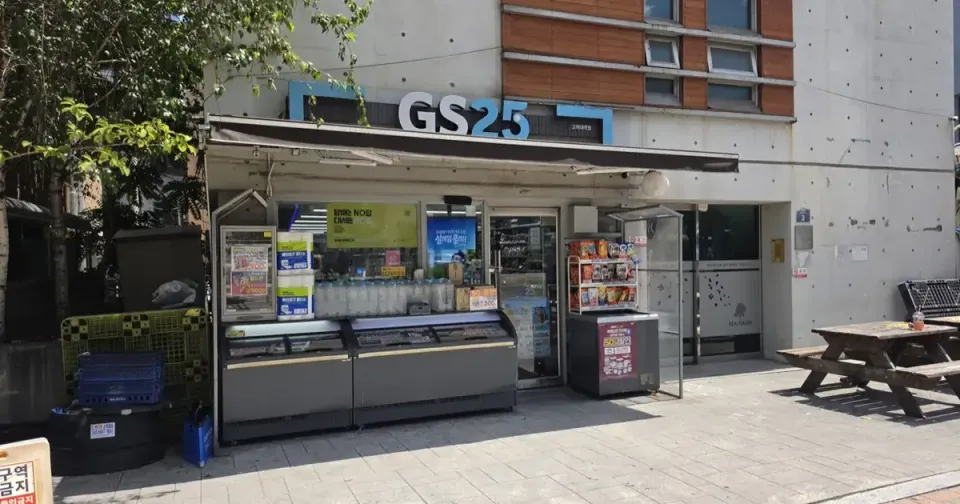
Nothing prepares you for the density. Stand on almost any Seoul street and you can usually see a convenience store, and often two, belonging to different chains, facing each other across the road. They are not corner shops that happen to open late. They’re a layer of public infrastructure that happens to sell crisps — and once you understand what they do, a surprising number of your problems here have a two-minute answer.
The four chains
GS25, CU, 7-Eleven and emart24 dominate, and the honest summary is that the differences are small. All four run the same basic model: 24-hour opening, hot and chilled food, a services counter, and an own-brand range that’s usually the cheapest thing on the shelf.
Two things do differ enough to notice:
- Own-brand lines. Each chain has its own coffee, snacks and ready meals — CU’s and GS25’s coffee brands are cheaper than any cafe and perfectly drinkable.
- App and membership discounts. Each runs a loyalty app, and Korean mobile carriers’ membership discounts apply at specific chains. If you’re on a Korean plan, ask which store yours matches — it’s a standing 10–15% on some items.
The deals system: 1+1 and 2+1
This is the single biggest lever on your grocery bill here, and it’s labelled in a way you can read without Korean.
Look for the red circular tags on the shelf edge:
- 1+1 — buy one, get one free.
- 2+1 — buy two, get the third free.
- A yellow tag with a struck-through number is a straight discount.
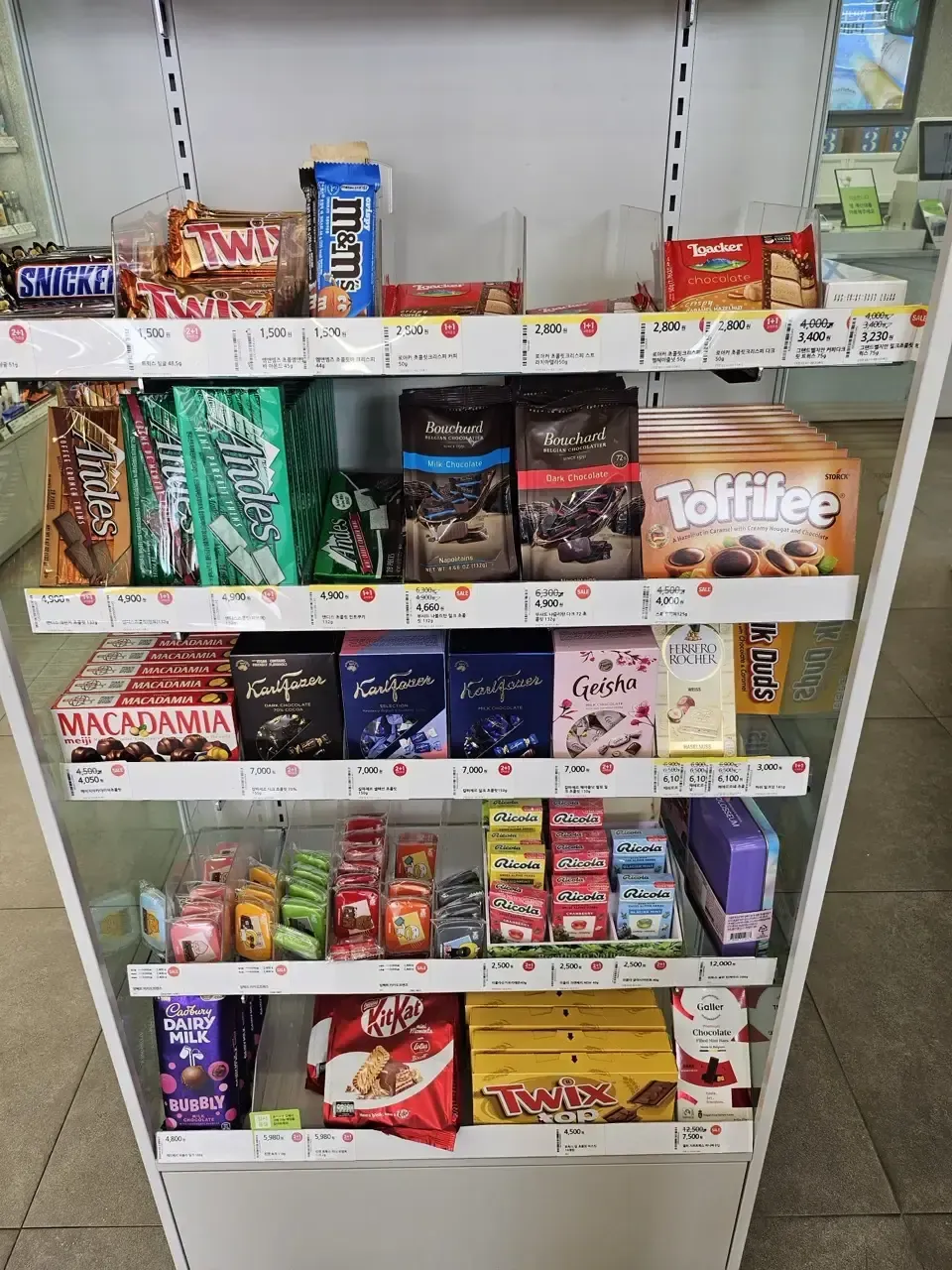
Red circle = free item. Yellow = price cut · ⓒ @BalliBalliSeoul
Two practical notes. You have to actually take the extra item — nothing is deducted automatically if you only pick up one. And the free item usually has to be the same product or from the same promotional group, so if you want to mix flavours, ask at the counter before queueing.
These promotions rotate monthly, and they’re aggressive. Drinks, snacks, ready meals and beer are all routinely on them.
Food: this is a functioning kitchen
The chilled wall is the part visitors underestimate. It carries triangular rice balls (삼각김밥), rolled gimbap, sandwiches and full lunchboxes (도시락) — a lunchbox is typically ₩4,000–6,000 and is a genuine meal, not a snack.
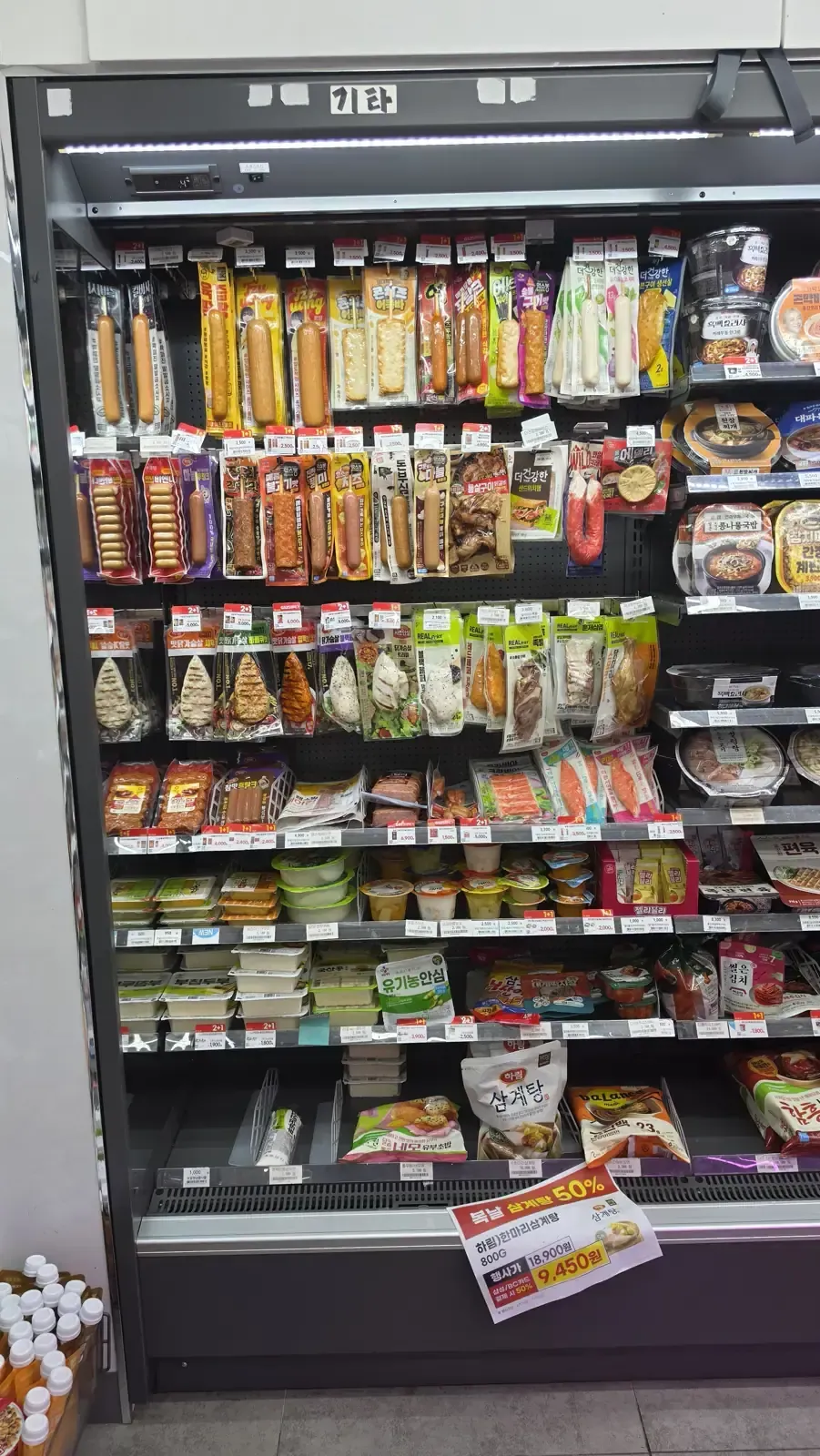
The chilled wall — lunch, at any hour · ⓒ @BalliBalliSeoul
Everything here is designed to be eaten on the spot — and the equipment to do it is standing right there, free to use.
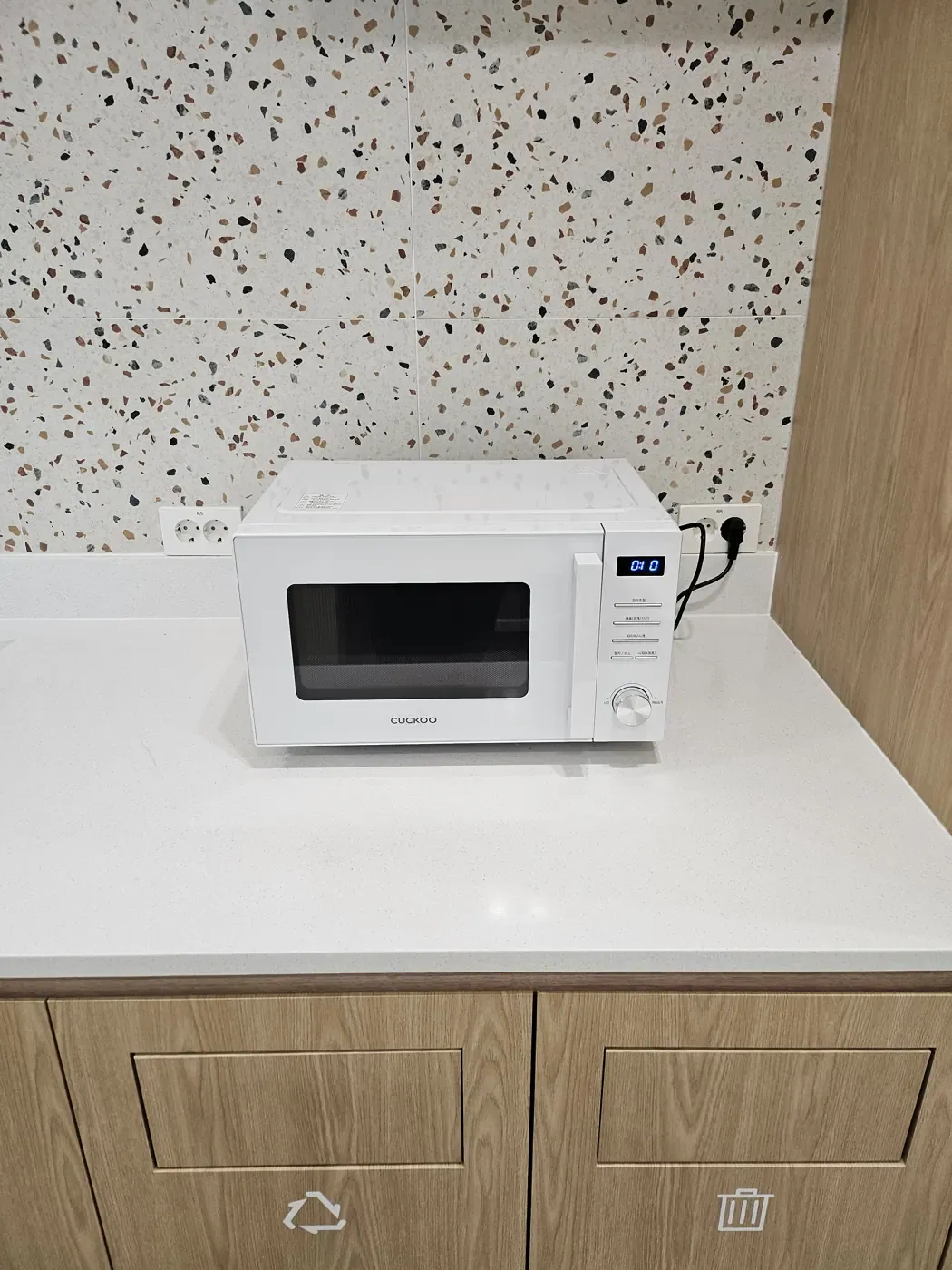
Microwave above, sorting bins below — the whole loop in one corner · ⓒ @BalliBalliSeoul
The microwave heats your lunchbox; the staff will do it for you if you ask, but most people press the buttons themselves. Look at the cabinet doors underneath it in that photo: the recycling and waste symbols mark the store’s sorting bins, which is where your container goes when you’re finished. Heat it here, eat it here, bin it here.
For hot water, look for a dispenser or a water purifier by the counter — the tap that fills your noodle cup:
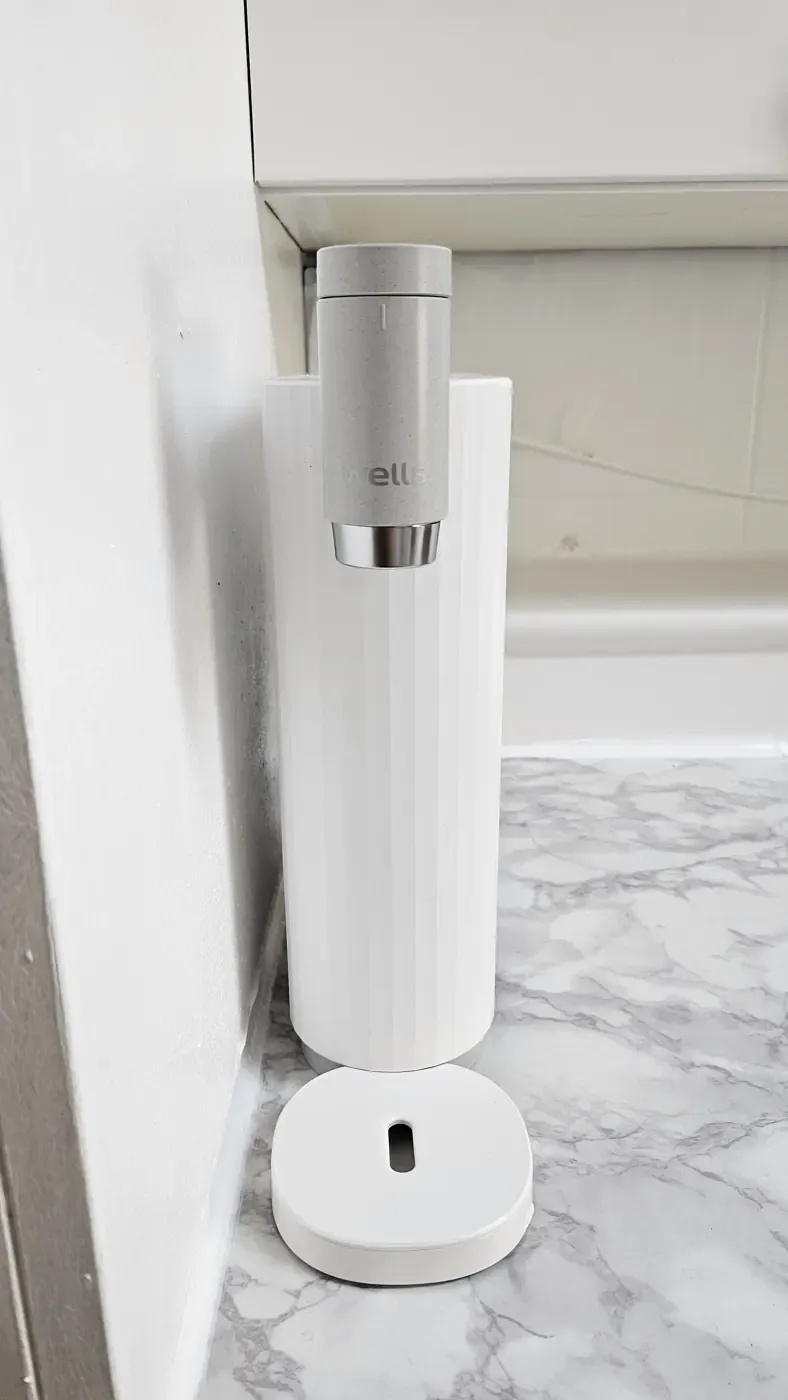
Hot water for the cup you just bought · ⓒ @BalliBalliSeoul
Chopsticks, spoons and lids sit in a box on the counter and cost nothing. We wrote the full version of that ritual — including how to read the noodle wall — in our guide to the convenience store ramyeon shelf.
Watch for discount stickers on food near its sell-by time, usually applied in the evening. Marked-down lunchboxes are one of the better-value meals in the city.
The services counter — the part nobody tells you about
Here’s where “convenience” stops being a brand name. Depending on the branch, that counter will:
- Send and receive parcels. Convenience-store courier (편의점택배) is cheap and open at any hour, and it’s a common delivery destination for online orders — handy if you’re out all day or don’t want packages left in a shared hallway.
- Top up your transit card. Hand over your T-money card and cash. At a shop counter this is a cash-only transaction — the one errand where you genuinely need notes in your pocket. (Station machines are different: those take cards, including foreign ones.)
- Give you cash. Most branches have an ATM, and many accept foreign cards, though fees and limits vary by machine.
- Take utility and bill payments, through the in-store kiosk.
- Sell alcohol and cigarettes — with an ID check, and note that alcohol sales are legal at any hour here.
Nothing on that list requires much Korean beyond pointing. All of it is available at 3 a.m.
Open 24 hours — mostly
The 24-hour default is real, but not absolute: some branches in quiet residential areas or inside office buildings close overnight or at weekends. In practice, in any dense neighbourhood, at least one nearby store will be open.
Two consequences worth internalising:
- You never need to stockpile. Small fridge, small kitchen, no problem — the shop is your pantry, five minutes away.
- It’s a safety net. A lit, staffed, air-conditioned room open all night is a useful thing to know about when you’re lost, overheating or unwell.
Paying, and the small print
- Card works everywhere, including for a ₩900 drink. Phone payment too. Cash is only genuinely required for transit top-ups.
- There is no tipping, here or anywhere else in the country — the full explanation is here.
- The bins by the door are for store rubbish — your cup, your wrapper, your noodle tub. They are not for household waste, which has its own strict system.
- Bags cost money (a small charge for a plastic one), so regulars carry their own.
What else it solves
Three problems that send visitors searching at midnight all have the same answer, and we’ve written each one up:
- A fever, and every pharmacy shut — registered stores sell a designated list of over-the-counter medicines, including children’s fever syrups. The full ladder is here.
- A dinner you can cook and eat in the shop — the ramyeon wall, decoded.
- Pads, tampons or condoms at an awkward hour — where to buy the essentials.
It’s also, quietly, one of the things that surprises people most about living here.
The Korean part
The labels are the easy part — your camera translates those. The hard part is the counter: a parcel form that wants a Korean name and phone number, a bill-payment kiosk that only speaks Korean, a delivery you need sent to a store rather than an empty flat. Those are transactions, not translations, and they’re what we handle.
Get it sorted
Need to send a parcel, pay a bill, or receive a delivery you can’t be home for? Message us on WhatsApp — we’ll fill the Korean form and walk it through with you. Asking costs nothing — you pay only for the work you book.
The one-line version: red tag means a free one, the chilled wall is a real meal, the counter sends parcels and tops up your transit card in cash, and something nearby is open right now.