Korean Ramyeon at the Convenience Store: Buldak, Decoded
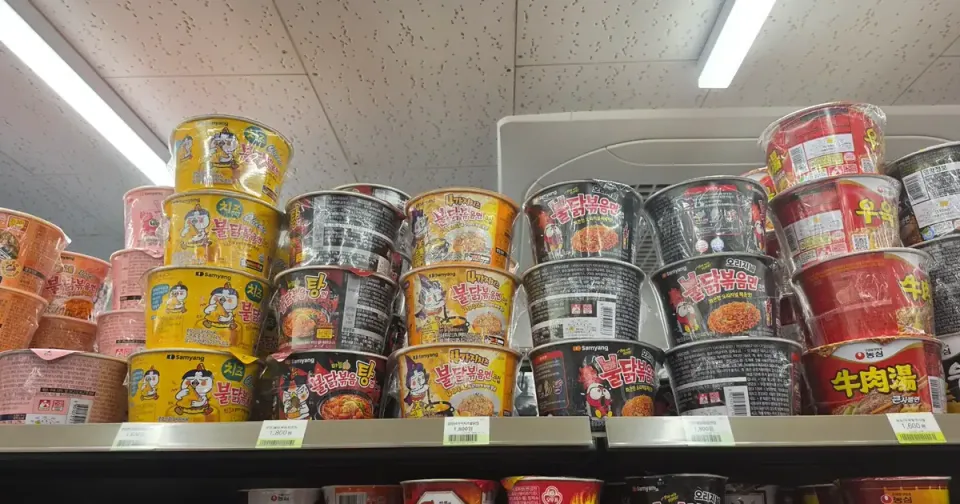
You came for one thing and you’re now looking at a wall of forty cups, most of them red, most of them shouting, none of them in a language you read. Somewhere in there is the noodle you saw online — and next to it are five things that look identical but aren’t. Here’s how to read that shelf in about ninety seconds.
The heat ladder
Spice is the axis everything else hangs off. Korean instant noodles carry an official Scoville number, and the useful ones look like this:
| Noodle | Scoville (SHU) | What that means |
|---|---|---|
| Most non-spicy cups (udon, beef soup, jjajang) | ~0 | Genuinely mild |
| Shin Ramyun (신라면) | ~3,400 | The national default. Warm, not painful |
| Buldak Bokkeummyeon (불닭볶음면) | 4,404 | The famous one. Hot, but survivable |
| Nuclear Buldak (핵불닭볶음면) | 8,706 | Twice the original. Treat with respect |
For scale, a jalapeño runs somewhere in the 2,500–8,000 range. So original buldak sits in jalapeño territory — hot, but not the apocalypse the internet sold you. Nuclear is the one that hurts.
The buldak you know abroad isn’t quite the one on this shelf
This trips up almost everyone. The export packs sold overseas as “2x Spicy” are labelled around 10,000 SHU, while the domestic Korean pack called 핵불닭 (Nuclear) is 8,706. The naming, the packaging and the numbers simply don’t line up between markets.
Two consequences, both practical:
- The variety here is much wider than the export range. Korean shelves carry seasonal and limited flavours that never leave the country.
- Don’t assume your tolerance transfers. If you’ve only had the export version, buy one cup and find out before committing to a four-pack.
Buldak is not one noodle — it’s a whole product line
Look at the cover photo again and count the colours. That is a single brand occupying an entire shelf, and the variants are not ranked by heat in any way the packaging makes obvious:
- Original (black) — 4,404 SHU, the reference point.
- Carbonara (pink) — creamy, and noticeably milder than original. This is the one to hand a nervous friend.
- Cheese (yellow) — same trick, dairy blunts the burn.
- Mala (마라) — different heat entirely: numbing Sichuan-style rather than straight fire.
- Stew / soup versions (탕면) — buldak flavour with broth instead of the dry stir-fried format.
The rule of thumb: cream and cheese variants are milder, “Nuclear” and 마라 are the ones to approach carefully, and the black original is your baseline.
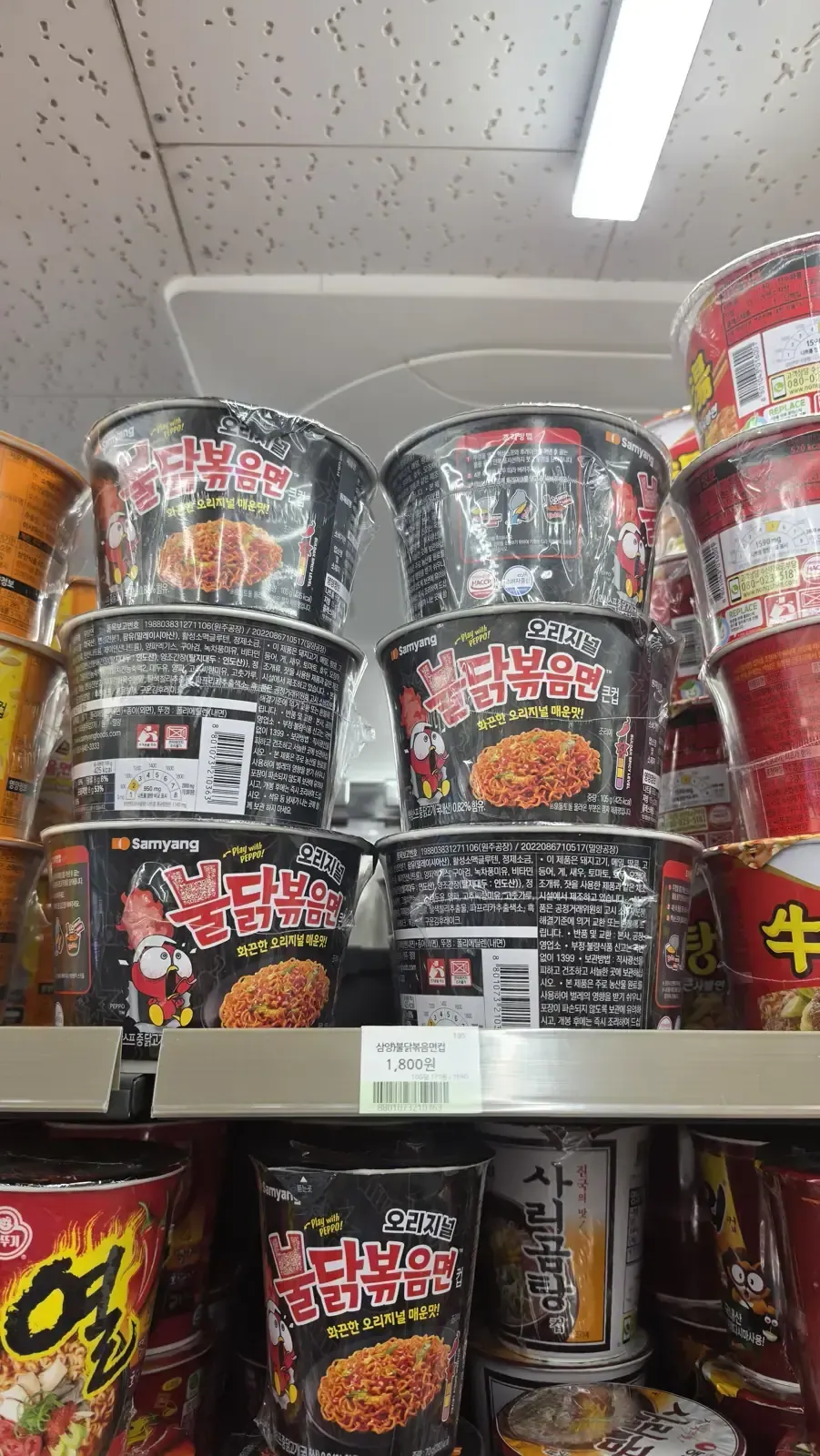
Big cups, ₩1,800 · ⓒ @BalliBalliSeoul
Cup or bag?
Both formats sit on the same aisle and the choice is really about where you’re going to eat.
- Cup (컵라면) — everything is in the cup. Add hot water, wait three minutes. Big cups run about ₩1,800; smaller ones ₩1,300–1,350 at the shelf in these photos.
- Bag (봉지라면) — cheaper per serving, but you need a pot, a hob and about eight minutes. Multipacks at a mart are cheapest of all.
If you’re staying anywhere with a kitchen, bags win on price. If you’re out, the cup is the entire point — because of what comes next.
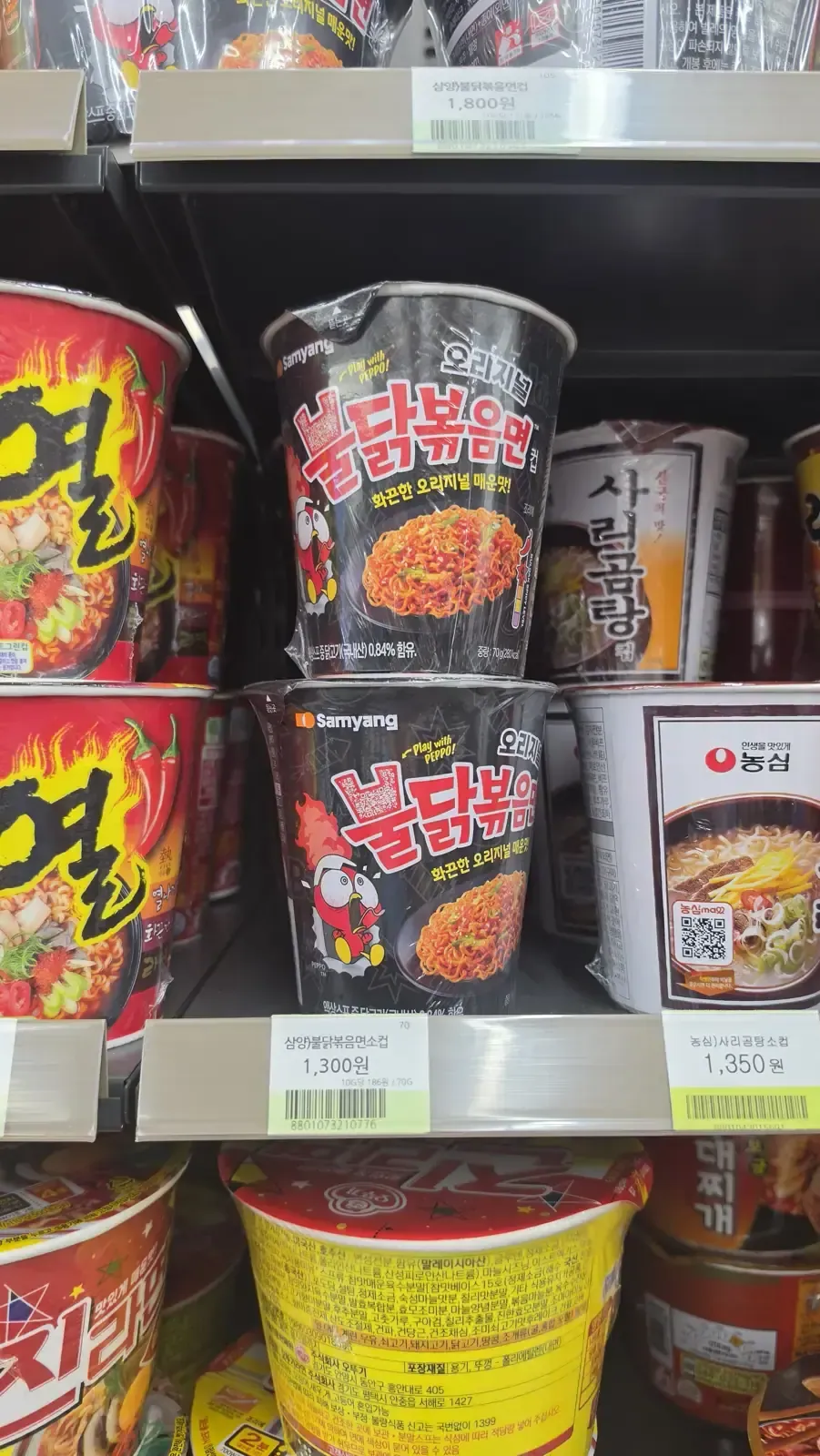
Smaller cups, ₩1,300–1,350 · ⓒ @BalliBalliSeoul
You can cook it and eat it in the store
This is the part nobody tells visitors, and it’s the best thing about the whole system.
Korean convenience stores are set up for you to eat there. Not tolerated — designed. Near the counter you’ll find a hot water dispenser (온수기) and usually a microwave, and by the window or outside there are tables and stools. Ramyeon is only one thing they do — the full tour of what a Korean convenience store is for covers the meal boxes, the deals and the services desk.
The routine:
- Pick your cup and pay first, at the counter.
- Peel the lid back to the marked line, fill with hot water to the inside line, close it.
- Wait three minutes — the dispenser is right there, and chopsticks and lids are on the counter, free.
- Eat at the table. When you’re done, bin it in the store’s bins — this is exactly what those bins are for, since the rubbish came from the store.
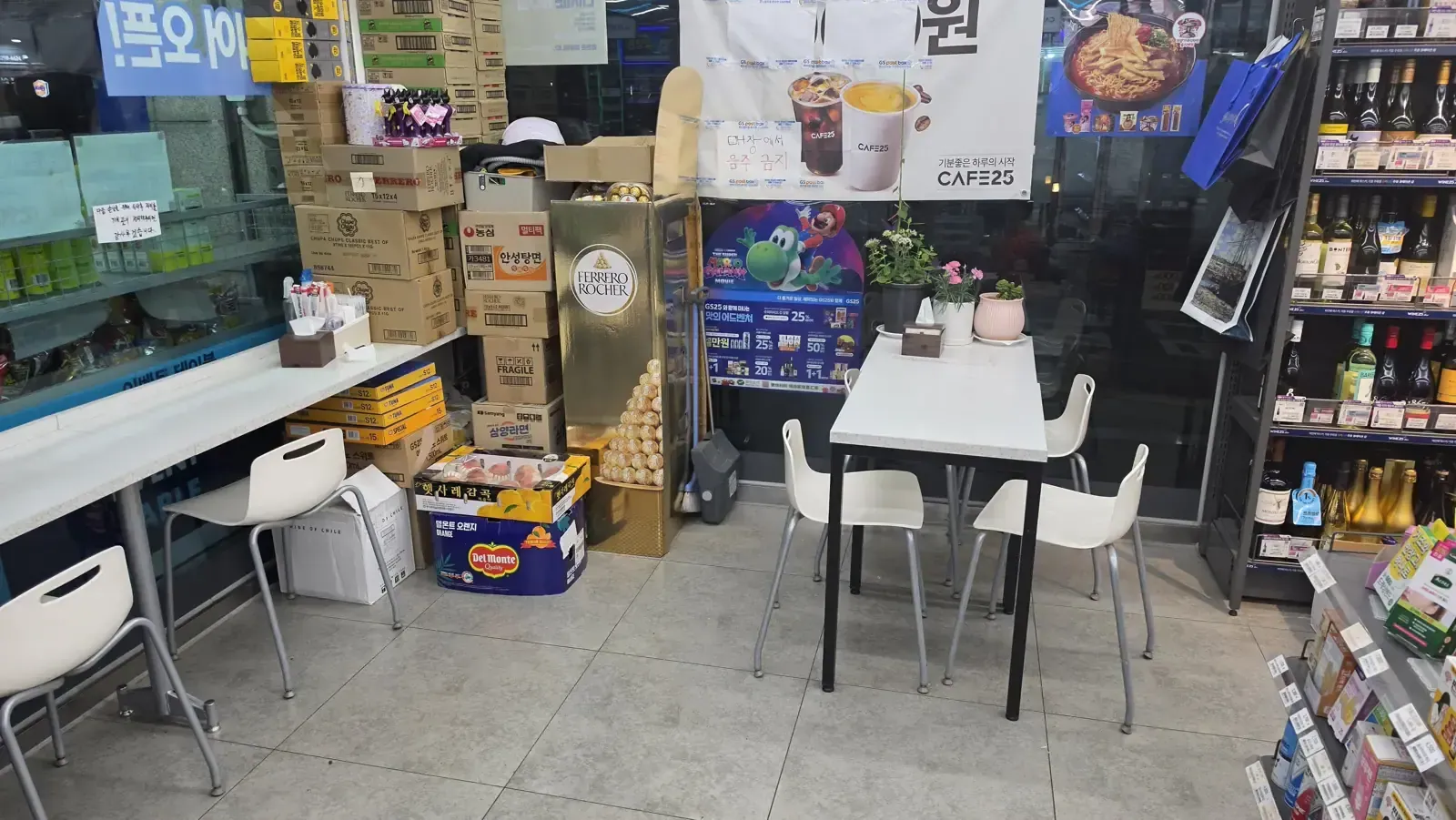
Tables inside the shop — this is normal, not cheeky · ⓒ @BalliBalliSeoul
A cup of noodles, a table, air conditioning and a coffee machine, at 3 a.m., for under ₩4,000. It’s one of the things that genuinely surprise people about Korea, and it’s the reason the convenience store is the answer to so many questions here — from a fever at midnight to a box of tampons.
If you want a chair and a laptop instead of a chair and a noodle, that’s the cafe’s job — different rules, same idea.
The sauce shelf, for taking it home
Buldak’s second act is sauce in a bottle, sold on the condiment aisle rather than with the noodles. It’s the same flavour in a form that works on rice, chicken, eggs or anything else, and it has quietly become one of the most practical souvenirs you can buy — lighter than snack boxes and actually used at home.
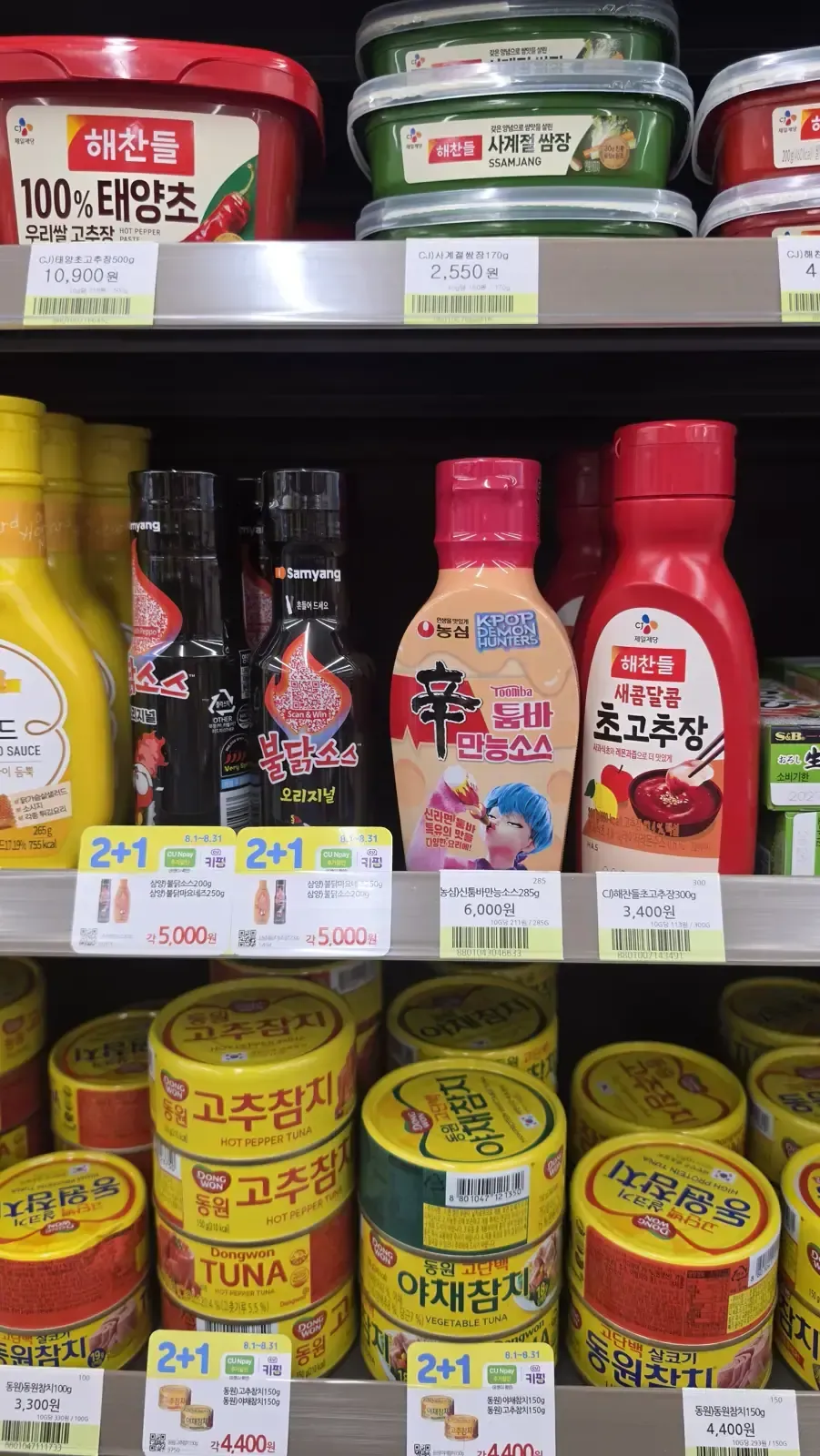
Sauces sit with the condiments, not the noodles — note the 2+1 tags · ⓒ @BalliBalliSeoul
Watch the shelf tags: 2+1 (buy two, get one) is extremely common on this aisle, and it’s how a ₩5,000 bottle turns into three bottles for the same money. Just remember they’re liquid — pack them in checked luggage.
If you don’t want spicy at all
Perfectly reasonable, and well catered for. The same wall carries beef soup (육개장), udon, seafood, kalguksu-style and jjajang (black bean, sweet and not spicy at all) cups. If the packaging is red with flames, it’s hot. If it’s brown, yellow or blue with a picture of clear broth, it isn’t.
The Korean part
The flavour names are in Korean, the heat warnings are in Korean, and the difference between “very spicy” and “the one that made people cry on YouTube” is one word on a lid. Send us a photo of the shelf and our anything-else concierge service will tell you what you’re holding — before you buy four of them.
Two aisles over on the same shelf run is the other thing Korea buys by the boxful — coffee sticks. Same logic, same colour-coded packaging, same “which one is the sweet one” confusion: we sorted Maxim and KANU out here.
Get it sorted
Standing in front of the ramyeon wall? Snap it and message us on WhatsApp — we’ll tell you which cup is which, in English. Asking costs nothing — you pay only for the work you book.
The one-line version: original buldak is 4,404 and manageable, Nuclear is 8,706 and isn’t, carbonara is the gentle one, cups are ₩1,300–1,800 — and you can cook it and eat it right there in the shop.