Sick in Korea: Where to Get Medicine, Day or Night
It’s 2 a.m., the pharmacies shut hours ago, and someone has a fever — maybe your child. You don’t know the word for “paracetamol” here, you don’t know if anything is open, and the internet is telling you to find a hospital. Usually you don’t need one. Korea has a four-step ladder for exactly this, and the first rung is the convenience store on your corner.
What we can and cannot help with
We are not a medical service, and we’re deliberate about where our help ends.
We do not recommend, endorse or refer you to any hospital, clinic, doctor or pharmacy. Korean medical law is strict about this and we stay well clear of the line. We accept no commission, referral fee or payment of any kind from any medical institution.
This article is general information, not medical advice. It describes what is sold where — not what you should take, or what is wrong with you. Dosage, suitability and interactions are questions for a pharmacist or a doctor, and the packaging is the authority, not us.
Choosing where and how to be treated is entirely your decision and your responsibility. If symptoms are severe or worsening, stop reading and go to step 4.
Step 1 — The convenience store, 24 hours
This is the part most visitors don’t know exists. Since 2012 Korea has allowed a short, officially designated list of over-the-counter medicines — 안전상비의약품 — to be sold in registered 24-hour convenience stores, precisely so that people aren’t stuck at 2 a.m.
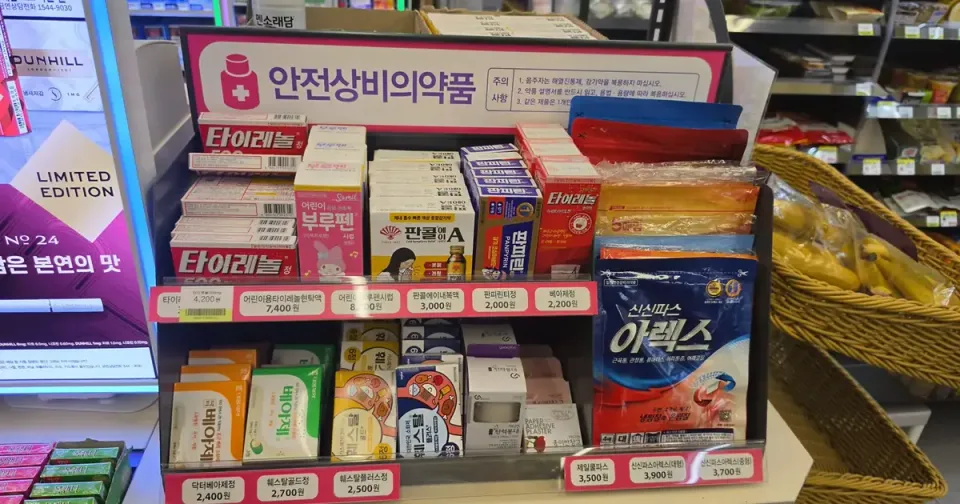
Look for a stand near the counter with a pink and blue 안전상비의약품 sign on it. If the store has one, everything on it is on the government’s list. (Medicine is one of several things these shops quietly do — the convenience store guide covers the rest, including the counter services.)
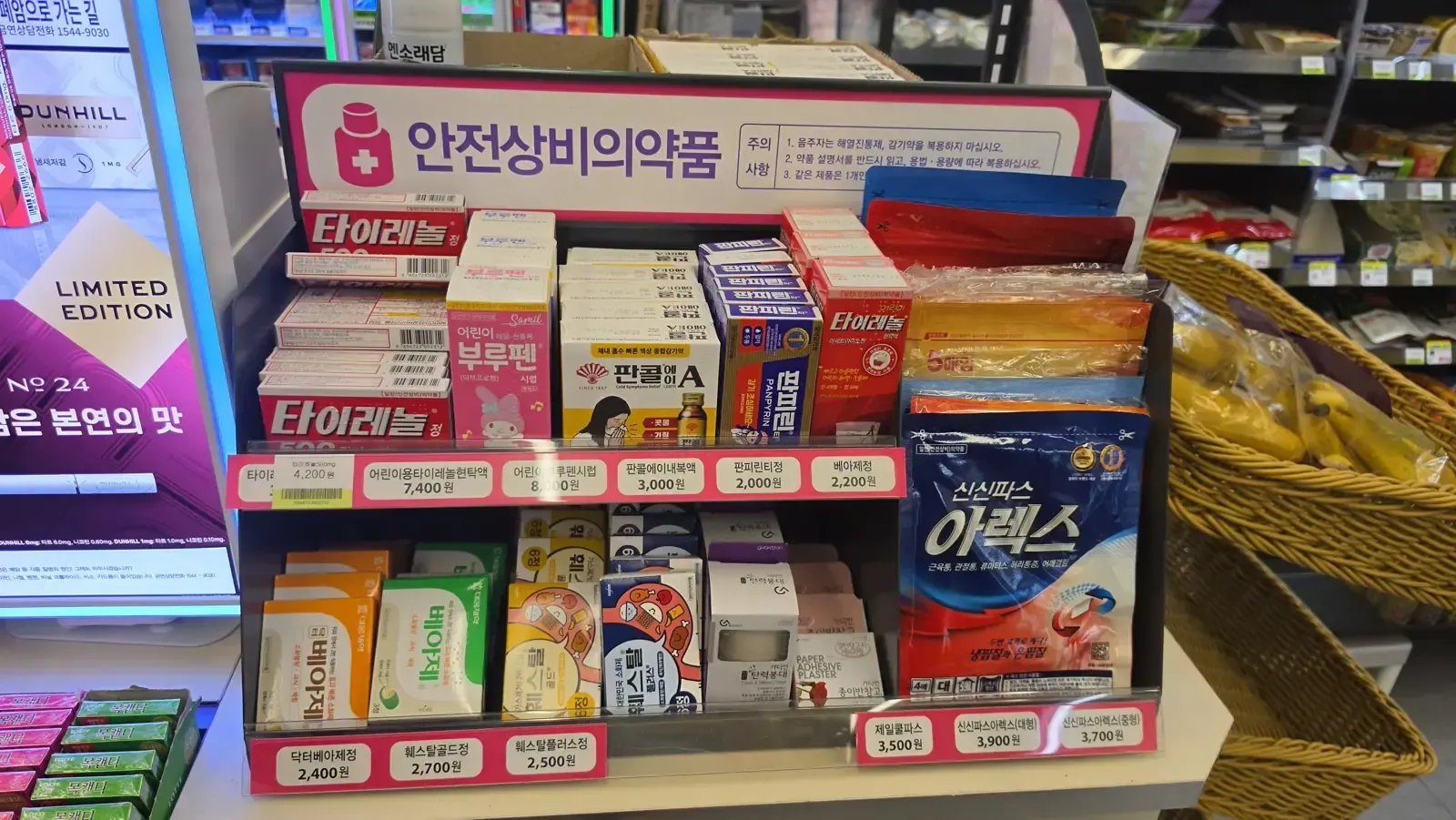
The designated stand — everything on it is government-listed · ⓒ @BalliBalliSeoul
The list covers four categories only: fever and pain relief, cold remedies, digestive tablets, and pain patches. From the price tags on the stand above, as of August 2026:
| Item | What it is | Price |
|---|---|---|
| 타이레놀 500mg | Paracetamol / acetaminophen, adult | ₩4,200 |
| 어린이용타이레놀현탁액 | Children’s paracetamol, liquid | ₩7,400 |
| 어린이부루펜시럽 | Children’s ibuprofen, syrup | ₩8,000 |
| 판콜에이내복액 | Cold remedy, liquid | ₩3,000 |
| 판피린티정 | Cold remedy, tablet | ₩2,000 |
| 베아제정 / 닥터베아제정 | Digestive enzyme tablets | ₩2,200 / ₩2,400 |
| 훼스탈골드 / 훼스탈플러스 | Digestive enzyme tablets | ₩2,700 / ₩2,500 |
| 제일쿨파프 · 신신파스 아렉스 | Cooling and medicated patches | ₩3,500–3,900 |
For parents, the important line is in the middle. Children’s fever medicine is on that shelf, in both paracetamol and ibuprofen form — and it is liquid. The children’s tablet versions were discontinued back in 2022, so don’t stand there hunting for a small box: you’re looking for a bottle.
Four limits worth knowing before you walk out at 2 a.m.:
- Not every store carries it. Only registered 24-hour branches do. If there’s no pink sign, try the next one — in most Seoul neighbourhoods that’s a two-minute walk.
- The list is short by design. No antibiotics, nothing for ongoing conditions, no prescription anything.
- Quantities are capped, so it’s a bridge to morning, not a medicine cabinet.
- It’s sold as an adult purchase. Staff can and do refuse to sell to children.
One clarification, because bad advice circulates: Olive Young does not sell fever medicine. It’s a health and beauty retailer, not a pharmacy. For medicine it’s the convenience store or the pharmacy, full stop.
The same shops also carry a wider non-medicine health aisle — plasters, patches, masks, saline, cooling sheets — which is useful but is not the regulated list:
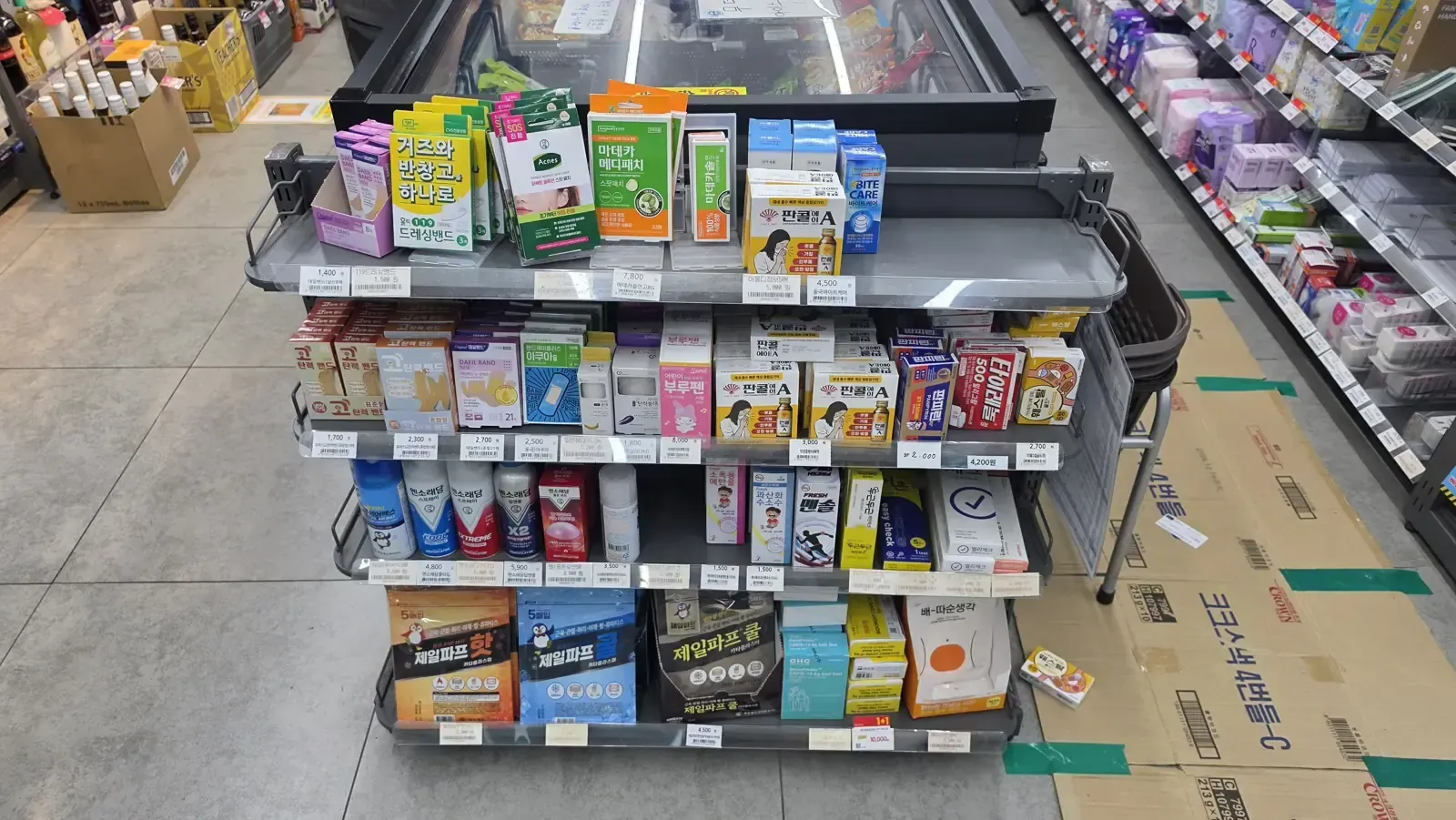
The general health aisle — plasters and patches, not medicines · ⓒ @BalliBalliSeoul
Step 2 — The pharmacy (약국)
If the four categories above don’t cover it, the next rung is a pharmacy. Look for the sign 약국, usually with a green cross.
- Hours: typically around 09:00–19:00 on weekdays, shorter on Saturdays, and many close on Sundays and holidays.
- Pharmacists here advise directly. Describe the symptom and they will hand you something appropriate from behind the counter — a far wider range than the convenience store list, and cheaper than you expect.
- Late-night pharmacies exist. They’re called 심야약국, and larger neighbourhoods and hospital districts usually have one.
To find one that’s actually open right now, Korea runs a public
emergency medical portal, E-Gen (e-gen.or.kr), which lists
pharmacies and hospitals open at the current hour. 119 will also
tell you — see step 4.
Step 3 — A clinic (의원)
Fever that persists, an infection, anything that needs a prescription: that’s a clinic, and in Korea you walk into a small local one rather than a hospital. They’re cheap, fast and everywhere, and they’re labelled by specialty, not by doctor — which is its own puzzle if you can’t read the sign.
We wrote the decoder for that separately: which clinic to walk into, by symptom — including what it costs without national insurance, and what to bring.
Step 4 — 119
For anything severe — trouble breathing, chest pain, a fever that won’t come down in a child, confusion, a bad injury — call 119. It’s free, it’s 24 hours, and there are two things foreigners routinely don’t know about it:
- 119 is not only an ambulance. It’s also a medical information line. You can call and be told which hospital near you is open and can take your case right now — without an ambulance being dispatched.
- Interpretation is available. You can ask for English on the call and be connected to interpretation support.
If you’re a tourist and want a general helping voice in English, the tourist information line 1330 also runs 24 hours with interpretation, and can help you communicate.
If you are unsure whether something is an emergency, call. That’s what the line is for, and nobody will be annoyed with you.
What you can’t get off a shelf, at any hour
- Antibiotics — prescription only, always.
- Anything ongoing or prescribed — you’ll need a clinic visit.
- Emergency contraception — prescription only here, which surprises many visitors; we cover it in where to buy the essentials.
- Bringing your own? Check your medication against Korean customs rules before you fly, especially anything containing codeine or stimulants.
The Korean part
Every rung of this ladder is written in Korean — the stand, the box, the dosage line, the pharmacy sign, the clinic’s specialty. At 2 a.m. with a sick child, that language wall is the actual problem, not the medicine.
What we do, through our anything-else concierge service:
- Read the box for you. Send a photo and we’ll tell you what it is and what the label says.
- Find what’s open right now — pharmacies or clinics near you, at the hour you need one.
- Find where English is spoken, by calling and asking.
- Translate on the call, or stay in the chat while you’re there.
We give no medical advice, no diagnosis, and no opinion on any provider — and we take no money from any of them.
Get it sorted
Standing at the medicine stand unable to read a box? Message us on WhatsApp — send a photo and we’ll translate it, in English. Asking costs nothing — you pay only for the work you book.
The one-line version: convenience store for a fever at 2 a.m. (including children’s syrups), pharmacy when it needs advice, clinic when it needs a prescription, 119 when it’s serious — and 119 will tell you what’s open even if you don’t need an ambulance.