Getting Around Seoul: Subway, Bus, Taxi, Uber and KTX
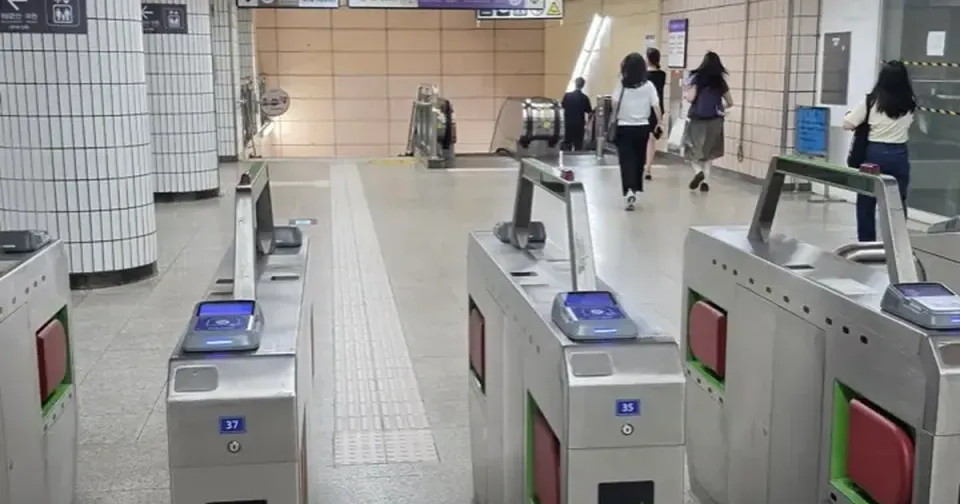
A visitor put the whole question on r/seoul better than we could:
“I’m a 29-year-old Saudi man, and my wife and I are planning a 6-day trip… I was thinking about using Uber for most of our transportation, but it sounds like it might be expensive or not as common as in other countries… Would you recommend sticking to public transport? Are taxis affordable and easy to hail? Is there a better ride-hailing app than Uber that locals use?”
Every one of those questions has a clean answer, and they don’t all point the same way. Here’s the whole thing, in the order you’ll need it.
Short answer: which one, when
| Situation | Use | Why |
|---|---|---|
| Anywhere in Seoul, daytime | Subway | Fastest, cheapest, fully signed in English |
| Short hop with luggage, heat or rain | Taxi | Cheap by global standards, door to door |
| After midnight | Taxi or night bus | The subway stops. This is the big one |
| Two of you, a couple of kilometres | Taxi | The maths flips — see below |
| Airport | AREX train or limousine bus | Bus wins with big suitcases |
| Day trip to another city | KTX or the metro network | Depends how far — see below |
| Crosstown at rush hour | Subway, always | Roads lose to rails, decisively |
The rest of this article is why.
The card that runs all of it
Everything except long-distance rail runs off one tap card, T-money, which you buy at any convenience store for a few thousand won and top up — in cash at a shop counter, or by card at a station machine, which accepts foreign ones. It covers subway, every bus, taxis, and even snacks at the till — and it’s what unlocks free transfers between bus and subway, which is the single biggest saving in the system.
We wrote that up separately, in detail: the T-money card, and why transfers are the point — including the monthly passes, which are mid-restructure in 2026 and worth reading before you commit to one.
Everything below assumes you have the card.
The subway: your default
Base fare is ₩1,550 for an adult with the card, rising in small increments with distance — we’ve broken the whole thing down, including the youth and child rates and a 20% discount before 6:30am, in our guide to Seoul subway fares. Signs, announcements and ticket machines are all in English, and every station has a number — so “Line 2, station 222” gets you there even when the name defeats you.
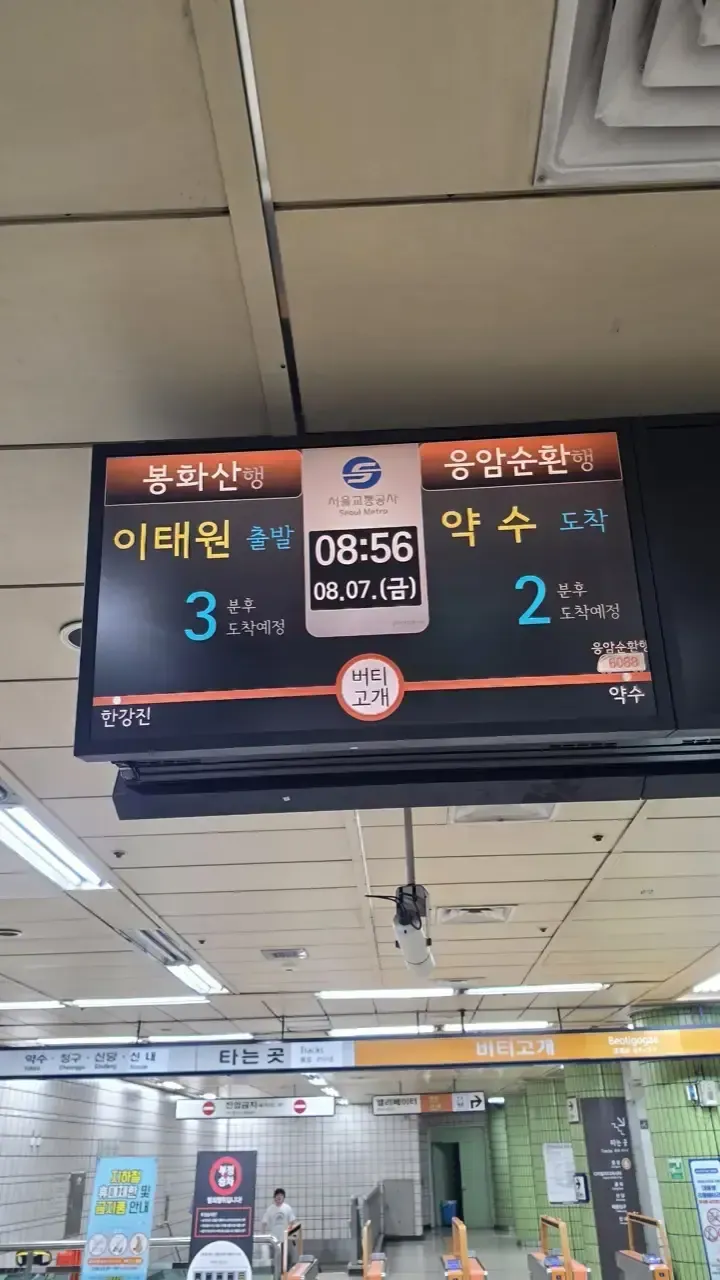
Arrival boards count down in minutes, on every platform · ⓒ @BalliBalliSeoul
Two things worth internalising:
- Trains run roughly 5:30 a.m. to around midnight. There is no overnight subway. Plan your night around that or plan on a taxi.
- Google Maps barely works here. Korean law restricts the export of detailed map data, so driving directions are largely missing and even transit routing is patchy. Install Naver Map or KakaoMap — both have English modes, live arrivals, and will even tell you which carriage to board for the fastest exit.
Stations also have coin lockers, which quietly solve the “checked out of the hotel, flight is at nine” problem:
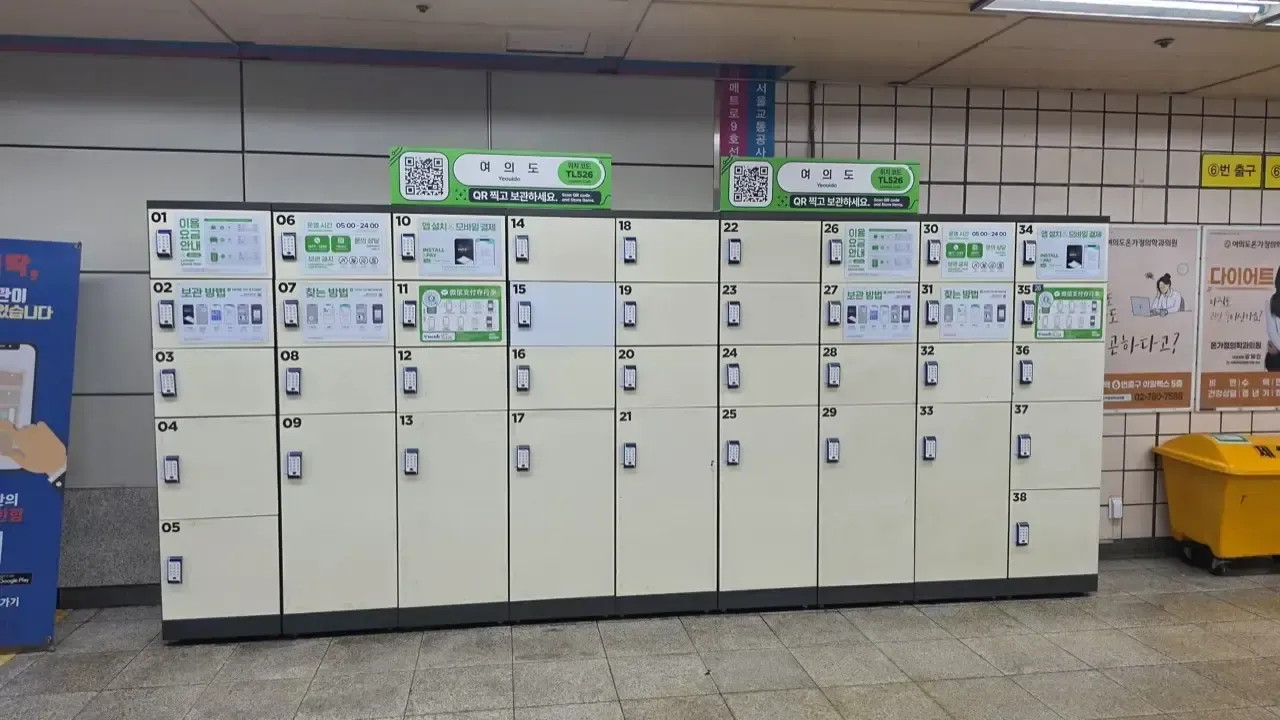
Left luggage, by the hour, in most larger stations · ⓒ @BalliBalliSeoul
And if the bag went the other way — left on the train rather than in a locker — Seoul Metro runs four separate lost property offices, split by line. Which number you call depends on which train you were on, and the car-and-door marker on the platform is what makes the search findable: how to get it back.
Buses: read the colours
The colour of a Seoul bus tells you its job:
| Colour | What it does |
|---|---|
| Blue | Trunk routes across the city on main roads |
| Green | Local routes and feeders to subway stations |
| Red | Express to suburbs and satellite cities |
| Yellow | Short downtown circulators |
| N | “Owl buses” — through the night on major corridors |
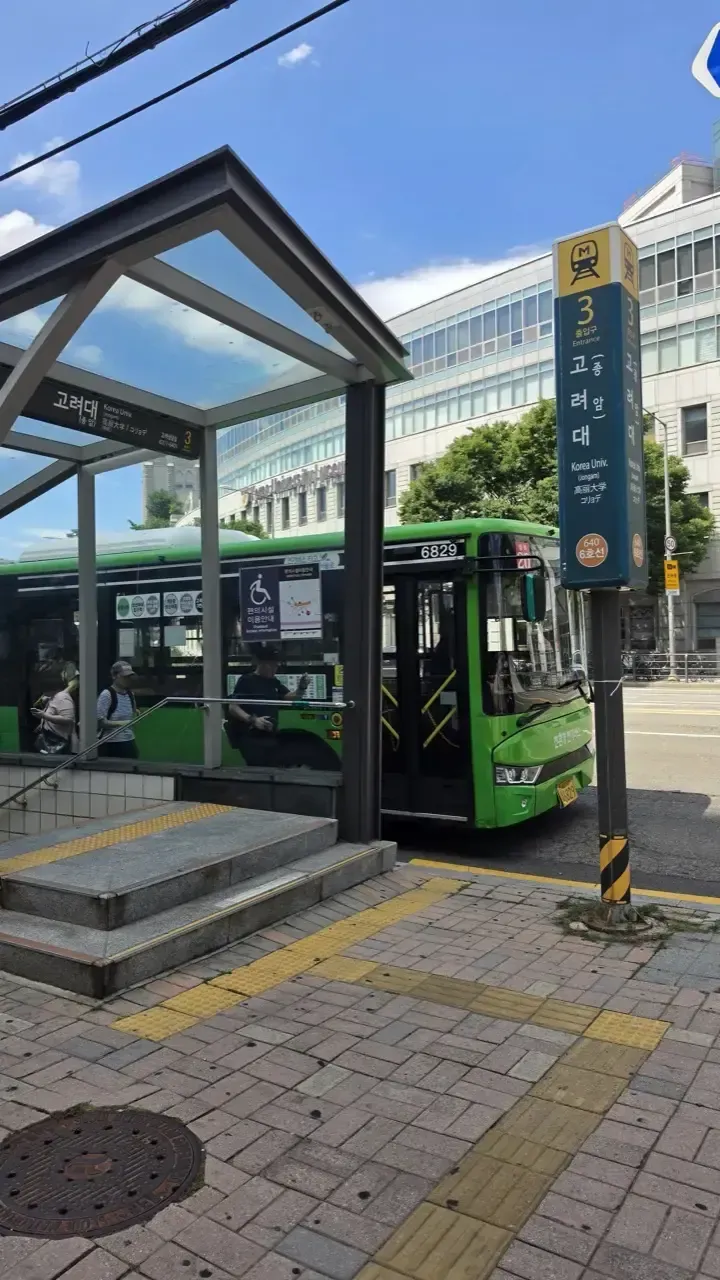
Green means local — and this one is a subway feeder · ⓒ @BalliBalliSeoul
Tap on when you board and tap again when you get off. The exit tap is what preserves your transfer discount; skip it and you can be charged the maximum fare. Buses are effectively cash-free now, so without the card you aren’t riding.
The N buses deserve their own line. When the subway is asleep and it’s raining and every taxi is taken, an owl bus on a main corridor is the answer nobody tells visitors about.
Taxis, Uber and Kakao T
Now the part the Reddit poster actually asked about.
Uber in Korea is not the Uber you know. It doesn’t run a private driver fleet here — it dispatches licensed Korean taxis through the app you already have. Which is good news: Seoul’s taxi fleet is enormous, clean and cheap, and Uber just gives it an interface you can read.
Three reasons it’s the usual recommendation for visitors:
- No Korean verification wall. Your existing account and your foreign card work — the barrier that blocks foreigners from most Korean apps isn’t there.
- Romanised search works. Type “hongdae” and it finds it. No Hangul, no dropping pins in a language you can’t read.
- The destination travels in the app, so the language gap mostly stops mattering.
The meter is sacred — and it never counts heads
Before anything else, the rule that decides how you should travel here:
A Korean taxi charges by distance. Never per person.
One fare per ride. Four people pay exactly what one person pays. There is no “per head” price, no group rate, no negotiation, and nothing to haggle over — the meter runs on distance and time, and that is the entire fare.
If your taxi instincts came from Bangkok, Manila or Cairo — agree a price first, watch for the per-person “special price”, pad 30% for the tourist tax — you can put all of it down. None of it applies.
That single fact is why the maths below works out the way it does: the more of you there are, the cheaper a taxi gets per head, while the subway charges every one of you separately. It’s the opposite of the instinct most visitors arrive with.
Two more things that follow from it:
- No tipping. Not in taxis, not anywhere — the full explanation is here.
- The payment method doesn’t change the number. Card, cash, T-money or in-app, you pay what the meter says.
The one scam vector left is the freelance “taxi?” man in the airport arrivals hall — an unlicensed van, not a taxi, with no meter and no rules. Walk past him to the official rank.
What it should cost — and how to check
This is the anxious question, so here is the actual arithmetic. A Seoul taxi meter, as of 2026:
| Component | Rate |
|---|---|
| Base fare | ₩4,800 for the first 1.6 km |
| Distance after that | ₩100 per 131 m |
| Time, when crawling under ~15 km/h | ₩100 per 30 seconds |
| Tolls | Added on top — normal, not a scam |
| Passengers | Irrelevant. One to four people, same fare. |
The surcharges are where the surprises live, and knowing them kills most “was I ripped off?” anxiety:
| When | Surcharge |
|---|---|
| 22:00–04:00 | Late-night surcharge applies |
| Seoul / Gyeonggi plates | +20% |
| Incheon plates | +30% |
| Late night and crossing a city boundary | Surcharges can stack — reportedly to as much as +60% in the worst case |
That last row explains the ride people complain about online: a 1 a.m. airport run crosses from Incheon into Seoul at night, so it can cost dramatically more than the same trip at 2 p.m. The meter isn’t lying to you; the rules changed at 10 p.m.
For a distance anchor: Incheon Airport to southern Seoul — roughly 62 km — runs about ₩50,000–60,000 in daytime, before tolls. Somewhere closer, like Hongdae, is less. At 1 a.m. it is meaningfully more.
Not sure what your ride should cost?
Tell us the route and the time — “Incheon Airport to Hongdae, landing 1 a.m.” — and we’ll tell you roughly what the meter should read, and what it should not.
Message us on WhatsApp. If you’ve already taken the ride and the number felt wrong, send us the receipt and we’ll read it. Free — this one is just so nobody gets fleeced.
Uber vs Kakao T
| Uber | Kakao T / K.Ride | |
|---|---|---|
| Signing up as a visitor | Existing account works | K.Ride: email + card |
| Foreign cards | Reliable | Now registerable; “pay in car” as fallback |
| Search in Latin letters | ✅ | Mostly wants Hangul or a pin |
| Fare shown | Estimated range | Exact fare upfront |
| Outside Seoul | Thinner | Stronger nationwide |
The playbook most travellers land on: Uber as the main app in Seoul, Kakao T or K.Ride installed as backup — and flip that outside the capital, where Kakao’s network is deeper. Prices are close enough that availability, not fare, should decide.
Street-hailing still works. Read the roof light: 빈차 red = empty, wave it down · 예약 green = booked · 휴무 blue = off duty. Drivers will U-turn for a fare, so don’t ignore the cabs going the other way.
When rides get hard
- Hongdae after 1 a.m. is the classic twenty-minute wait — everyone leaves at once.
- Rain and rush hour collapse availability everywhere. Order earlier than you think.
- Short hops get cancelled sometimes. Not personal; rebook.
The two-person maths
The Reddit poster is travelling as a couple, and that changes the answer more than people expect — because of the rule above. The taxi charges once. The subway charges each of you.
Transit costs roughly ₩1,550–2,000 per person per trip. So:
- Alone, a short hop: subway, obviously. ₩1,550 versus ₩5,000+.
- Two of you, a short hop: you’re already spending ~₩3,500 on transit, against a ₩5,000–7,000 taxi that goes door to door with air conditioning. In August heat, with shopping bags, that gap buys a lot.
- Three or four, a short hop: the taxi is frequently the cheaper option outright.
- Any number, a long crosstown haul at rush hour: subway wins on both money and time, decisively. Seoul traffic is real.
Getting out of Seoul for the day
The bit most transport guides skip. There are three tiers:
1. Still on your T-money card. The metropolitan rail network reaches far further than “Seoul” suggests — Incheon, Suwon, Uijeongbu, Chuncheon on the Gyeongchun Line. Same card, same tap, no booking. If your day trip is inside that network, you’ve already paid for the infrastructure.
2. KTX, for real distance. Seoul to Busan in around two and a half hours; Gyeongju, Jeonju, Gangneung all comfortable day trips. This is a separate ticket, not the T-money card — book on the Korail app (it has an English mode) or at any station counter, and book ahead on weekends and holidays.
3. Intercity and express buses, which cover the towns rail doesn’t and are usually cheaper. Terminals are large, signposted in English, and tickets are sold at machines with an English option.
For a six-day trip based in Seoul, the honest advice is: do your day trips by rail, and don’t rent a car. Parking is genuinely difficult, and the map apps that work here are the ones that assume you’re not driving.
If you do drive, read what to do after an accident in a rental before you need it — it includes a real settlement statement where a light touch with a Porsche came to ₩13.9 million.
Airport connections
From Incheon, the AREX train runs two flavours: the all-stop train, which takes your T-money and connects straight into the subway, and the Express, which runs nonstop to Seoul Station with reserved seats. Airport limousine buses cost more but stop near major hotels and take your suitcases underneath — the right call with heavy luggage.
Taxis and app taxis work too; expect highway tolls on top of the meter, which is normal and not a scam.
If the “luggage” in question is closer to a household than a suitcase — arriving to move in, or leaving with everything you own — that’s a van and a crew, not a taxi, and it’s what our moving service arranges.
The Korean part
The system is unusually foreigner-friendly. The friction is all at the edges: which pass fits your commute, a top-up machine that switches to Korean, a 5 a.m. airport run with three suitcases and a van taxi that needs booking by phone, a KTX seat on a holiday weekend.
That’s the errand our anything-else concierge service handles — we’ll tell you which card to get, book the awkward leg, and write your destination in Korean so you can show a driver.
Get it sorted
Not sure which one to use, or stuck at a machine? Message us on WhatsApp — tell us where you’re going and we’ll give you the route in English, and book it if it needs Korean. Asking costs nothing — you pay only for the work you book.
The one-line version: subway by day, taxi after midnight, Uber in Seoul and Kakao outside it, the card covers day trips as far as Chuncheon, and KTX for anything beyond. Nobody needs a car.