T-money Card Korea: Buy One, Tap Everywhere, Transfer Free
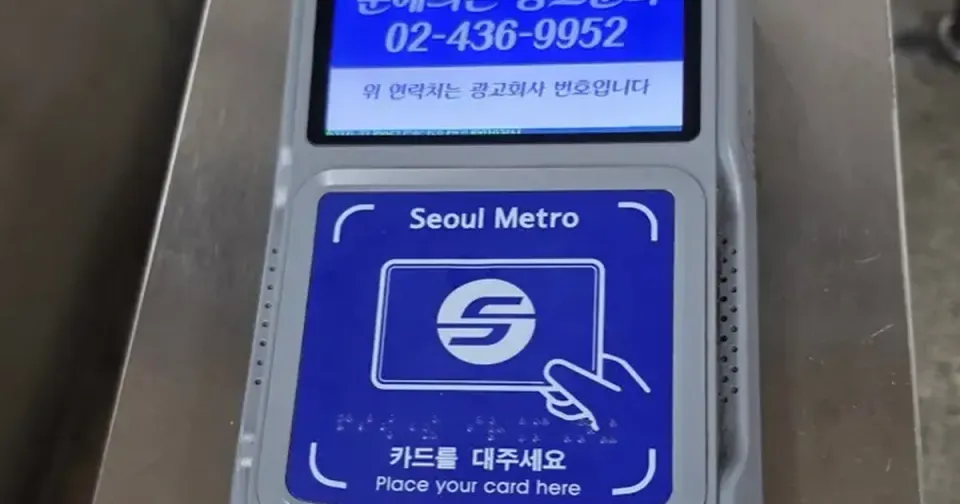
Every Korea trip planner eventually falls into the transit-card rabbit hole: T-money versus Cashbee versus tourist passes versus “can I just pay cash on the bus?” Here’s the answer that saves you the evening: walk into any convenience store, say “T-money card please,” pay a few thousand won, load some cash on it, and you’re done.
Don’t optimise this. The card is cheap, it works on almost everything, and the thing it unlocks — Seoul’s free transfer network — is the actual prize.
Buying one takes ninety seconds
Any GS25, CU, 7-Eleven or emart24 sells T-money cards at the counter. “T-money card juseyo” works; honestly, “T-money?” works too. The card costs a few thousand won (₩3,000–5,000 depending on the design, as of 2026), and then you top it up in cash at the same counter — ₩10,000 or ₩20,000 is a sensible start.
Carry notes for this one. At a convenience store counter, a top-up is a cash transaction — this is the single errand in Korea that still wants paper money.
Station machines are the exception, and a useful one:
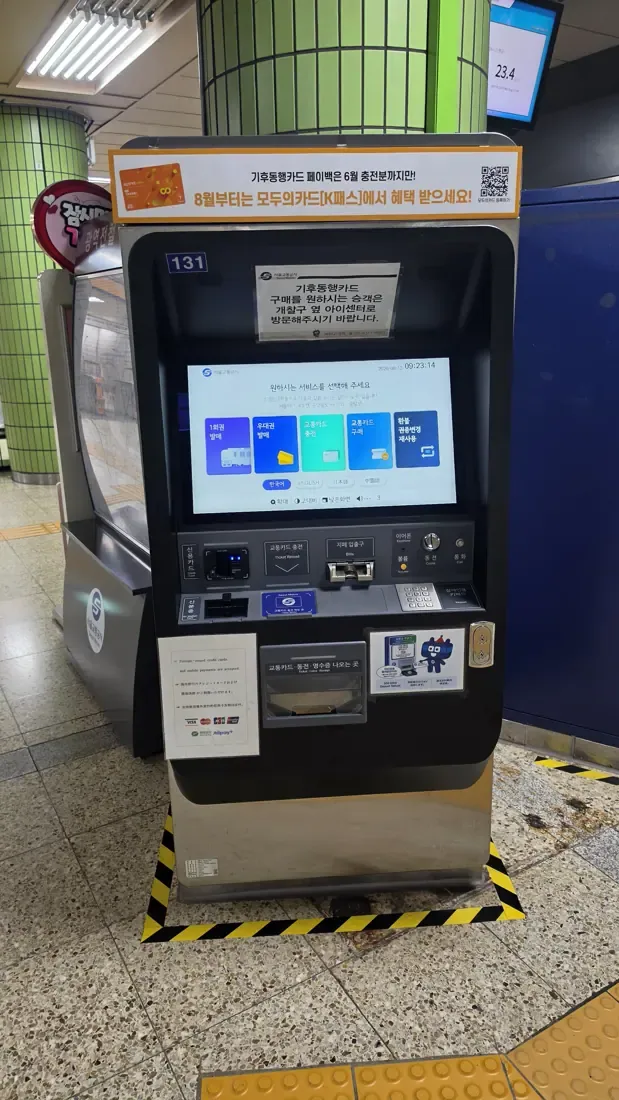
Note the placard on the left · ⓒ @BalliBalliSeoul
The machines take coins and notes, but they also have a credit card slot, and the placard taped to the side says it plainly: “Foreign-issued credit cards and mobile payments are accepted” — Visa, Mastercard, JCB, UnionPay and Alipay+. So if you land without won, a station machine is the better bet than a shop counter.
They all run in English, too. Press ENGLISH and the menu becomes five plain buttons:
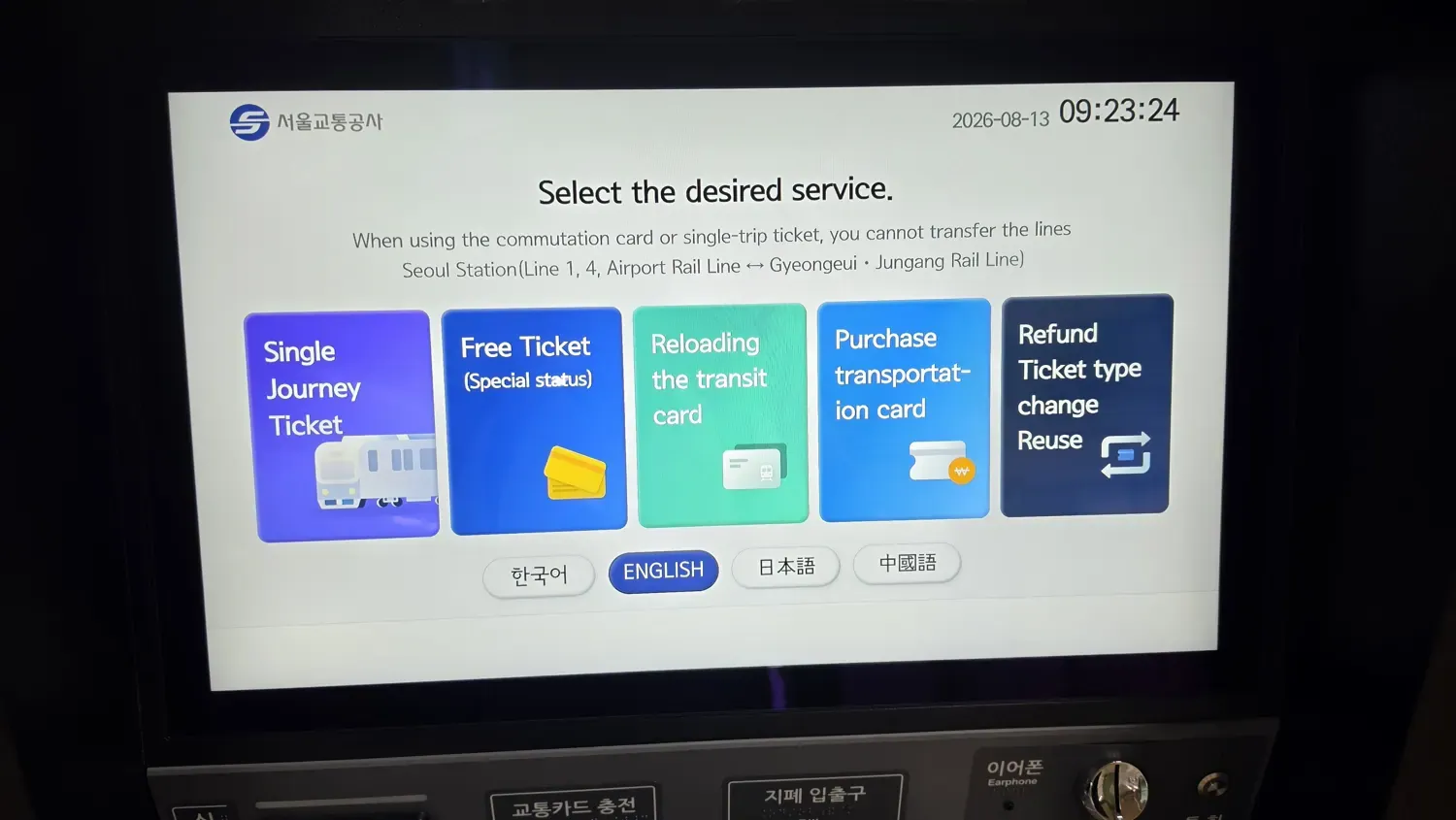
Buy a card, reload it, or get your deposit back — all in English · ⓒ @BalliBalliSeoul
“Purchase transportation card” buys you the plastic; “Reloading the transit card” tops it up. The screen also warns about something easy to trip over: a single-journey ticket does not transfer between lines at certain interchanges — another reason to hold a proper card.
Mobile T-money in your phone’s wallet exists, but effectively requires a Korean-verified phone number — visitors should just carry the plastic.
The transfer system is the whole point
Here’s what the card actually buys you. Seoul’s fare isn’t charged per vehicle — it’s charged per journey. Tap in, ride, tap out, and your next leg within 30 minutes counts as a transfer, not a new fare:
- Subway → bus? Transfer.
- Bus → subway? Transfer.
- Bus → bus → subway? Still one journey — up to four transfers.
You pay the base fare once (₩1,550 by card for an adult on the Seoul subway, as of 2026) plus small distance increments, instead of paying again for every vehicle you board. A three-leg crossing of the city costs a cash payer three separate fares and a card holder one. The full rate card — youth and child fares, the distance bands, and what a single-journey ticket costs on top — is in our Seoul subway fare guide.
So: is the card worth it for a short trip? It pays for itself in about two transfers.
The one habit to build: always tap out
On buses, tap the reader again as you get off — even when the door is open and everyone is pushing past you.
No tap-out means no transfer credit, and on distance-based routes it can also mean being charged the maximum fare. It takes half a second and it is the single most common mistake visitors make.
On the subway you can’t forget, because the gate won’t open.
Cash is quietly being retired
If you were planning to feed coins into a bus: increasingly, you can’t. Many Seoul buses have removed the cash box entirely, and those that still take cash charge more per ride — with no transfer rights at all. Cash on transit is now the expensive legacy option.
The subway still sells single-journey tickets from machines, but each one carries a ₩500 deposit you have to reclaim at your destination, from a machine like this:
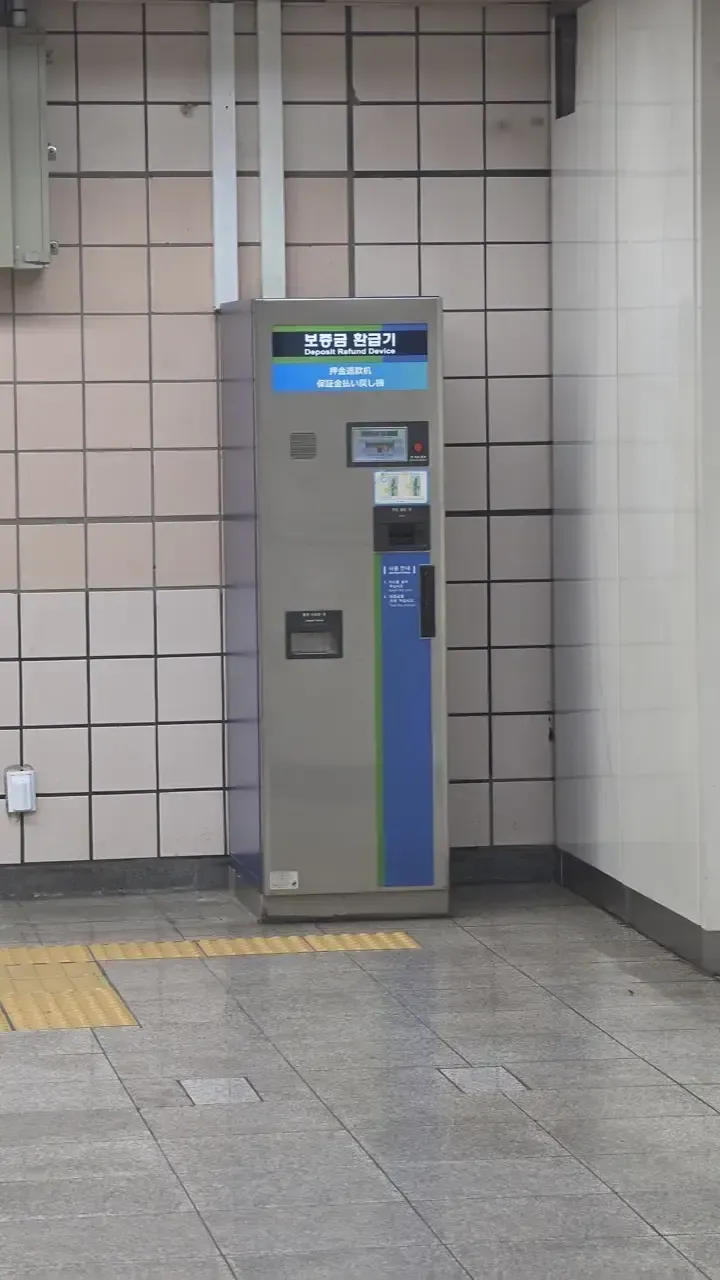
The ₩500 you get back — one of these sits inside every station · ⓒ @BalliBalliSeoul
It works fine. It’s just a small chore repeated at both ends of every single ride, which is exactly the thing the card abolishes.
Buses: how to read the stop
Bus stops carry an LED display showing which numbers are coming and how many minutes away they are — the same information the apps give you, in a format you can read while standing there.
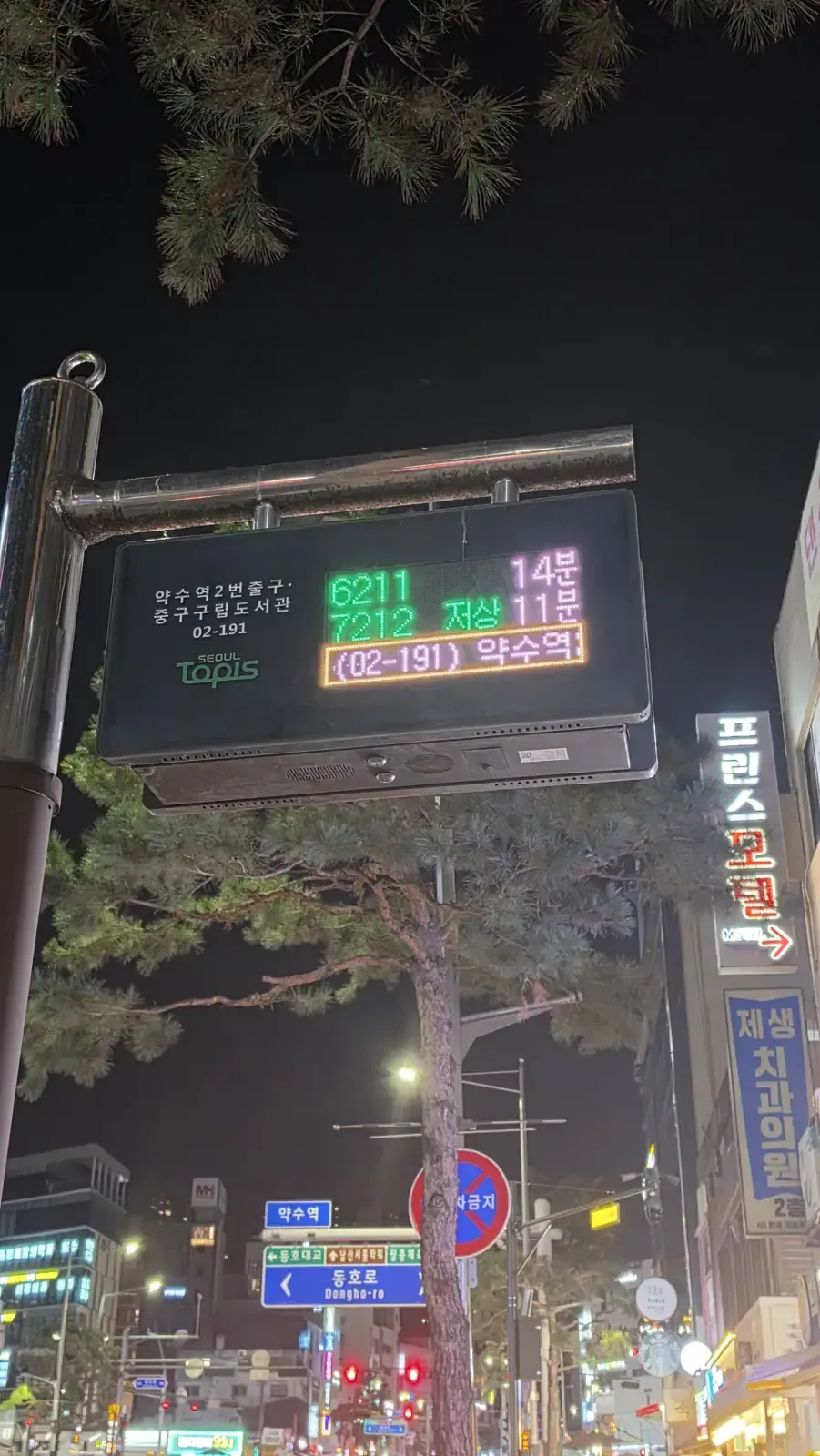
Two numbers, two waiting times · ⓒ @BalliBalliSeoul
Three things worth knowing before your first bus:
- Board at the front, tap. Leave by the back, tap again.
- Press the bell before your stop. Drivers don’t stop by default at quieter stops.
- Hold on. Seoul bus drivers move off promptly; find a rail before the bus does.
The comfort of the stops themselves — heated seats in winter, air conditioning in summer — is one of the things that quietly surprise people here.
Where the card works
One card covers more than most visitors expect, as of 2026:
| Works on | Notes |
|---|---|
| Seoul subway + all buses | The core use — with transfers |
| Metro systems nationwide | Busan, Daegu, Daejeon, Gwangju and more |
| Taxis | Accepted — though a long fare drains the balance fast, so pay taxis by credit card. No tipping, either way |
| Convenience stores | Tap to pay for snacks and drinks |
| Some intercity and airport transit | Coverage keeps expanding |
Buy it at the airport convenience store the hour you land and it stays useful until the hour you leave.
Monthly passes: don’t build a plan around them right now
If you’re staying months rather than days, unlimited passes can beat pay-per-ride at roughly 40+ rides a month. But this is the one part of Korean transit currently in flux, so treat any article you read — including this one — as a snapshot:
- Seoul’s Climate Card (기후동행카드) is being wound down, and we have written up what replaces it and by when in full. A banner on the ticket machines in August 2026 put it bluntly: payback applies only to top-ups made through June, and from August the benefits move to “모두의카드” — the K-Pass.
- The machines have also stopped selling the Climate Card altogether. A notice taped to the screen sends buyers to the i-Center beside the fare gates instead.
- From 1 October 2026 the short-term Climate Card narrows to journeys within Seoul city limits.
There’s also a practical catch that outlives any policy change: plain T-money recharges at every convenience store in the country, while the special passes generally only recharge at subway station machines. That’s a small thing until it’s 11 p.m., your balance is short, and you’re at a bus stop nowhere near a station.
For a visit measured in days or weeks, plain T-money wins on flexibility alone. For a long stay, check the current rules at the time you commit — not from a blog post.
Leaving Korea: get your balance back
Don’t donate the leftover money to the card. Any convenience store can refund a remaining balance under ₩20,000, minus a small service fee — hand over the card, take the cash.
Keep the card itself as a ₩4,000 souvenir, or for next time: balances don’t expire.
The Korean part
The card is the easy half. The hard half is a bus route that branches, a station with fourteen exits, or a destination you can’t pronounce to a driver.
Send us where you’re trying to get to and our anything-else concierge service will write it out in Korean, map the route, and sort the awkward legs — the 5 a.m. arrival, the three suitcases, the last bus you just missed.
Get it sorted
Not sure which card, or how to get somewhere? Message us on WhatsApp — we’ll map it in English and write your destination in Korean to show a driver. Asking costs nothing — you pay only for the work you book.
The one-line version: convenience store, “T-money juseyo,” top up with cash, always tap out, refund the balance before you fly. That’s the whole transit-card question — now go and spend the evening you just saved.