Seoul Subway Fares: What It Costs, Plus a 6:30am Discount
You tapped in at Hongdae and out at Gangnam and the gate took ₩1,550. Your friend rode two stops and paid the same. Someone else went to Suwon and paid more. The Seoul subway is not a flat fare and it is not a zone system — it charges by how far you actually travelled, and it only knows how far you went if you tap on the way out.
Here is the whole fare structure, taken from Seoul Metro’s official fare page, turned into the numbers you’ll actually meet. Fares below are as of 2026-08.
The base fare, and what pushes it up
Everything starts from one number and grows by distance. The shortest route between your two stations is what counts — not the route you actually rode, so taking a scenic detour doesn’t cost you extra.
| Rider | Base fare (up to 10 km) | 10–50 km | Past 50 km |
|---|---|---|---|
| Adult | ₩1,550 | +₩100 per 5 km | +₩100 per 8 km |
| Youth (13–19) | ₩900 | +₩80 per 5 km | +₩80 per 8 km |
| Child (6–12) | ₩550 | +₩50 per 5 km | +₩50 per 8 km |
These numbers are newer than much of what’s written about Seoul in English. The metropolitan fare rose from ₩1,400 to ₩1,550 for an adult card on 28 June 2025, across Seoul, Gyeonggi and Incheon together. If a guide quotes you ₩1,400 — and plenty still do — it was written before that date. The distance surcharges above were left unchanged in the same revision.
Those are transportation card fares — a T-money or Cashbee card, or a card-linked phone. If you don’t have one yet, our T-money card guide covers buying one at a convenience store in about ninety seconds.
Worked example, adult card: a 25 km ride is 10 km of base fare plus three more 5 km bands, so ₩1,550 + ₩300 = ₩1,850. Most rides inside Seoul proper never leave the base fare at all — the city is smaller than the map makes it look.
Two things stretch the distance beyond the ordinary rules:
- Past 50 km, the surcharge interval widens from every 5 km to every 8 km. Long trips get proportionally cheaper, not more expensive.
- Outside the Greater Seoul area — the Pyeongtaek–Sinchang and Gapyeong–Chuncheon stretches — the metropolitan fare is applied first, then ₩100 is added for every 4 km of the outer section. That’s the one part of the system that gets more expensive per kilometre, and it’s why a run out to Chuncheon costs what it does.
You never have to do this arithmetic yourself. Naver Map and Kakao Map both show the exact fare for a route before you ride it, and they’re the same apps you’re already using for directions.
Tap out. Every time.
This is the single rule that costs travellers real money, and it’s the one nobody tells you at the airport.
Korean fare gates read your card on the way in and on the way out. The tap-in starts the journey; the tap-out is what tells the system how far you went. Skip the tap-out — walk through an open gate behind someone, or use an exit where you didn’t touch the reader — and two things happen:
- You lose your free transfer. Each leg of the trip gets billed as a separate journey at full base fare.
- On distance-based routes you can be charged the maximum fare for that line, because the system has no idea where you got off and assumes the worst.
The reader is the panel that lights up and beeps. If it didn’t beep, it didn’t read. This applies to buses too, which is where most people slip up — tapping on when boarding feels natural, tapping off when alighting doesn’t.
Transfers are where the system pays you back
Seoul doesn’t charge you per vehicle. It charges you per journey, across subway and bus together, and that’s the part that makes the fares above better than they look.
- Subway → bus? One journey.
- Bus → subway? One journey.
- Bus → bus → subway? Still one journey.
You pay the base fare once and keep going, up to four transfers — five legs in total. Beyond 10 km the usual ₩100-per-5 km surcharge applies to the combined distance, so crossing the whole city on three vehicles costs a card user a fraction of what it costs someone paying each leg separately. Where several types of transport are involved, the highest base fare among them is the one charged.
Two conditions:
- The window is 30 minutes from tapping off one vehicle to tapping onto the next. Miss it and the next leg is a fresh journey at full fare.
- Between 21:00 and 07:00 the window doubles to 60 minutes. Late-night connections are thinner, and the fare system quietly accounts for it. This is worth knowing if you’re heading home after dinner and the bus you want is twenty-five minutes out — you’re still inside the window.
For the metropolitan, Gyeonggi express and Incheon express buses, the free transfer distance runs to 30 km rather than 10 km before surcharges start.
Stuck on the Korean part? Message us on WhatsApp — we’ll work out the route, the fare and which exit you actually want, in English. Asking costs nothing — you pay only for the work you book.
The 6:30am discount nobody mentions
From the start of service until 6:30am, transportation card users get 20% off the fare. Not a special ticket, not a registration — you tap as normal and the gate charges less.
The one exclusion: it doesn’t apply to a leg you’re transferring onto after already riding something else. It’s a discount for starting your journey early, not for being mid-journey at 6:29.
Most visitors will never use this. But if you’re catching an early train out of Seoul Station, or you’re on the way to a fish market that opens before dawn, you’re already awake and inside the window — and the discount applies whether or not you knew about it.
Single-use tickets cost more — and teenagers pay full price
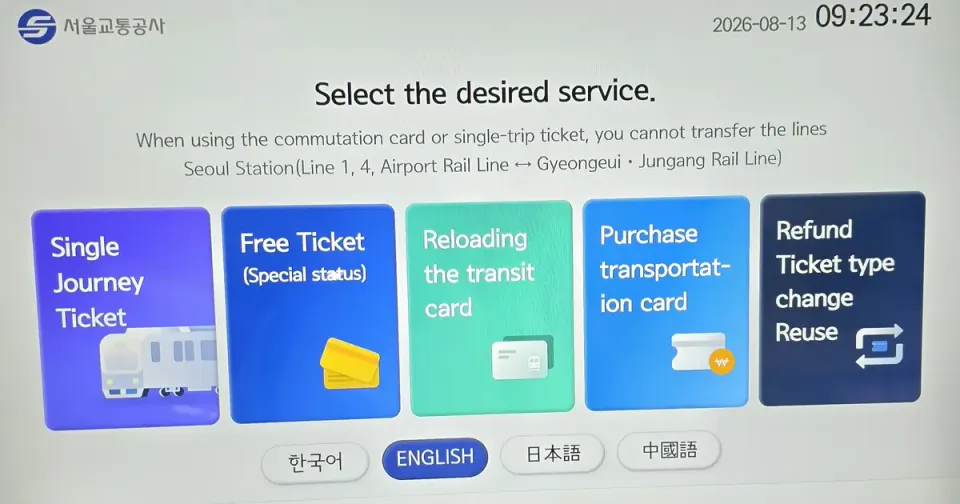
If you’re not using a card, you buy a single-journey ticket from a machine in the station — the screen at the top of this page, with English on it. It costs ₩100 more than the card fare, so an adult base fare becomes ₩1,650.
The machine will also take a ₩500 deposit on top. That isn’t a fare — it’s a returnable deposit on the plastic card itself, and you get it back by feeding the used ticket into a deposit refund machine, which sits inside every station. So an adult single ride actually costs ₩2,150 at the machine and ₩1,650 once you’ve collected the ₩500. Miss the refund machine on the way out and you’ve simply paid ₩500 for a piece of plastic.
Here’s the trap for families: on single-journey tickets, youths pay the adult fare. The ₩900 youth rate exists only on transportation cards. A child (6–12) still pays ₩550 either way. This isn’t an oversight in the tables — the June 2025 revision raised the youth single-journey price in step with the adult one, keeping the two identical.
| Card | Single-journey ticket | |
|---|---|---|
| Adult | ₩1,550 | ₩1,650 |
| Youth (13–19) | ₩900 | ₩1,650 — adult price |
| Child (6–12) | ₩550 | ₩550 |
For a family of four with two teenagers, a week of single-journey tickets versus cards is a meaningful gap — and single-journey tickets earn no transfer credit either. Buy the cards.
There’s one more restriction the fare tables don’t mention, and it’s printed on the ticket machine screen itself — you can read it on the cover photo above: at Seoul Station, a single-journey ticket or a commuter ticket can’t be used to transfer between Line 1, Line 4 and the Airport Railroad on one side and the Gyeongui–Jungang Line on the other. Those platforms sit behind separate gates. A transportation card handles the move; a paper ticket doesn’t. Seoul Station is exactly where a visitor is most likely to attempt that transfer, coming in from the airport.
Who rides free
The system carries a number of riders at no charge:
- Seniors aged 65 and over
- Registered disabled persons, including one guardian for severely disabled riders
- Persons of national merit, including one guardian in the applicable categories
- Toddlers under 6 — one guardian may bring up to three free. From the fourth toddler, the child fare applies.
The senior and disability exemptions are tied to Korean registration, so a visiting 70-year-old on a tourist visa pays the adult fare. The toddler exemption has no such condition — young children ride free regardless of where you’re from.
Staying longer: commuter tickets
If you’re commuting daily rather than sightseeing, the 정기권 (jeonggigwon) — commuter ticket — is priced as your base fare × 44 rides, less 15%. For travel inside Seoul that works out to ₩68,200, and distance-based versions run up to ₩129,000 across 18 pricing tiers.
It gives you 60 rides within 30 days, and it expires at whichever comes first — the 60th ride or the 30th day. Since 44 rides’ worth of money buys 60 rides, it pays off from roughly the 45th ride onward. That’s a genuine commute, not a holiday.
Seoul also runs short-term tourist passes and a monthly unlimited pass, but that side of the system is being restructured through 2026 as the city’s Climate Card is wound down and its benefits move to the national K-Pass — the dates and the switch are here. We track what the ticket machines are actually saying about it in the T-money guide, because it has been changing faster than most guides update. The plain fares in this article are the part that isn’t changing.
The Korean part
The fares themselves are handled in English: ticket machines have an English mode, the gates are pictographic, and Naver Map will tell you what a ride costs before you take it.
Where English runs out is everything around the fare. A card that stops reading, a gate that charges you the maximum because a tap-out didn’t register, a refund on an unused single-journey ticket, a lost card with money on it — those are conversations at the station office, in Korean, with a staff member who may not have English.
That’s the kind of thing we sort out. If a gate has taken money it shouldn’t have, or you’re stuck at a station office trying to explain something, send it to us and we’ll make the call in Korean for you.
For the rest of the network, see our guide to getting around Seoul for when the subway isn’t the right answer, and the subway lines cheat sheet for what each colour actually gets you. And if something of yours stayed on the train after you got off, that has its own procedure — we wrote it up in what to do when you lose something on the Seoul subway.
Source: Seoul Metro — Fare. Last verified: 2026-08-18.