K-Pass Korea for Foreigners: 20% Refund, and When It Lands
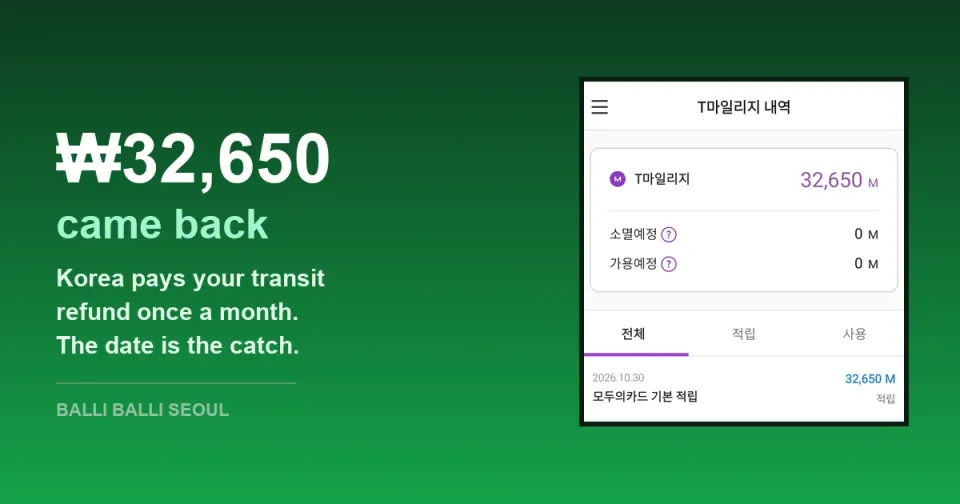
K-Pass gives you 20% of your public transport spending in Korea back, and most foreign residents who qualify never collect it. Not because the scheme is hard, but because it has been renamed twice, the English guides are out of date, and the money arrives weeks after you stopped expecting it.
Here is the screen that prompted this post. One line, one payment, dated 30 October 2026.
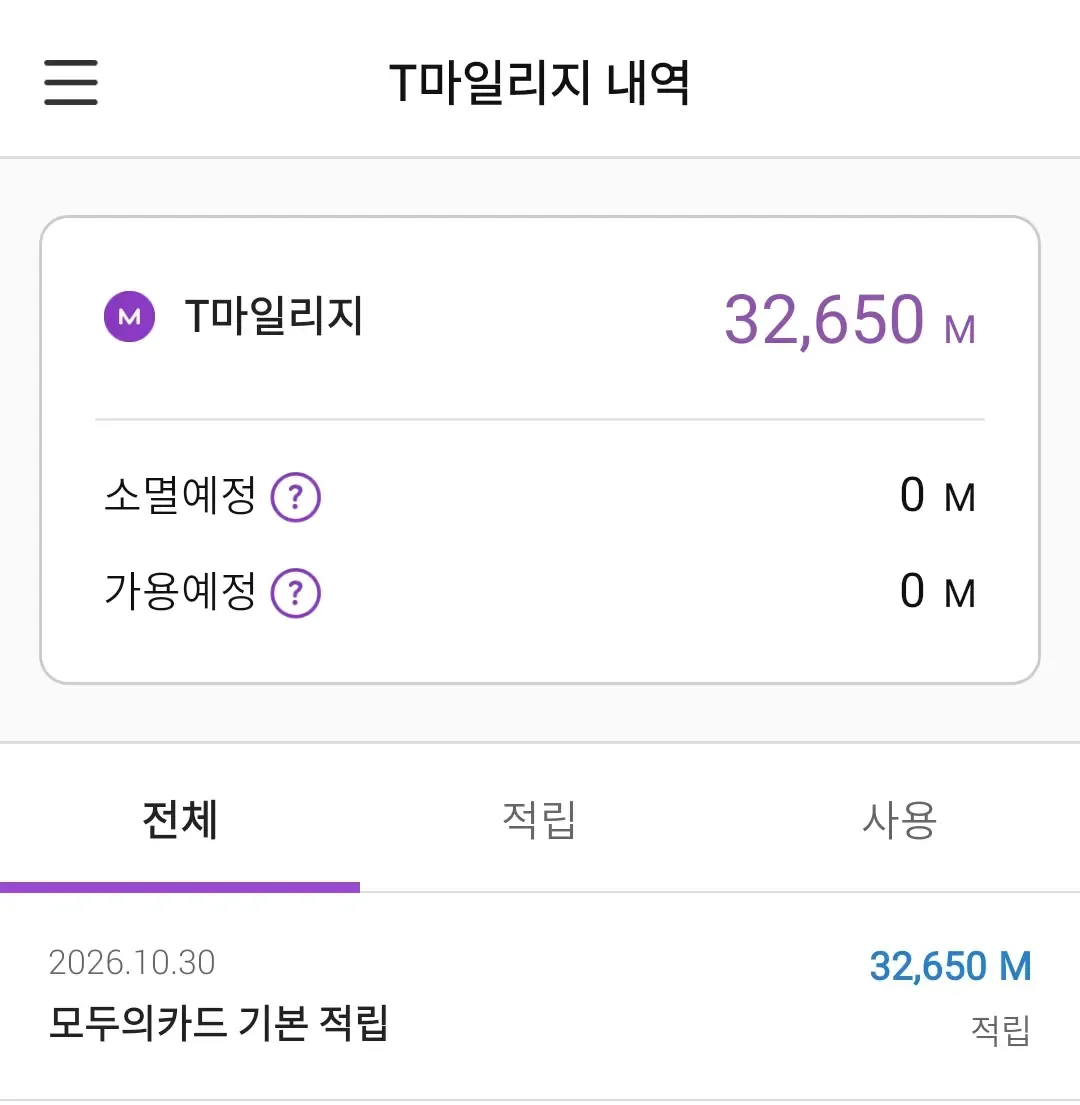
32,650 mileage points, which top the card up one-for-one with won. That date is not a coincidence, and it is the part no English guide gets right.
Why is K-Pass now called Modu Card?
This is why your search results contradict each other:
| When | Called |
|---|---|
| until April 2024 | 알뜰교통카드 (Almoon transport card) |
| May 2024 – August 2026 | K-Pass (K-패스) |
| since 12 August 2026 | 모두의카드 / Modu Card (“everyone’s card”) |
K-Pass and Modu Card are one scheme the whole way through — same operator, same refunds, no reapplying. English-language pages still say K-Pass, Korean pages and apps now say 모두의카드, and both describe the same card in your wallet. This post uses K-Pass throughout, because that is still what English speakers search for.
The official site is korea-pass.kr, and it is Korean-only. There is no language switcher and the official app ships in Korean alone. Budget for a translation app or a Korean-reading friend.
The question that decides everything: do you have an ARC?
Before any of the numbers matter, there is a gate.
The sign-up page says “외국인도 OK!” — foreigners welcome — and that is true as far as it goes. But registration runs through Korean identity verification: a bank certificate, a phone check tied to a Korean number in your own name, a 공동인증서, or a Kakao/Naver account that was itself opened with one. All four assume a Korean resident registration or an alien registration number.
| Your situation | Realistically |
|---|---|
| Hold an ARC | Get the card, register, collect every month |
| Applied, waiting for the card | Wait. Use an ordinary transit card meanwhile |
| Staying 90 days or less | No ARC exists for you. See the last section |
Under the Immigration Act, foreign nationals staying more than 90 days register within 90 days of arrival. Short visitors have no number to enter, so the form stops them. If you are still at the stage of getting that identity layer working at all, the same wall blocks banking — opening a bank account in Korea covers it.
And one trap that costs people their first month: getting the card is not joining. Trips taken before you register the card number do not count. Card in hand, then register, then start riding.
How much does K-Pass actually refund?
The K-Pass refund is a percentage of what you spent. You do not pick a tier; the system applies whichever is better for you.
| You are | Base rate | In the staggered hours |
|---|---|---|
| General, 35–64 | 20% | 50% |
| Youth, 19–34 | 30% | 60% |
| Senior, 65+ | 30% | 60% |
| Two children | 30% | 60% |
| Three or more children | 50% | 80% |
| Low income | 53.3% | 83.3% |
Those boosted rates apply when you tap in during 05:30–06:30, 09:00–10:00, 16:00–17:00 or 19:00–20:00 — a congestion measure that pays you to travel off-peak. Shifting your commute by an hour moves a general rider from 20% to 50%.
This boost was due to end on 30 September 2026. On 28 September the ministry extended it to 31 December 2026, and it is expected to be written into the 2027 budget.
What did end on 30 September
There is a second refund style — a spending threshold, where everything above a monthly figure comes back in full. Between April and September 2026 that threshold was cut by half. That cut expired with September’s travel.
| Seoul area threshold | Apr–Sep 2026 | From October |
|---|---|---|
| Standard | ₩30,000 | ₩62,000 |
| Plus (incl. express buses, GTX) | ₩50,000 | ₩100,000 |
If you read a guide written over the summer — and most of the English ones were — it will quote the cheap thresholds. They are gone. The off-peak percentages are the part that survived.
Fifteen trips a month — and what K-Pass counts as one
K-Pass needs 15 or more trips in a calendar month. Miss it and that month pays nothing. Your first month after joining is exempt.
A “trip” is not a tap. It is a journey: from your first boarding until the transfer window closes, up to four transfers in the Seoul area. Bus to subway to village bus on one commute is one, so a normal working day earns you two. The old caps — two per day, sixty per month — were both scrapped in 2026, so there is no ceiling any more.
If the transfer rules themselves are the confusing part, they are set out in Seoul subway fares.
What earns a K-Pass refund, and what does not
Earns: city, town and express buses · subway and metropolitan rail, including GTX and the Shinbundang line · the airport railroad’s ordinary trains.
Does not earn: intercity and express coaches · airport buses · the airport railroad’s express train · KTX and SRT.
The rule underneath is simple: if you buy a ticket rather than tap a card, it does not count. Which produces the trap worth memorising — going to Incheon, the train earns and the bus does not.
Where you ride does not matter. Registered in Seoul and riding in Busan still earns. Since February 2026 every district in the country takes part.
When does the K-Pass refund actually arrive?
This is the part that sends people to the help desk, and it is where the English guides are simply wrong.
The refund moves in two stages, and most articles only describe the first:
- The scheme totals your month and sends the money to your card company on the 7th working day of the following month.
- Your card company then pays you on its own schedule — and those differ by up to 22 days.
Stage one is the number everyone quotes. Stage two is the one you actually experience.
| Your card | You are paid |
|---|---|
| Shinhan, Samsung, Woori, NH, Hana, Lotte, BNK Busan | 7–10 working days |
| Jeonbuk, K-Bank, Shinhyup | the 15th |
| Kakao Bank, EZL, Naver Pay, Kakao Pay | the 20th |
| Rail Plus | the 20th–25th |
| Toss Bank | the 25th |
| KB Kookmin, T-money | the last working day of the month |
| BC, Hyundai, IBK, Gwangju, BNK Gyeongnam | on your statement date |
T-money’s own wording is unambiguous: credited as T-mileage “on the last working day of the month following the month of use, excluding weekends and holidays.”
So the screenshot at the top is the system working correctly. September’s travel, paid on Friday 30 October 2026 — the last working day, because the 31st was a Saturday. Had we been on a Shinhan card, the same money would have arrived around 9 October, three weeks earlier.
Mobile T-money is the route many foreign residents take, because it needs no Korean credit card. It is also the slowest-paying option on the list. That is a fair trade, but it is worth knowing before you conclude your refund has been lost. Our T-money card guide covers the card itself.
Two more timing notes. Trips take up to two weeks to appear in your history, so a missing journey today is usually not missing. And refunds are paid from a budget — in December 2024 some districts paid out reduced amounts when the money ran low. It is rare, but it is not guaranteed.
No ARC? What to use instead
No ARC means no K-Pass registration, and no refund. Seoul’s own guidance points short-term visitors to the Climate Card short-term pass (1, 2, 3, 5 and 7 days, ₩5,000–20,000) instead.
It is the opposite design: a flat pass, no sign-up, no identity check, no 15-trip rule, nothing to collect later. The trade-offs are that it covers Seoul only — no GTX, no Shinbundang, no express or airport buses, no subways in other cities — and it cannot be loaded in advance, so you charge it the day you start.
The 30-day Climate Card was wound down this autumn and folded into this scheme; the short-term passes continue. What replaced what, and on which dates, is in Seoul’s Climate Card is ending.
For everything a transit card does not cover — KTX, intercity coaches, taxis between cities — see getting around Seoul.
Get it sorted
If you hold an ARC and ride more than fifteen times a month, this is free money you are currently leaving behind: roughly ₩30,000 back on ₩150,000 of travel, and more if you can move a daily trip into an off-peak hour.
The two things that stop people are both fixable. Register the card, not just order it — trips before registration do not count. And check the right date for your card before deciding the refund never came.
The Korean part is what we do. If the sign-up screen stops you, or the card company’s Korean-only help desk does, describe it in English on KakaoTalk and we will tell you whether it is something we can take on. Asking costs nothing, and if it is not ours, we will say so and point you at who it belongs to.
Rates, thresholds and payment dates are as published in October 2026, and this scheme has been revised every year it has existed. The off-peak boost is confirmed only to 31 December 2026. Check korea-pass.kr before you plan around any figure here.