Emergency Cleaning in Korea: Two Hours Before They Arrive
The message arrives at eleven in the morning. The landlord is coming at two. Or the boiler technician. Or your partner’s parents, who are already on the train. And your flat looks like your flat.
This page is for the next two hours. Not for getting your home clean — for getting the mess level down far enough that nobody comments, in the time you actually have, without buying anything.
There is a version of this advice on every English-language cleaning site, and the first step on all of them does not work in Korea. So start there.
Why does the usual advice break here?
Every emergency-cleaning checklist written in English begins the same way: gather all the rubbish and take the bags out.
In Korea that instruction can be illegal at eleven in the morning.
Three things make it so, and they are worth knowing cold:
- Bags are district-specific. General waste goes only in your district’s official 종량제 봉투, bought at a convenience store counter. A Mapo bag does not work in Gangnam, and a black bin liner on the pavement is the thing that gets you fined.
- Districts set put-out hours, usually an evening window on the collection night — not whenever you are panicking.
- Food waste is separate and mandatory, and so is recycling by material.
Fines commonly start around ₩100,000, residential dumping spots are on camera, and building offices do check. The whole system, once and for all is the long version.
So the rule for today is: bag it, do not bin it. Everything gets sorted into tied bags and staged out of sight. The bags leave the building tonight, at the hour your building actually collects. That single change makes the rest of this plan work.
Do not know your building’s night? That is one Korean phone call to the 관리사무소, and it is the one thing on this page we can genuinely do for you in the next ten minutes. Message us on KakaoTalk with your address — we will ring them and tell you the night, the hour and the spot. No charge, and nothing to book.
Before you touch anything: who is coming?
Twenty seconds of thinking here saves you forty minutes of cleaning the wrong room. Different visitors look at completely different things.
| Who is coming | What they actually see |
|---|---|
| Boiler, aircon or appliance technician (기사님) | The route from the front door to the machine, and the space around it. Nothing else. They have seen worse today |
| Landlord or estate agent | Walls, ceilings, window frames, the balcony. They are checking the building, not your tidiness |
| Agent bringing viewers | Light and floor space. Clutter reads as “small flat” |
| Friends, a 집들이 | The 현관, wherever they sit, and the bathroom |
| Your partner’s parents | The kitchen sink and the bathroom. In that order |
Two of those are liberating. A technician needs a path and a metre of clearance, and that is twenty minutes of work, not two hours. A landlord checking for damp is not scoring your laundry pile — if anything, you want them looking at the ceiling corner you have been meaning to report.
Pick the row that applies and clean for that person. Everything below assumes the hardest case: people who are going to sit down.
The two-hour plan
Set a timer on your phone for each block. The timer is not a gimmick — the single biggest failure in a panic clean is spending fifty minutes on one drawer.
0:00–0:15 — supplies, and somewhere to put things
Use what you own. Do not spend your first half hour shopping, and do not order anything: even Korea’s overnight delivery arrives tomorrow, which is after the problem.
If you genuinely have nothing, 다이소 is the five-minute answer and three items cover almost everything: 물티슈 (wet wipes), 청소포 (disposable floor sheets for a flat mop), and a pack of rubber gloves. Buy your 종량제 봉투 at any convenience store counter on the way back — ask for them by name and by size, and say your district.
Then decide where things go while you work. You need a staging area that is not the middle of a room: the 베란다, the 다용도실, or one bedroom whose door stays shut.
One warning about that, because this is how Korean flats end up with a balcony nobody uses: a staging area is temporary. Write yourself a note with tomorrow’s date on it. If you are honest that it will not get undone, you are not emergency cleaning, you are putting off a sort-out that needs its own day.
0:15–0:40 — bag it, don’t bin it
One bag in each hand, one room at a time, and do not stop to make decisions.
- General waste into the 종량제 봉투.
- Recycling into a separate bag — paper, plastic, PET, glass, cans, and film. It does not have to be perfectly sorted right now; it has to be out of the room.
- Food waste into its own bag or your building’s RFID bin. If you are not putting it out tonight, put the sealed food-waste bag in the freezer. This is not a trick — it is ordinary practice in Korean flats in summer, and it is the single most effective thing on this page for smell.
Tie every bag. Stage them in the spot you chose. Do not carry them outside unless it is your collection window — a stack of bags by a building entrance at midday is exactly what the fine is for.
If what you are facing is not a few bags but a room of them, that is a different job and a different page: trash removal in Seoul.
0:40–1:05 — the floor, and the 현관
This is where Korean flats differ most, and where the time pays back hardest.
Korean homes are floor-oriented. The heating is in the floor, people sit on it, and visitors take their shoes off and stand in your entrance for thirty seconds with nothing to do but look. A clear floor reads as a clean home here in a way that a clear worktop does not.
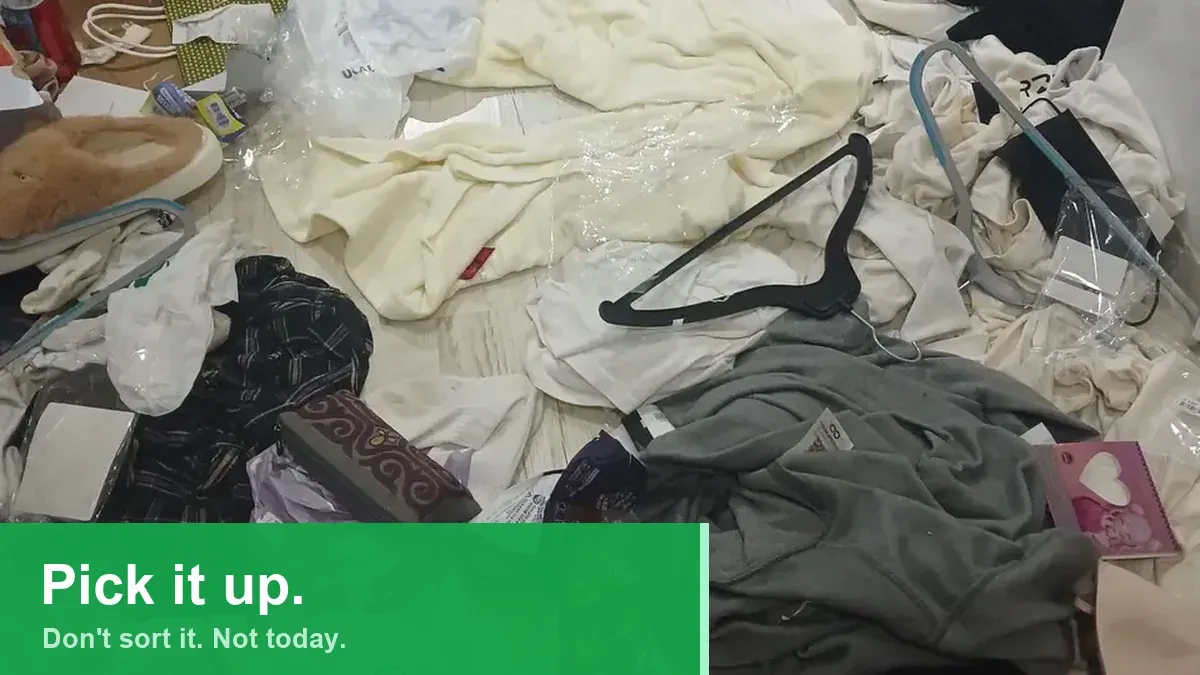
A real one-room floor, before anybody started · ⓒ @BalliBalliSeoul
That photograph is from a job, not a stock library, and it is worth looking at for one reason: there is nothing unusual in it. It is clothes, packaging, hangers and carrier bags — ordinary things that stopped getting put away for a few weeks. No single item in that room is a problem. The floor is the problem.
Which is also why it comes back fast, and why picking up beats sorting when the clock is running.
So, in order:
- The 현관. Everything but one pair of shoes per person goes into the shoe cupboard or a bag. This is the first thing anyone sees and it takes four minutes.
- Pick things up off the floor. Not sort — pick up. Into the staging area, or into the right room, and keep moving.
- The 빨래건조대. The drying rack in the middle of the living room is the most recognisable sight in Korean domestic life and it makes any room look like a laundry. Dry clothes go away; damp ones go to the balcony with the rack.
- Clear the flat surfaces you can see. Table, counter, the top of the fridge. Into a box, into a drawer. Do not start organising the box.
- 청소포 on a flat mop, straight across every floor you can reach. One sheet per room, no bucket, no wringing. Four minutes a room.
1:05–1:30 — the bathroom, then the sink
If people are going to be in your home for more than an hour, they will go into your bathroom, and it is the room that gets judged hardest.
Twelve minutes, in this order: wipe the basin and the taps, do the toilet including the base and the seat hinges, wipe the mirror, swap the towel for a clean one, put the bin out of sight or empty it. Skip the shower screen and the grout. Mould in the silicone is not a two-hour problem — it is a different conversation about whether cleaning can fix it at all.
Then the kitchen: wash what fits in fifteen minutes and put the rest in the dishwasher or out of sight. An empty sink with a wiped rim reads as a clean kitchen even when the cupboards are chaos. A half-washed pile does not.
1:30–1:45 — the thing that actually gives you away
You cannot smell your own home. Everybody who walks in can.
Three Korean-specific sources, in the order they are likely:
- Food waste. Dealt with above. It is almost always this one.
- The drains. A Korean bathroom floor drain, and any sink you rarely use, holds a small water seal that stops the smell from the pipe coming back up. In a dry month, or a bathroom nobody showers in, that water evaporates and the drain starts breathing at you. The fix is thirty seconds: pour a mug of water down every drain in the flat, including the ones you forgot you had. The twenty-minute version of this job covers the trap properly when you have time.
- Shoes, in the 현관. Into the cupboard with the door shut.
Then open every window for ten minutes, even in winter — especially in winter, when flats are sealed. Korean apartments ventilate fast.
Only after that should you light anything or spray anything. Scent on top of smell is worse than smell, and it is obvious.
1:45–2:00 — walk out and walk back in
Put your shoes on, go out of the front door, stand on the landing for ten seconds, and come back in as a visitor.
You will see three things you have been walking past all morning. Deal with exactly those three, then stop.
Then: shower, change into clothes you did not clean in, and eat something. Answering the door out of breath in a damp t-shirt undoes a surprising amount of the work.
What should you not do with two hours?
Every one of these feels productive and costs you the deadline:
- Do not deep clean one thing. A gleaming oven in a messy flat impresses nobody and eats forty minutes.
- Do not start sorting. The moment you are making keep-or-bin decisions, you have stopped emergency cleaning. That is a job with its own day.
- Do not open a cupboard you cannot close again. Today is not the day.
- Do not move furniture. Nothing behind it is being inspected.
- Do not clean what your visitor is not there to see. Re-read the table.
And one that catches foreign residents specifically: do not put bags out early just to get them out of sight. It is the one action on this list that can cost you money.
What if the visit is an inspection?
Different problem. If this is a move-out walkthrough or a deposit conversation, tidiness is not what is being argued about — condition is.
The thing that settles those arguments is not how clean the flat is this afternoon. It is the photographs you took on the day you moved in, repeated from the same angles on the way out. If you have two hours and a deposit at stake, spend twenty minutes of it taking photographs and the rest on the plan above.
And if the move-out date is still ahead of you, move-out cleaning is a priced, bookable job that exists precisely to stop this conversation happening.
If you have two days instead of two hours
Then do not do any of this.
We cannot send a cleaner this afternoon, and neither can anybody good. Cleaning crews in Seoul are booked days out, the ones with same-day gaps generally have them for a reason, and a rushed crew in a flat they have not been quoted on is how people end up paying for a job they are unhappy with.
What we ask for is two to three days, and ideally a week. With that, the cleaning page has the guide prices, and a move-in or whole-flat deep clean is a different order of result from anything in this article.
Two hours is triage. Two days is a solution. The useful thing to take from today is which one you are actually in.
The Korean part
Most of this you can do alone. These are the bits that are Korean rather than difficult:
- Your building’s collection night, hour and spot. It varies by district and by building, and the notice is on a board in Korean.
- Asking the 관리사무소 anything at all — where bulky items wait, whether tonight is recycling night, whether the bin by the gate is yours to use.
- Buying the right bag. District, size and type, at a counter, in Korean.
- Telling a technician you need twenty minutes before they come up.
Someone is coming and you are reading this at the wrong end of the morning? Send us your address on KakaoTalk — or WhatsApp if that is what you have — and we will ring your building, find out when the bags can go out, and tell you in English. That answer is free and it takes one call. If what you actually need is a cleaner, tell us the date and we will quote it properly, which means not this afternoon.
Last verified: 23 October 2026. Bag rules, collection windows and fines are set by each district and change; your building’s notice board and the 관리사무소 are the authority, not this page.
And the one line worth keeping for next time: bag it, clear the floor, kill the smell, walk out and walk back in. Everything else in a panic clean is optional.