Which Clinic in Korea? A Symptom-to-Department Guide
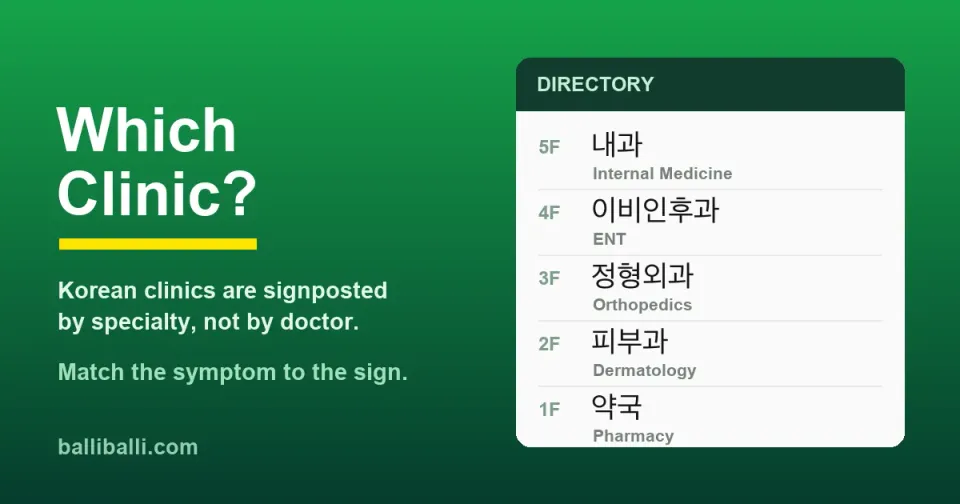
Korean healthcare is genuinely excellent, genuinely cheap with insurance, and genuinely fast — you can often walk in and be seen within the hour. The part nobody explains is the first decision: which clinic do you even walk into? There’s no family doctor gatekeeping the system here. You pick the specialty yourself, and picking wrong costs you a wasted afternoon and a second copay.
Here’s how the system is laid out, and how to land in the right room on the first try.
Note: this article is general information about how Korea’s clinic system is organized. It is not medical advice, and it is not an advertisement or promotion for any medical institution. For anything about your health, ask a licensed doctor.
First: clinic, hospital, or ER?
Three tiers, and starting at the right one saves money and time:
- 의원 (uiwon) — local clinic. One or two doctors, a single specialty, usually on the 2nd–5th floor of a commercial building with a sign by the elevator. This is where you start for anything routine.
- 병원 / 종합병원 — hospital / general hospital. Multiple departments, imaging, admissions. For serious cases, or when a clinic refers you. Going here first for a sore throat means longer waits and higher fees.
- 응급실 — emergency room. Genuine emergencies only — call 119 for an ambulance (and here is what the other numbers do, including the fact that you can text them). ER visits are expensive by Korean standards and slow for non-urgent problems.
The big-hospital fees are also structured to push you toward clinics first: without a referral, the insurance share is worse.
The department decoder
Korean clinic signs are specialty names, so this table is the whole trick. Read the Korean, match your symptom:
| Your problem | Department | Korean |
|---|---|---|
| Cold, flu, fever, stomach upset, general illness | Internal medicine | 내과 |
| Sore throat, cough, blocked nose, sinus, ear, dizziness | ENT | 이비인후과 |
| Anything you can’t classify; check-ups; vaccines | Family medicine (closest to a GP) | 가정의학과 |
| Broken bones, sprains, back/knee/shoulder pain, sports injuries | Orthopedics | 정형외과 |
| Spine, disc, nerve pain, headaches after injury | Neurosurgery | 신경외과 |
| Rashes, acne, eczema, hair loss, moles | Dermatology | 피부과 |
| Eyes, vision, styes | Ophthalmology | 안과 |
| Teeth | Dentistry | 치과 |
| Pregnancy, periods, contraception, women’s health | OB-GYN | 산부인과 |
| Children (usually under 15) | Pediatrics | 소아청소년과 |
| Urinary, kidney stones, men’s health | Urology | 비뇨의학과 |
| Anxiety, depression, sleep, ADHD | Psychiatry | 정신건강의학과 |
| Allergies, asthma | Internal medicine (allergy) | 알레르기내과 |
| Acupuncture, herbal medicine, cupping, chronic aches | Korean medicine | 한의원 |
One row above needs a caveat: you do not need 안과 to buy glasses. Korean opticians test your eyes themselves and sell you the glasses in the same visit, with no prescription and no doctor involved — see getting glasses in Korea. Save ophthalmology for pain, sudden vision changes or floaters.
Two things surprise Western patients most. First, Koreans go to ENT for a common cold — if your symptoms are above the neck, 이비인후과 is the local instinct, and they’ll treat it faster and more thoroughly than you expect. Second, you can walk straight into a specialist: no referral, no gatekeeper, no two-week wait for a GP appointment. If you genuinely don’t know where to go, 가정의학과 (family medicine) is the closest thing to a general practitioner and will redirect you if needed.
The parallel system: 한의원 (Korean medicine)
One category sits outside the Western-medicine map entirely. 한의원 (haniwon) are clinics of Korean traditional medicine — acupuncture, moxibustion, cupping, herbal prescriptions and chuna manual therapy — staffed by separately licensed doctors of Korean medicine, with their own six-year training track. They are everywhere, they are regulated, and a lot of Koreans use both systems depending on the problem.
What locals typically bring there: chronic back and neck pain, sports and posture problems, digestive complaints, fatigue, recovery after an accident. Acupuncture and chuna for musculoskeletal issues are partially covered by national insurance, which makes a session surprisingly affordable; herbal prescriptions (한약) are generally not covered and are the expensive part.
It’s also become a wellness draw for visitors — a fair share of tourists now come specifically for acupuncture or herbal consultations. If that’s you, two practical notes: English support varies enormously (some clinics in Gangnam and Itaewon are set up for foreign patients, most neighborhood ones are not), and an herbal prescription is a real medical prescription — tell the doctor about any medication you’re taking and any dietary restrictions, including if you’re vegetarian, since some formulas use animal-derived ingredients.
What a visit costs
With National Health Insurance — which is mandatory for residents staying six months or more — a routine clinic visit plus a prescription typically lands in the ₩5,000–15,000 range out of pocket, as of 2026. Pharmacies are almost always in the same building or next door, and prescriptions are filled in minutes.
Without insurance (tourists, or before your enrollment kicks in), you pay the full price — still modest by American standards, but several times higher.
Clinics and pharmacies take cards, and — since the question comes up — you don’t tip your doctor, your nurse or your pharmacist. Nobody tips anybody here, in healthcare or anywhere else (the full story).
Finding a clinic where English works
Here’s the honest picture: most neighborhood clinics run in Korean. Doctors often read English well and speak it unevenly; reception and nurses usually don’t. Your realistic options:
- Large general hospitals often have an international healthcare center with English-speaking coordinators — the most reliable English, at hospital prices.
- Expat-dense neighborhoods (Itaewon, Hannam, Gangnam, university districts) have clinics used to foreign patients.
- 1330, Korea’s 24/7 travel helpline, answers in English and can help you find and call a clinic.
- 119 for emergencies — English support is available on the line.
- Ask before you go. A two-minute phone call — “do you have anyone who speaks English?” — saves an entire wasted trip. That call is the part that stops most people.
Picking the department is half of it. Saying what hurts is the other half, and it is one of the few situations here where rehearsing the sentence beforehand genuinely pays — how to practise the ones that actually come up.
Before you go: the practical checklist
- Bring your ARC (and insurance card if you have one) — the registration desk needs your foreigner registration number.
- Write your symptoms down before you arrive, in simple terms, and translate them. “Sore throat, 3 days, fever 38, no cough” beats improvised charades.
- Know your allergies and current medications in writing.
- Expect efficiency, not chat. Korean consultations are short and to the point. That’s not rudeness; ask your questions directly and you’ll get direct answers.
- Take the prescription to the pharmacy — usually downstairs. Medication is dispensed per dose in strips; take exactly what the label says.
Where we come in — and where we stop
We are not a medical service. What we remove is the language wall around one, and we’re deliberate about where that ends.
What we can and cannot do
We do not recommend, endorse or refer you to any hospital, clinic or doctor. Korean medical law is strict about this, and we stay well clear of the line. We accept no commission, referral fee or payment of any kind from any medical institution — our fee comes from you, for the errand, and from no one else.
What we actually do, through our anything-else concierge service:
- Help you work out which department your symptoms belong to — the general information in this article, applied to your situation.
- Find which clinics are open on the day and at the hour you need one.
- Find which ones can handle you in English, by calling and asking.
- Make the booking call, and stay on chat to translate if you want us to.
Choosing where to be treated is entirely your decision and your responsibility. We provide no medical information, no diagnosis and no opinion on quality of care — and nothing we send you is advertising for any medical institution.
For a resident on national insurance, that’s a phone call and an errand: two minutes for a local, an afternoon for you.
Get it sorted
Sick, and stuck at the first decision? Message us on WhatsApp with your symptoms and your neighborhood — we’ll tell you which department to look for, and find which clinics near you are open and can take you in English. We don’t recommend providers and we take no money from them; the choice is yours. Asking costs nothing — you pay only for the work you book.
The one-line version: start at a local clinic, match the symptom to the specialty sign, bring your ARC, and phone ahead about English. The medicine here is world-class; the only hard part is the door.