Korea's Emergency Numbers: 112, 119 (and Yes, You Can Text)
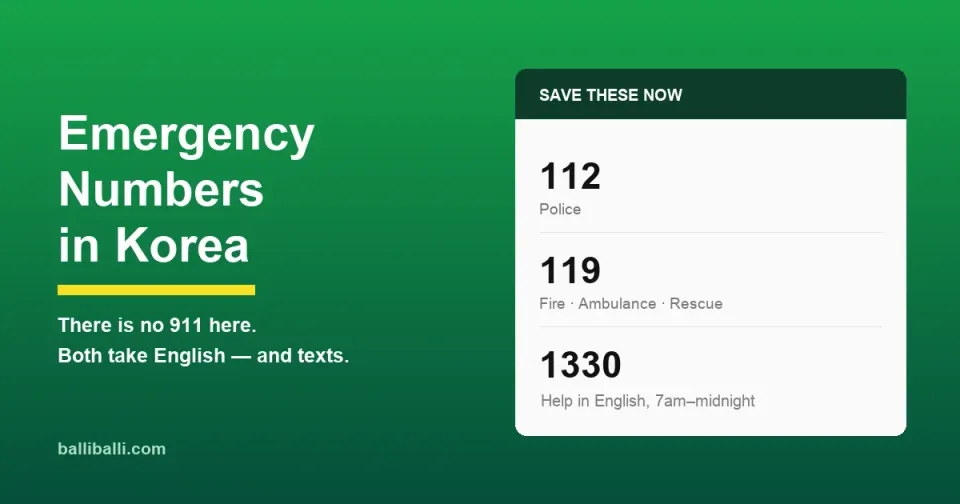
There is no 911 in Korea — and in a real emergency, that’s exactly the kind of thing you don’t want to be googling. Korea splits emergencies across two numbers, both free, both 24/7, and both more foreigner-friendly than most people assume. Save these now; read the rest when you can.
The two numbers that matter
112 — Police. Crime, theft, assault, harassment, traffic accidents with a dispute, anything where you need officers. For a straightforward bump between two cars, though, the police usually aren’t the call you need first — here’s who to ring after a car accident, and in what order.
119 — Fire & Ambulance. Fire, medical emergencies, rescue — including situations like being trapped in an elevator. One number covers all of it; the dispatcher routes the right team.
If you’re weighing up whether something is an emergency at all, we wrote the whole ladder separately — convenience store, pharmacy, clinic, then 119 — because most midnight health problems stop at the first rung.
Both services handle foreign-language calls: dispatchers can bring an interpreter into the call three-way (English and many other languages). Don’t hang up if the first voice is Korean — say “English, please” and hold on. Speaking slowly and leading with your location works better than perfect sentences.
You can also text them
The part almost no foreigner knows: both 112 and 119 accept SMS reports. Text your situation and location to the number just like a phone contact — and you can attach photos or video (a threatening situation, a fire, an accident scene). It exists for people who can’t speak safely (a domestic situation, an intruder in the home), for the hearing-impaired — and it quietly solves the language problem too, since a short English text with an address is easier for dispatch to translate than a panicked call. There are also official apps (the government’s Emergency Ready app in English) with one-tap reporting, but plain SMS needs no setup at all.
When texting, lead with what and where: “Fire, apartment 302, 12 Itaewon-ro 34-gil, Yongsan-gu.” Address first if you only manage one line.
What happens when you call 119
Worth knowing in advance so it doesn’t surprise you mid-crisis: the 119 ambulance is a public service and free of charge — there’s no bill for the ride. Paramedics take you to an appropriate emergency room, and the hospital costs themselves are where insurance matters. And if the question is “it hurts, but is this ER-worthy?” — ask 119 itself. The same number runs emergency medical guidance: they will talk through the symptoms and tell you which hospital near you is open right now, without dispatching an ambulance you don’t need.
A three-phrase Korean emergency kit, if you want one: 도와주세요 (dowajuseyo — help me), 불이야 (buriya — fire!), 구급차 불러주세요 (gugeupcha bulleojuseyo — please call an ambulance). But again — English plus an address gets the job done on both numbers.
The support cast
| Number | What it’s for |
|---|---|
| 1330 | Korea Travel Helpline — tourist help & interpretation, 7 a.m.–midnight |
| 120 | Seoul Dasan Call Center — city services, complaints, info (foreign-language support in working hours) |
| 1345 | Immigration Contact Center — visa/ARC questions, multilingual |
| 1339 | KDCA disease helpline — infectious disease, outbreak and travel-vaccination questions |
The one to remember alongside 112/119 is 1330: 7 a.m. to midnight, 365 days, eight languages, and happy to interpret or point you to the right agency when the situation is urgent-ish but not sirens-urgent. (It is not 24 hours, whatever else you read — after midnight, 112 and 119 are the ones still awake.) It will even conference in 1345 (immigration) on a three-way call rather than making you hang up and start again — which is the single most useful thing any Korean helpline does for a foreigner. We gave 1330 its own guide: what it does, in eight languages, and when to use it instead of us.
One more thing your phone will do without asking: Korea’s emergency alert texts (재난문자) blast every handset in an affected area for floods, extreme weather, and civil alerts — loudly, and in Korean. Don’t dismiss them unread; a ten-second pass through a translation app tells you whether it’s a heatwave advisory or something that needs your attention right now.
Know where you are
The weak point in every foreigner’s emergency call is the address. Korean addresses lead with the district and street (our transportation guide covers the system) — but in the moment, three shortcuts work:
- Every utility pole and building corner carries a road-name address plate — read it out, even in bad pronunciation.
- Subway exits, convenience stores and phone-booth-style emergency pillars are locatable landmarks — “GS25 next to exit 4, Itaewon Station” dispatches fine.
- Screenshot your home’s Korean address now and keep it pinned in your notes and taped inside a kitchen cabinet. Two minutes today; it’s the line you’ll read aloud with shaking hands someday.
The Korean part
To be direct about our role: emergencies go to 112 and 119 first, always — that’s professionals with sirens, and both numbers work in English. Where we come in is everything after and around: the police report follow-up, the insurance paperwork, the hospital’s Korean-language admin (our guide to which clinic to walk into covers the daylight version), the locksmith after the break-in, the plumber after the flood, the landlord conversation after the fire scare. Message our concierge service once everyone is safe, and we’ll walk the aftermath with you in English.
Get it sorted
Not an emergency, but urgent and confusing? That’s our lane — message us on WhatsApp and we’ll figure out who needs to be called and call them in Korean. Asking costs nothing — you pay only for the work you book. If it’s a real emergency, stop reading and dial 112 or 119.
Tonight’s homework: save 112, 119 and 1330 as contacts, and pin your Korean address to your notes app. That’s the whole preparedness plan — five minutes, once.
Corrections
We log changes here rather than editing quietly, so you can see what we got wrong and when.
| Date | What changed |
|---|---|
| 19 August 2026 | Corrected 1330’s operating hours. This page described the Korea Travel Helpline as “round-the-clock” and listed it as “24/7” in the table above. It is not: 1330 runs 7 a.m. to midnight, 365 days a year. Only 112 and 119 are staffed around the clock. Both the table and the paragraph beneath it were fixed, and the cover image of this page was corrected too — it also carried the wrong “24/7”. The error came from older public pages that still repeat a 2012 announcement; the current figure is confirmed against Korea’s government service listings and the Korea Tourism Organization. |