Clean a Mattress Yourself in Korea: What It Really Takes
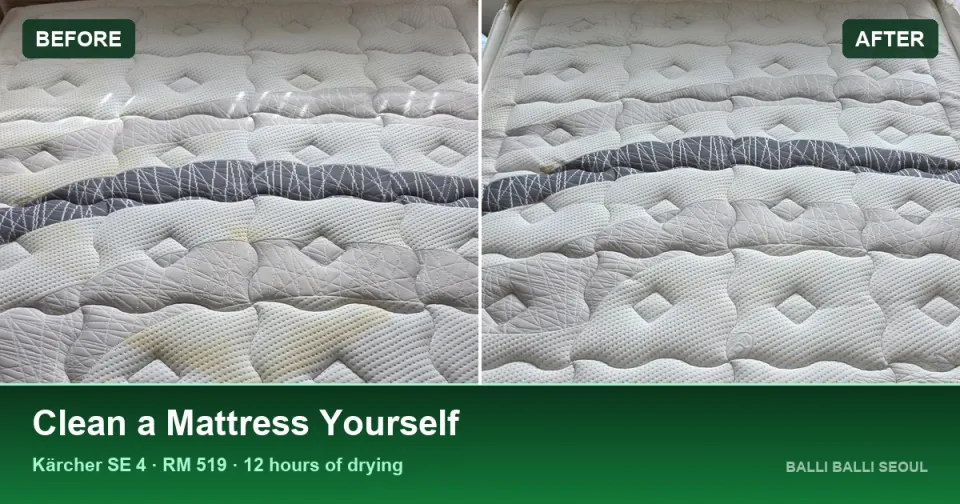
A child in the flat had an accident at night, and nobody caught it in time. By the time anyone looked properly it was not a wet patch any more. It was a yellow map across the middle of a double mattress, dried in and spread sideways through the quilting.
We bought a machine and did it ourselves. It worked. It was also several times harder than it looks in anybody’s before-and-after photo, and the part that costs you the most — the drying — has no shortcut at all.
This is the hands-on companion to sofa and mattress cleaning in Korea, which covers what the service costs and how to book it. That post is about hiring somebody. This one is about what you take on if you don’t.
What a dried accident actually looks like
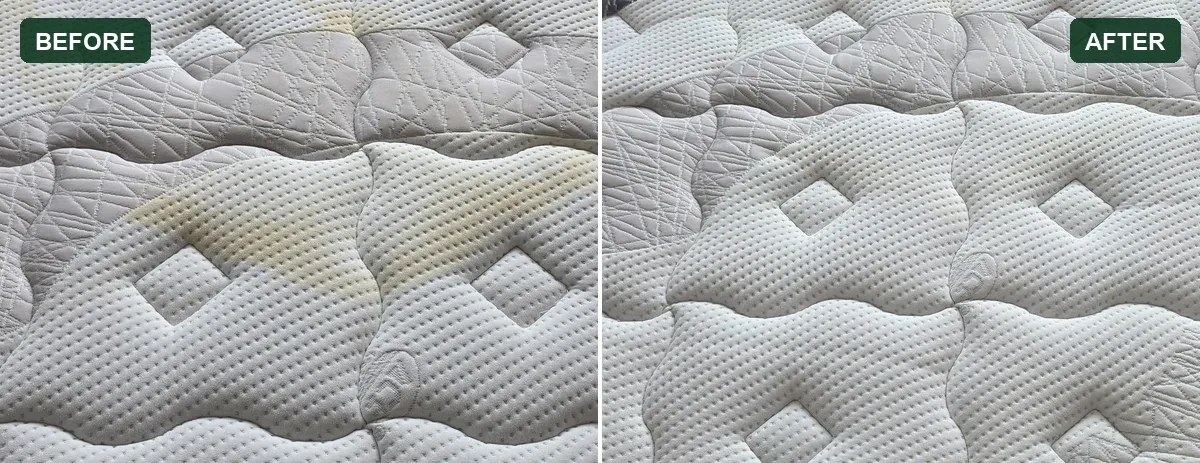
The same patch of quilting, ninety minutes apart · ⓒ @BalliBalliSeoul
The yellow border is the most useful thing in the left-hand frame. Urine does not sit on the surface. It goes down into the fill and travels outwards until it runs out, and the brown-yellow line you end up staring at is the outline of where it stopped. Everything inside that line is the actual job.
Which is why wiping it fails. The top centimetre was never the problem, and in a Korean summer whatever is left deeper down comes back to life with the humidity — the reason the smell returns in July even after the stain stops looking bad.
The machine, and what it is actually doing
We used a Kärcher SE 4. It is a spray-extraction cleaner, not a steam cleaner and not a vacuum: it sprays water and detergent into the fabric and sucks it straight back out in the same pass. That is the same principle as the machine a professional crew arrives with, at a smaller scale.
The clear window in the nozzle head is not decoration. It is the only live feedback you get. You watch the water change colour as you pull, and when it stops changing, that pass is finished and you move along. Working without looking at it is how people soak a mattress and achieve nothing.
The detergent is the part people get wrong
The machine takes Kärcher RM 519, the maker’s own carpet and upholstery detergent, which fits the whole SE line from the SE 2 up to the SE 6.
Do not put laundry liquid, dish soap or shampoo in the tank. This is the single rule worth carrying away from this post, and the reason is foam.
Here is the evidence, because it is better than the usual forum advice: Kärcher sells a separate product called Foam Blocker (RM 761) whose only job is to go into the waste-water tank of spray-extraction machines, scrubber dryers and wet vacuums. The maker’s own description says it lets the tank fill properly without the float tripping early and without damaging the suction turbine. That is Kärcher telling you, in a product listing, that foam reaching the motor is a real way to kill one of these machines.
What we could not find is a line in the SE 4 manual saying “low-foam only.” So take the rule at the level the evidence actually supports it: use the detergent that was made for the machine, and keep the kitchen out of the tank.
What Kärcher publishes for RM 519 itself:
| Dose | 100–200 ml of detergent per 4 litres of water, more for heavier soiling |
| Water temperature | Under 50 °C |
| Heavy soiling | Pre-spray, leave it 5 minutes to work, then vacuum off |
| Afterwards | Do not rinse |
| Before you start | Check the fabric is colourfast |
| Absorbent fabrics (wool) | Vacuum a second time |
Kärcher product information for RM 519. Checked 26 October 2026 — verify against the sheet in your own box, since dosing differs by product and by market.
The five-minute dwell is the instruction people skip, and it is the one that does the work on a set-in stain. Spray, walk away, come back, extract.
The proof is in the tank, not on the mattress
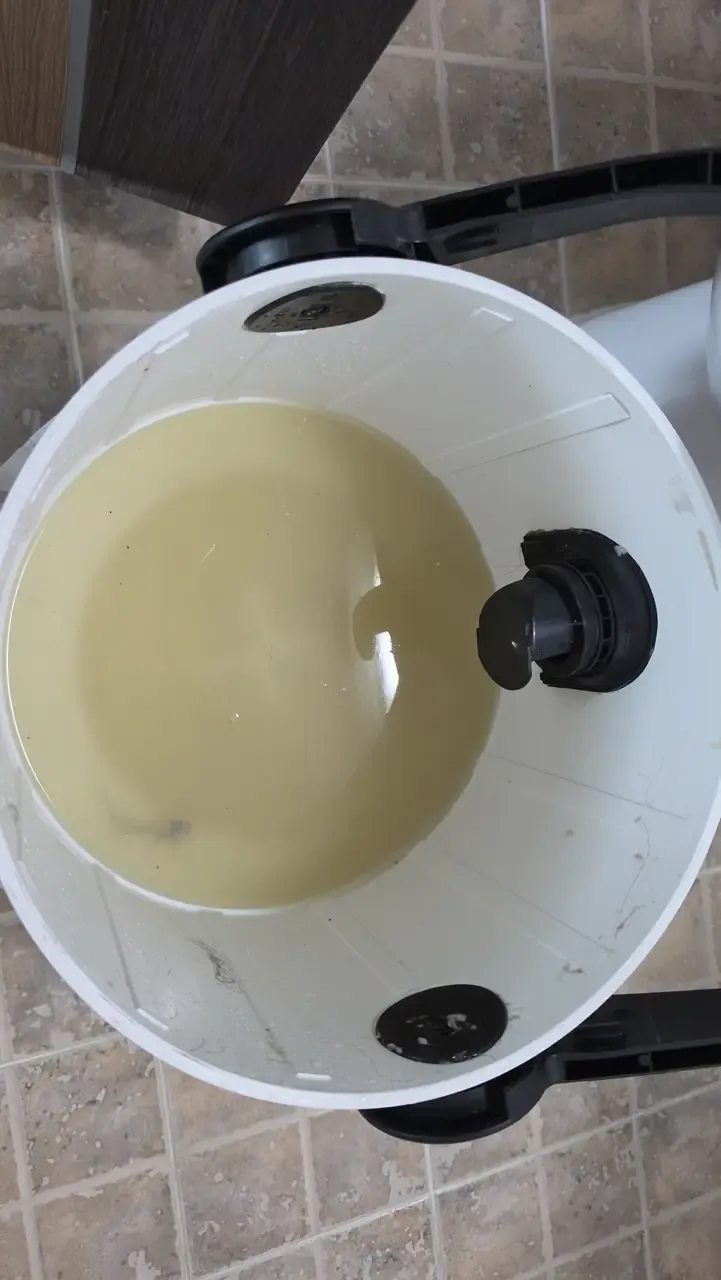
One tank, from one mattress · ⓒ @BalliBalliSeoul
That is not surface dirt. It is what was sitting inside the quilting, and it is the only honest measure of whether the pass did anything.
If your waste tank comes back more or less clear, you are not reaching anything — either the solution is not getting down far enough, or you are extracting before it has had time to lift anything, or the nozzle is not being pressed in hard enough. Change one of those three things rather than doing another twenty passes.
Nobody tells you how hard this is
The listings sell you a machine that does the work. It does one part of the work. You do the rest, and the rest is most of it.
A single double mattress took ninety minutes of unbroken work — the gap between the first photo here and the last. You cannot stand up to it — you are kneeling on the bed, leaning across, dragging a hose and a tank behind you, and a mattress is wider than your arms are long, so half of it is done from an awkward angle. Then you empty the waste tank, refill the clean one, and start again.
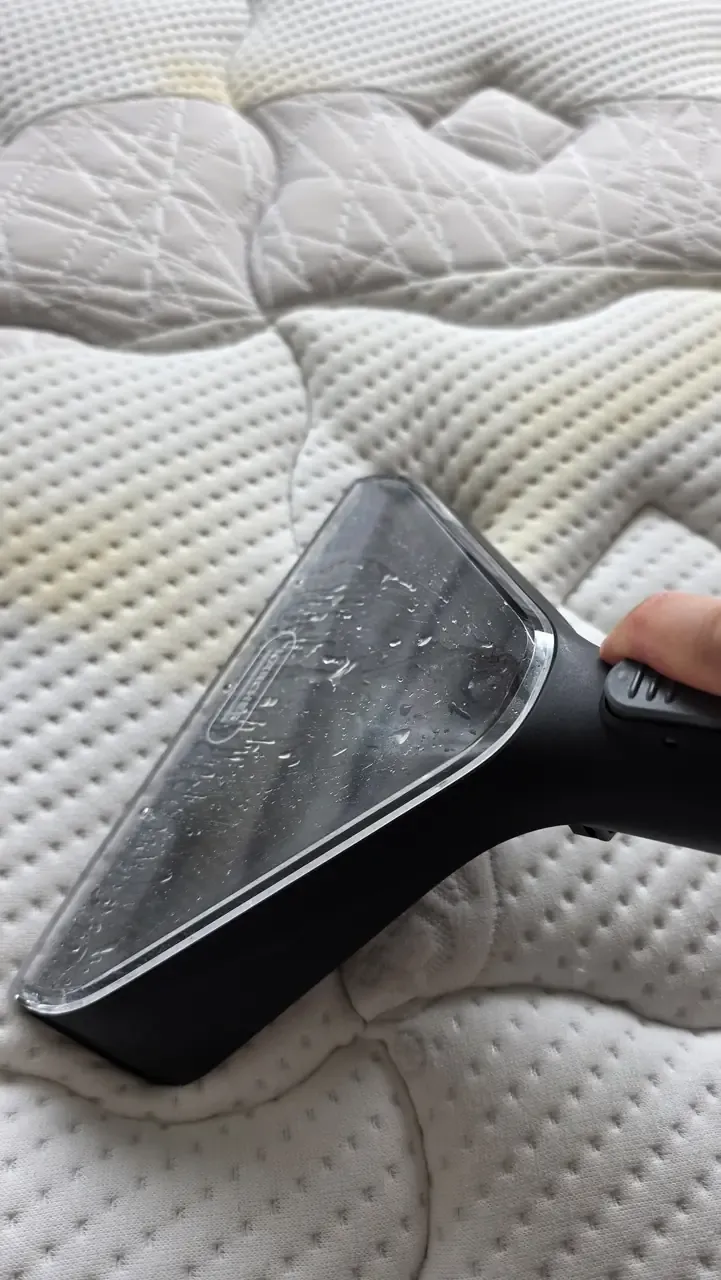
Several light passes beat one soaking, every time · ⓒ @BalliBalliSeoul
Three things we would tell anyone starting:
Blot first, never scrub. Scrubbing drives the stain deeper and frays the quilting stitching.
Work from the outside of the stain inwards. Push from the middle and you widen the edge you were trying to remove.
Several light passes, not one soaking. The machine can only pull back what it put in. Put in more than it can recover and you have simply moved water into the foam, which is the next section’s problem.
Drying is half the job, and it has no shortcut
Plan on 8 to 12 hours before bedding goes back on. That was our experience and it is the number we would give anyone asking. A mattress is not a towel: the surface feels dry long before the fill is, and sealing a damp core under a fitted sheet in a Korean autumn is how you turn a stain problem into a mould problem.
What actually sped it up:
| Lever | Why it works |
|---|---|
| Aircon on 제습 (dehumidify), not 냉방 (cooling) | Cooling drops the air temperature. Dehumidify pulls water out of the air, which gives the mattress somewhere to send its own moisture. A cold room at 80% humidity dries nothing |
| A fan pointed at the surface | Moving air clears the saturated layer sitting on the fabric. A fan on its own is slow; a fan plus 제습 is noticeably not |
| Bedding off, covers back | Do not remake the bed, not even loosely. Leave the whole surface open |
| Stand it up if you can | Air on both faces roughly halves it. On a heavy double in a small room this is often not realistic, and that is fine |
Most Korean wall units have 제습 on the remote as a separate mode, and this is exactly the job it is for. If you have had damp trouble in the flat before, the same logic is the whole of mould behind the baseboard — and if the unit itself smells when you run it, that is a different job, covered in aircon cleaning.
Look again the next morning. As a mattress dries, whatever is still deeper down wicks back up to the surface, so a stain that looked finished in the evening can reappear faintly by breakfast. A second pass on the dry mattress is normal, not a failure.
What it looks like afterwards
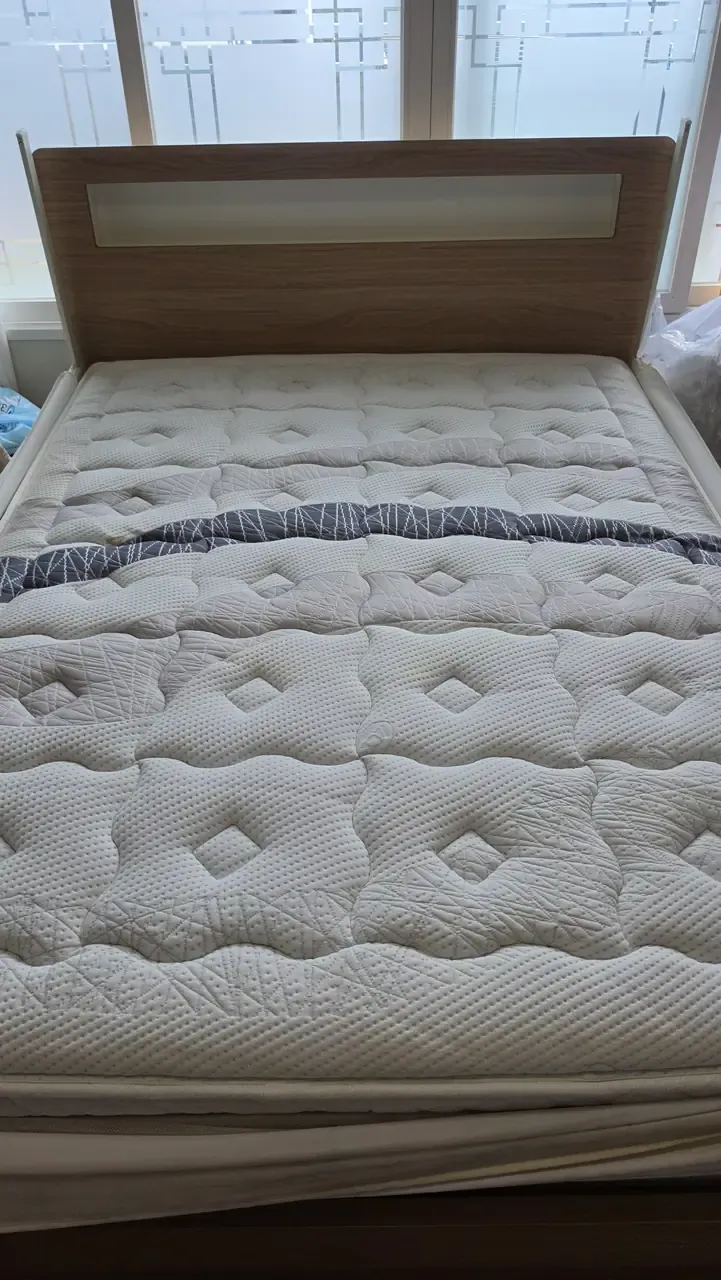
Straight after the last pass — a faint shadow still where the worst of it was, and twelve hours of drying to go · ⓒ @BalliBalliSeoul
Honestly: it is dramatically better, there is no smell, and the room feels different. It is not a new mattress. Dried urine that has been in the fibres for a while has already taken some of the colour with it, and a domestic machine lifts most of that rather than all of it.
That gap — most rather than all — is the gap you are paying a professional to close, and it is worth knowing which one you are buying before you start.
While you have it out, do the other one
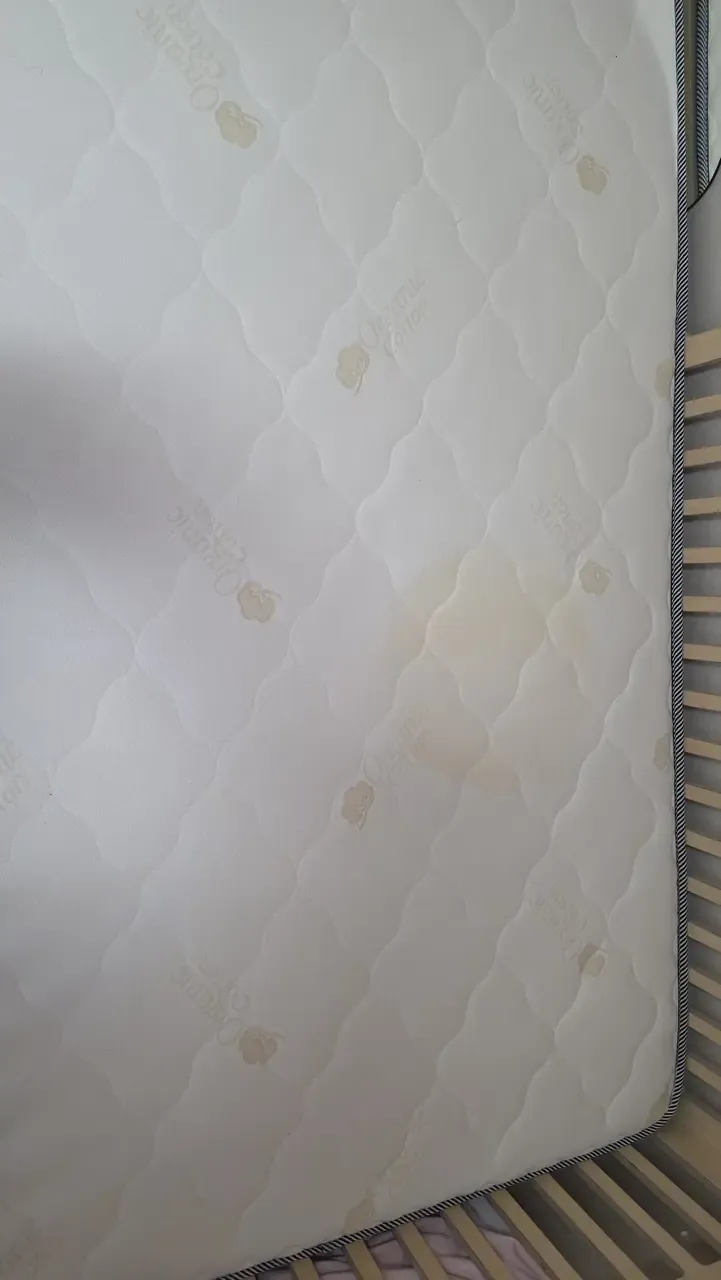
The other mattress in the house, waiting its turn · ⓒ @BalliBalliSeoul
The tank is already dirty and the solution is already mixed. The marginal cost of the second mattress is an hour and a refill, and every household with a small child has a second one.
If there is a small child in the flat, buy the cover first
A 방수 매트리스 커버 (bangsu maeteuriseu keobeo) — a waterproof mattress protector — costs around ₩20,000, goes in the washing machine, and makes everything above unnecessary. It is the cheapest item in this article and by some distance the highest-return one. The rest of the between-cleans routine is in the sofa and mattress post.
Buy it before the accident, not after. That is the entire advice.
Buy the machine, rent one, or call somebody
Spray-extraction machines on Coupang. The first two are purchases — the Kärcher SE 4 is the machine in the photos above, and the Bissell SpotClean C5 is the smaller, lighter household version. The last two are rentals, which is usually the right answer for one accident rather than a habit; the Bissell Professional on the right is a three-day hire with delivery and collection included. All four do the same thing: put solution in, pull it back out.


Affiliate links — we earn a small commission if you buy or rent through them, at no extra cost to you.
이 포스팅은 쿠팡 파트너스 활동의 일환으로, 이에 따른 일정액의 수수료를 제공받습니다.
If you rent, stay inside the rental terms. Read them before the box arrives, not after: how many days you have, when the collection is booked for, what counts as damage, and what has to be emptied, rinsed and dried before it goes back. A rental kept an extra day or returned with water still in the tank stops being the cheap option.
And buying is only cheap if you will use it twice. With a small child, a pet or a fabric sofa that gets sat on, you will. For one accident, hire it — or skip both and have somebody else kneel on the bed for an hour and a half.
When to call somebody instead
The honest list, after doing it:
- The stain is older than a few months and large. A crew’s machine has more suction and hotter water, and the gap between “most of it” and “all of it” is exactly where that shows
- You cannot get the room dry. No aircon, no fan, wet season, north-facing room — a half-dried mattress is worse than a stained one
- It is a smell rather than a mark, which usually means the core, not the cover
- It is the landlord’s mattress, in which case the conversation about who pays happens before anyone cleans anything
- Your back, your knees, or your weekend say no. This is a legitimate reason and we are not going to pretend otherwise
Prices for the booked version — per item, by size and condition — are in sofa and mattress cleaning in Korea, and where upholstery sits among the Korean cleaning categories is in deep cleaning.
Not sure whether yours is worth cleaning or replacing? Send a photo on KakaoTalk — or WhatsApp — and tell us how old the stain is. We will tell you honestly which of the three it is: a weekend with a rented machine, a job for a crew, or a mattress that has had its life. Asking costs nothing.
Get it sorted
Buy the waterproof cover today, whatever else you decide. If the mattress already needs the work, rent the machine for one stain and buy one only if you will reach for it again — and give the drying the twelve hours it wants, because that is the half of the job that cannot be rushed and the half that ruins the result when it is.
If the Korean side is what is stopping you — ringing a cleaning company, describing the stain, agreeing a price per item before anyone arrives — that is the part we arrange in English. We are an intermediary, not the crew: we book it, we hold the conversation in Korean, and the quote is agreed with you in the chat before anyone comes to the door. The cleaning page covers the rest of the house.
Corrections
We log changes here rather than editing quietly, so you can see what we got wrong and when.
| Date | What changed |
|---|---|
| 26 October 2026 | How long the job took, and one line about 제습. The first version said the mattress “took the better part of a morning” and later that you could “kneel on the bed for three hours”. Our own photographs are timestamped 11:02 and 12:31, so the figure is ninety minutes and both lines now say so. The same version called 제습 “the one week of the year it earns its place” — the dehumidify mode is not a one-week-a-year setting, and the claim has been removed. |