Lost Your Suitcase Lock Key in Korea? The ₩5,000 Answer
A message came in today. Someone had a padlock on their suitcase and no key — lost, somewhere between one country and another, in the way those things go. Could we send someone to open it?
Yes. Easily. We know locksmiths, they answer the phone, and one of them would have been at the door within the hour.
We said no, and sent a shopping link instead. This page is why, because the reasoning is more useful than the answer.
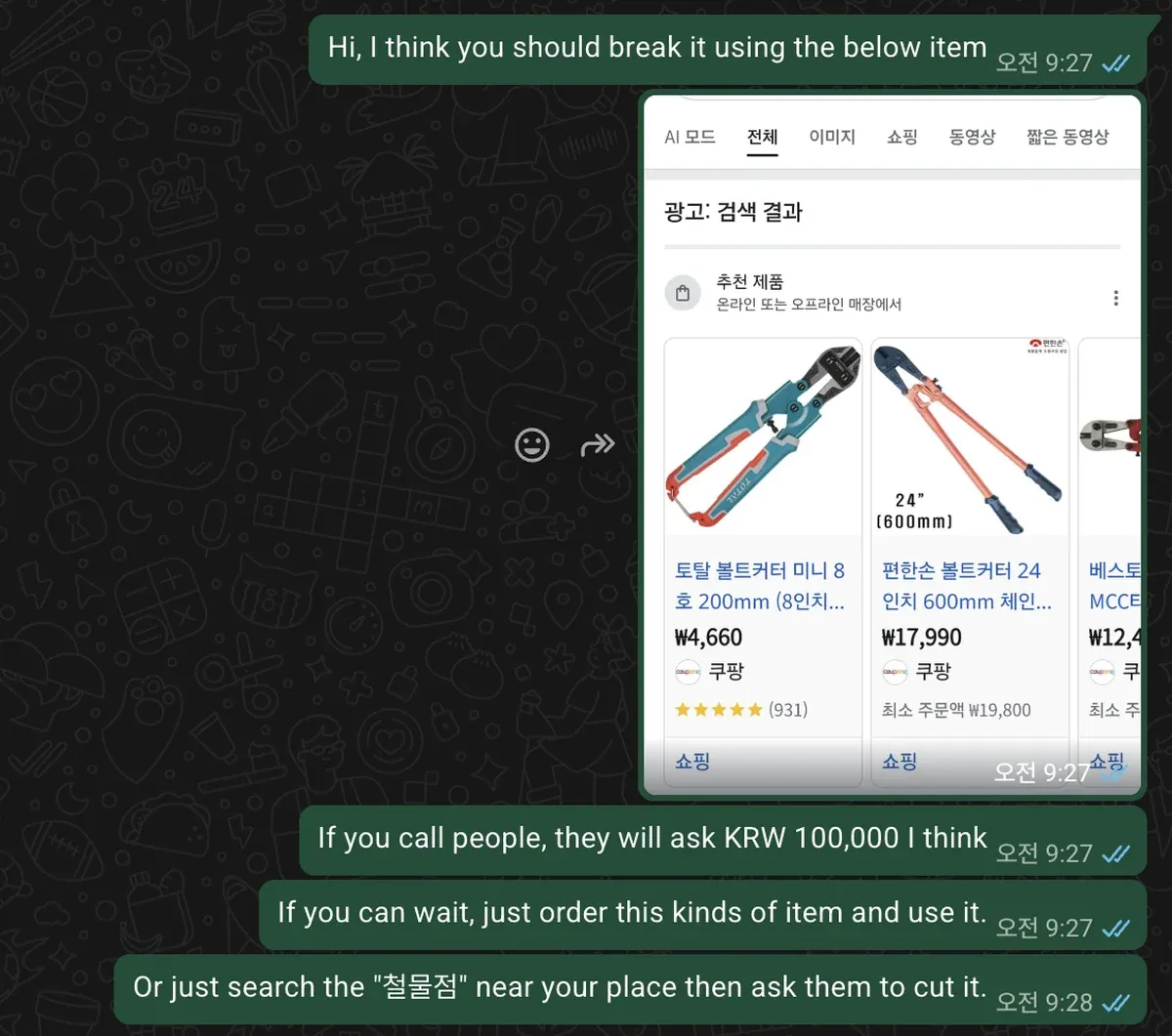
What we actually sent, this morning · ⓒ @BalliBalliSeoul
That is the whole exchange, more or less. ₩4,660 for a 200mm bolt cutter, against a call-out we estimated at about ₩100,000 — and a third option underneath it for anybody who could not wait for delivery.
What it would have cost to do it our way
Start with our own price list, because it is published and we are not going to pretend otherwise. Our locksmith page says a standard lockout opening runs ₩50,000–100,000, depending on the lock and the time of day.
That is a fair price and we stand behind it. A call-out has a floor — a person stops what they are doing, travels across a city, and arrives with tools. The number is mostly the journey, not the work, and it does not get smaller because your problem is small.
Now look at what was actually being bought for it.
| The job | Cut one padlock |
| The tool | A bolt cutter |
| The skill | None |
| The time | Ten seconds |
| The call-out | ₩50,000–100,000 |
There is no version of that where the customer wins. At the top of the range you are paying more than a lot of suitcases are worth. You could buy a replacement case and throw the locked one away and still be ahead, which is an absurd sentence to have to write about a lock the size of a thumb.
So we did not send anyone. The fee we would have earned on that job is money we decided not to make, and this is the part of the business that nobody writes down: the easiest thing in the world is to say yes.
What we sent instead
Three options, cheapest first. Try them in this order.
1. Look at the lock before you cut it
Thirty seconds, and it might save the padlock entirely.
Check the face of the lock for a TSA mark or a small red diamond, and check whether there is a key slot on the underside that does not match your own key. Travel padlocks sold for flights are built so that airport security can open them with a master key rather than cutting them off.
That does not mean a hardware shop can help — they will not have the master — but a luggage shop or a luggage repair counter sometimes can, and it is worth one phone call before you destroy anything. Department stores with a luggage floor are the likeliest place to ask.
And one thing worth knowing even after this is over: a padlock on a soft suitcase is not security. It is a deterrent against a casual hand, and the zip it is attached to is the weakest part of the whole bag. Pack accordingly, and do not put anything in there you would be sorry to lose.
2. Buy a bolt cutter
This is the answer in almost every case. A small bolt cutter — the kind sold for cutting wire and light chain — goes through a suitcase padlock shackle without any technique at all.
The one we sent was a 200mm (8-inch) mini bolt cutter at ₩4,660, with nearly a thousand reviews. The cheapest one on the page will do, because you are cutting a few millimetres of soft brass, once.
Buy the small size. The same search offers a 600mm two-handed cutter at ₩17,990 — four times the price, for a tool built to cut rebar and chain, which you will never use again and cannot get into a drawer. The 200mm is the right tool here precisely because the job is small.
Smallest on the left, biggest on the right — and smaller is almost certainly what you want. A suitcase padlock has a thin brass or plated shackle, and the two aluminium-handled cutters on the left (275mm and 300mm) go through one easily while still fitting in a kitchen drawer afterwards. Go bigger only if the lock is not a suitcase lock — a hardened-steel shackle on a bike lock, a shed or a storage cage needs the leverage of the 460mm class on the right, and will defeat a small cutter rather than being cut by it. Check what you are cutting before you buy the tool, because the mistake runs in both directions: too small and it will not bite, too big and you have bought a tool you cannot store for a job that took ten seconds.


Affiliate links — we earn a small commission if you buy through them, at no extra cost to you. We would have earned considerably more by sending somebody to your door, which is the point of this article. Cut only locks that are yours.
이 포스팅은 쿠팡 파트너스 활동의 일환으로, 이에 따른 일정액의 수수료를 제공받습니다.
If Coupang checkout is where you get stuck — a foreign card declining at the last step is the usual culprit — that is an ordinary Korean payments problem and it has workarounds.
3. If it is urgent, walk to a 철물점
Overnight delivery is not fast enough when the flight is tomorrow morning.
철물점 (cheolmulcheom) is the neighbourhood hardware shop, and there is one near you — usually a narrow, crowded place with tools hanging outside, run by somebody who has been there for twenty years. They have bolt cutters. They will cut it.
Around ₩20,000 is the number we gave, and expect it to be less a transaction than a favour. Bring the suitcase — this is the one condition that matters. A shop will cut a lock in front of you in ten seconds; almost none of them will come to your flat to do it, and the moment somebody has to travel you are back at call-out prices.
Say this:
이것 좀 잘라 주실 수 있을까요? Igeot jom jallа jusil su isseulkkayo? — “Could you cut this for me?”
If the shop is busy, point at the lock and hold up the suitcase. It is not a sentence anyone will need repeating.
Why this works and a call-out does not: you are going to the tool instead of paying the tool to come to you. The journey is the expensive part, and the journey is now yours and it is five minutes.
And we did not leave them to it. We found a hardware shop near their address, offered to ring it and ask whether the owner would do it, and said what we thought it should cost. That part is free and it is the part we are actually for — the Korean phone call, not the dispatch fee.
So when is a locksmith the right call?
We are not telling you locksmiths are overpriced. We arrange them, we publish what they cost, and we think the price is right for the job they are actually for.
| Call one | Do not call one |
|---|---|
| You are outside your home and cannot get in | A padlock on something you are holding |
| The keypad lock is dead, or the door will not open with the right code | A lock you could carry to a shop |
| Somebody — or a pet — is shut inside a room | Anything a ₩5,000 tool solves in ten seconds |
| You need the lock replaced or recoded after moving in |
The distinction is not how hard the lock is. It is whether the lock is attached to a building. A door cannot come to the tool, so the tool has to come to the door, and that journey is what you are paying for.
If it is a door rather than a suitcase, we have written both of the common versions: locked out of the flat entirely, and shut out of a room inside your own home, which is usually solved in about a minute with a paperclip.
The part this is really about
We turned down a job today, and the honest reason is not that we are generous.
It is that sending someone would have been the easy answer, and the wrong one. We would have been paid, the customer would have been annoyed in a week when they realised, and they would have been right.
We take no commission from any provider — that has been true from the start — so there is no hidden reason for us to prefer the expensive answer. But the fee on the job itself is real money, and we gave it up, and we would do it again.
If the cheapest answer is a shopping link and a walk to a hardware shop, you should get the shopping link and the walk. That is the whole policy.
Get it sorted
Stuck on something and not sure whether it needs a professional at all? Send us a photo on KakaoTalk — or WhatsApp — and we will tell you honestly which of the three it is: something you can do yourself, something a shop can do for ₩20,000, or something that genuinely needs a call-out. Asking costs nothing, and sometimes the answer is that you do not need us.
And the line worth keeping: a call-out is mostly the journey. Before you pay for one, check whether the thing that is stuck can come to you instead.