Kimchi in Korea: The One Line to Read on the Menu
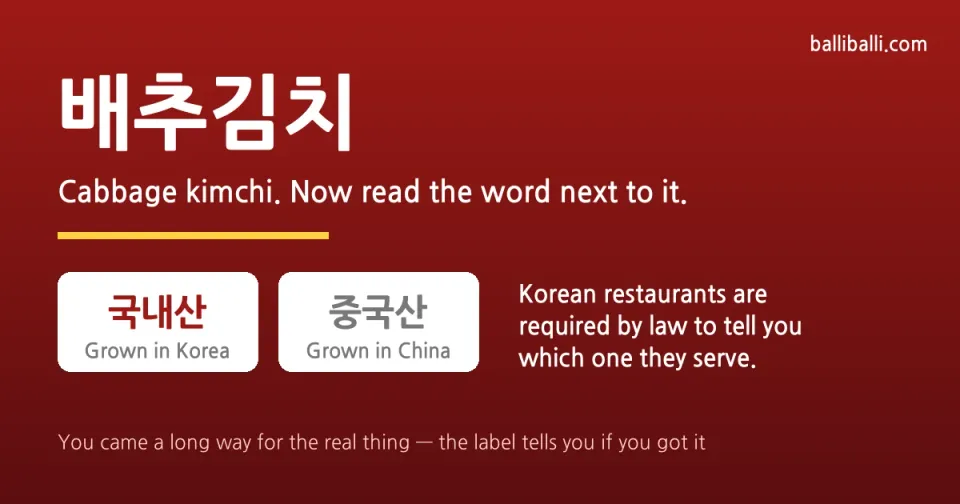
You came to Korea and you are going to eat kimchi. Good. It will arrive before you order anything, free, and it will be refilled without you asking.
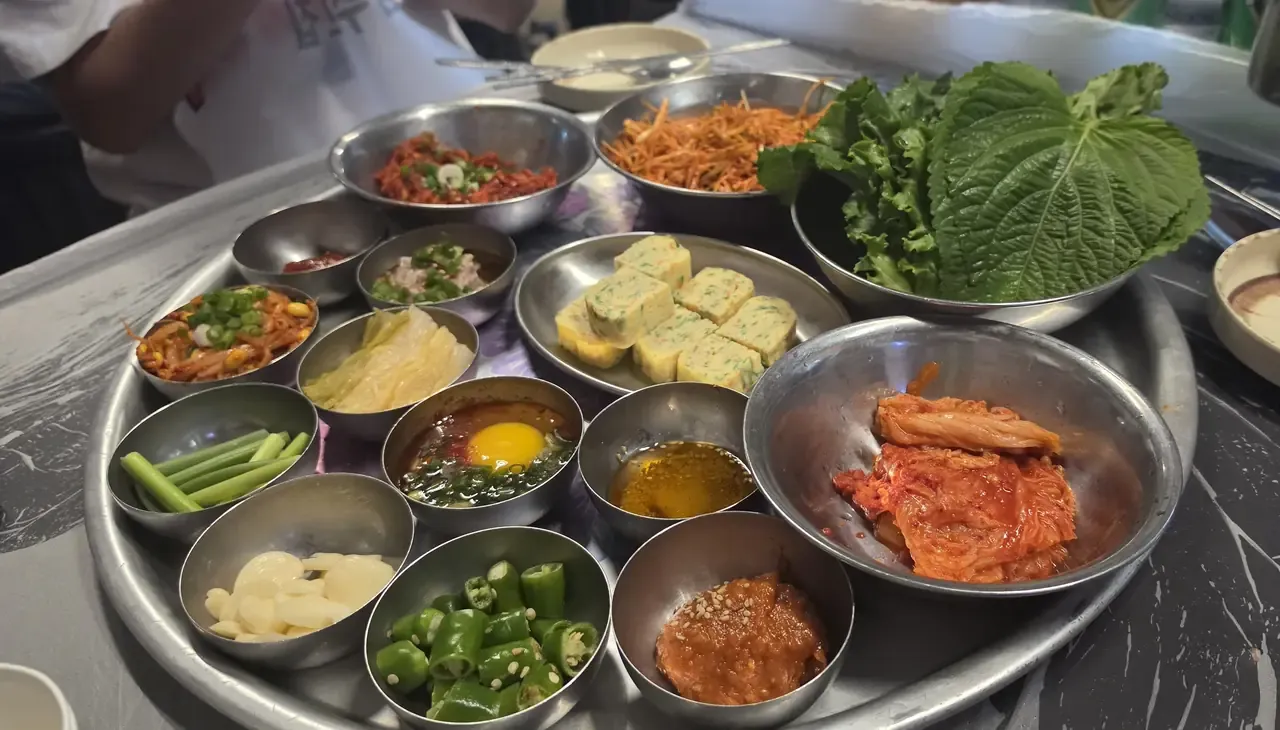
Nobody ordered any of this. The kimchi is the bowl on the right · ⓒ @BalliBalliSeoul
But there is a line printed on the menu — or on a small board screwed to the wall — that decides whether the kimchi in front of you was made from Korean cabbage or imported cabbage. Most visitors never notice it, because it is written in Korean and looks like fine print.
It isn’t fine print. It’s the law, and it’s there for you to read.
The line
Somewhere on the menu, or on a printed sheet near the counter, you will find something like this:
배추김치 (국내산)
Three things to know:
| Korean | Say it | What it means |
|---|---|---|
| 배추김치 | baechu-kimchi | Cabbage kimchi — the default kind |
| 원산지 | won-san-ji | Country of origin |
| 국내산 | gungnae-san | Grown in Korea |
| 중국산 | jungguk-san | Grown in China |
That’s the whole skill. Find 배추김치, read the word in the bracket beside it. If it says 국내산, you’re eating Korean cabbage. If it says 중국산, you’re eating cabbage that was grown in China and very likely turned into kimchi there too.
Korean restaurants don’t get to skip this. Origin labelling is a legal requirement, not a courtesy, and cabbage kimchi is specifically on the list of items that must be declared. That’s why even a tiny 분식 shop with six tables has a laminated sheet on the wall.
It shows up in one of two formats. The first is a board on the wall — two columns, 품목 (item) on the left and 원산지 (origin) on the right:
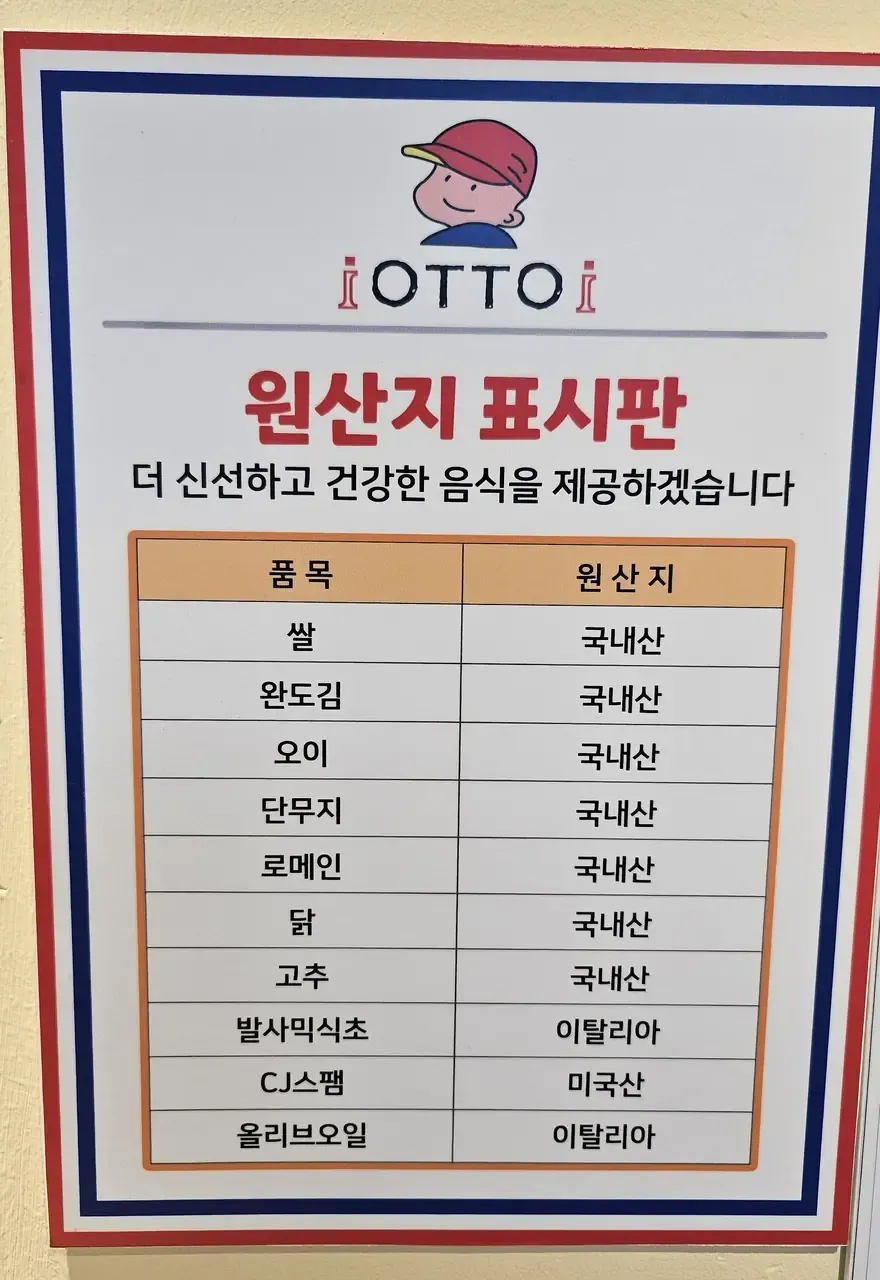
A real one: rice, Wando gim, cucumber, pickled radish, romaine, chicken and chilli all 국내산 — with the balsamic and olive oil declared as Italian and the Spam as American · ⓒ @BalliBalliSeoul
Two things that board teaches you at a glance. It isn’t only about kimchi — rice, meat, seafood and more all have to be declared, which is why the list is long. And honest imports are normal: nobody is hiding that the olive oil came from Italy. The label is a disclosure system, not an accusation.
Two practical notes:
- The sheet is usually Korean-only. Photograph it and run it through a translation app — it takes ten seconds and the layout is always the same.
- If you can’t find it, ask. “김치 국내산이에요?” — kimchi gungnae-san-ieyo? — “Is the kimchi Korean?” Staff hear this from Korean customers constantly. It is not a rude question here.
Why so many restaurants serve imported kimchi
Not a scandal — arithmetic.
Kimchi made from Korean cabbage costs meaningfully more than kimchi made from Chinese cabbage, and kimchi is given away free, in unlimited refills, at a table where the main dish might be ₩9,000. For a small restaurant running on thin margins, the side dish that nobody pays for is the first place the cost gets squeezed.
The second format shows you this happening in real time: the origin written in brackets after each dish, right on the price list.
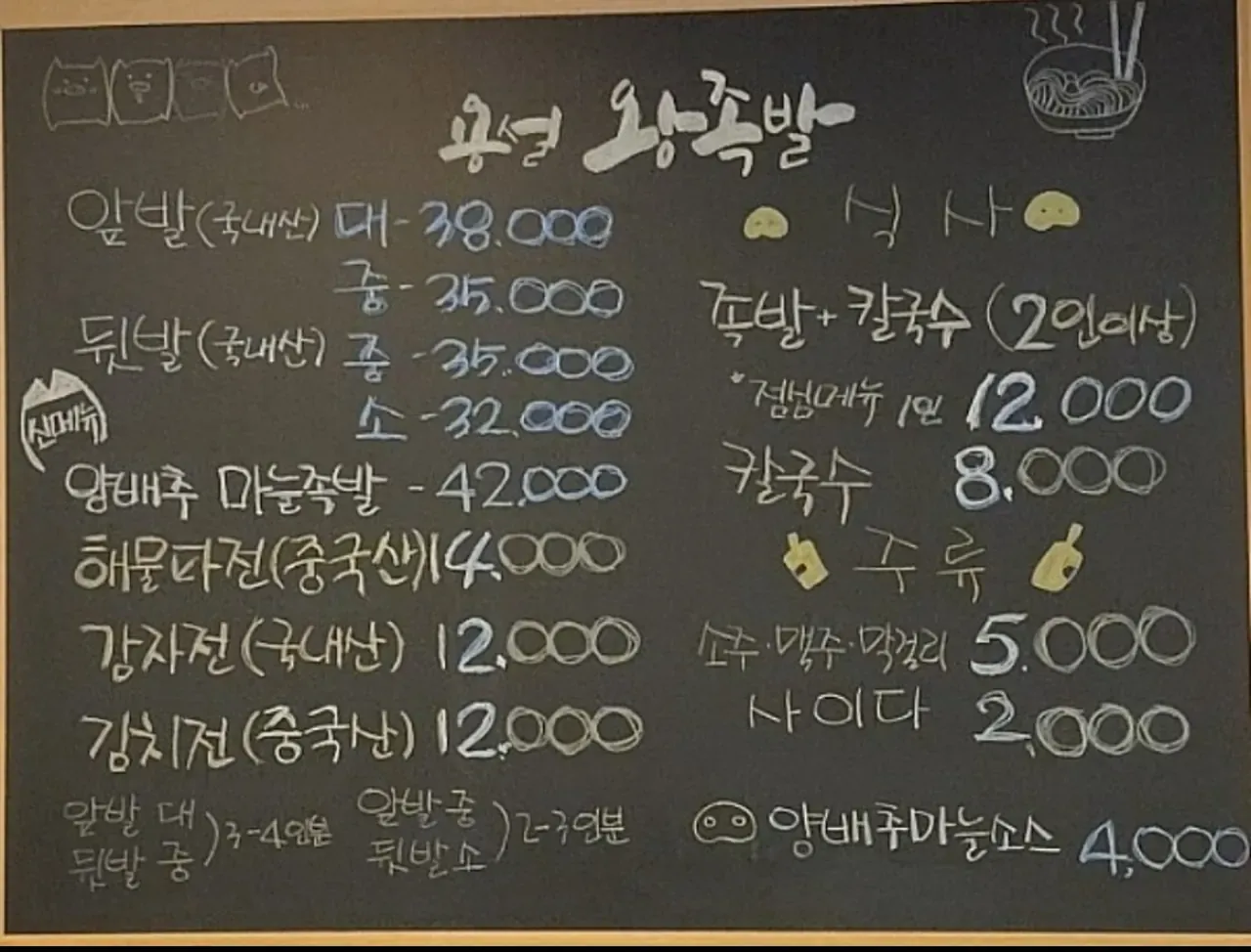
One board, one restaurant, three different answers · ⓒ @BalliBalliSeoul
Read down that board and the economics are laid out for you. The 족발 (pork trotters) — the dish people come for, at ₩32,000–38,000 — is 국내산, Korean. The potato pancake is 국내산. But the seafood pancake and the kimchi pancake are 중국산, Chinese.
Nothing is being hidden. The restaurant buys Korean pork because Korean pork is what the customer is paying for, and buys imported cabbage for the ₩12,000 pancake because that is where the margin lives. The label lets you see exactly where a kitchen decided to spend and where it decided to save — and then lets you order accordingly.
So the pattern is roughly this: the cheaper and more volume-driven the dish, the likelier the cabbage is imported. Places that make their own kimchi — and there are many — usually say so loudly, because it is a selling point.
None of which makes imported kimchi unsafe. It makes it not the thing you travelled for. You can buy Chinese-made kimchi in your own country. You came here for the other one.
The news that made everyone start reading labels again
In August 2026 a Chinese blogger posted video from a cabbage-buying yard in Kangbao County, Zhangjiakou, Hebei Province, showing workers dipping cabbages into a liquid before loading them onto trucks. Containers on the truck were labelled formaldehyde solution. Someone on site explained that treating the cabbage this way kept it looking fresh for another two or three days.
The local government investigated and confirmed the video was accurate, calling it an illegal act by a produce buyer trying to preserve freshness in transit. Police took enforcement action against the people and vehicles involved. China’s central government then ordered the shipment traced and launched nationwide spot-testing of perishable vegetables, promising that violations would be “severely punished.”
Formaldehyde is classified by the IARC as a Group 1 carcinogen — the category reserved for substances with sufficient evidence of causing cancer in humans. Using it as a food processing aid is already illegal in China under its own food safety law.
Now the part that most of the reposting leaves out, and that we are not going to leave out:
- The batch was traced to a wholesale market in Suqian, Jiangsu, and the testing done there had not found formaldehyde above legal limits at the time of reporting.
- There is no confirmation that any of this cabbage was exported to Korea or anywhere else. As of the reporting, neither Chinese authorities nor major Chinese outlets had established that.
So this is not “the kimchi in Seoul is poisoned.” It is context — the reason a Korean diner’s eyes go to that origin line by reflex, and the reason the labelling law exists in the first place. Read the label because it is there and it is free information, not because you are in danger.
Source: 머니투데이, 24 August 2026.
How to end up with Korean kimchi
At restaurants. Look for 국내산 on the origin sheet. Restaurants that make kimchi in-house often advertise it on the window or the menu — 직접 담근 김치 (jikjeop damgeun kimchi, “kimchi we made ourselves”) is the phrase. Kimchi-forward restaurants — a 김치찌개 specialist, a kimchi-jjim place, an old 백반 house — are the ones most likely to care, because kimchi is the product rather than the freebie.
If you are vegetarian, there is a second label problem. Kimchi is normally fermented with 젓갈 — salted shrimp or anchovy — so origin is not the only thing worth asking about. Kimchi without it exists, but it is not what arrives free with a meal; eating vegetarian here covers what to ask.
At the supermarket. Packaged kimchi carries its origin on the back label, in the same 원산지 box. The large domestic brands sit in the chilled aisle in bags and tubs, and there is usually a clear price gap between the Korean-cabbage products and the cheaper imports — the gap is the label.
At a market. Traditional market kimchi stalls sell by weight from big tubs, and this is the most fun version: you can taste before buying, and they will tell you how long it has been fermenting.
Why the Korean one is worth the trip
Kimchi is not a condiment here, it is a category. What arrives at your table is one of dozens:
- 배추김치 — napa cabbage, the default
- 깍두기 — cubed radish, crunchy, the standard partner to soups
- 총각김치 — whole young radishes with the greens on
- 열무김치 — young summer radish greens, thin and sharp
- 파김치 — spring onion, aggressive, superb
- 물김치 / 동치미 — watery, barely spicy, cold and clean
And kimchi is alive. It keeps fermenting, which means age is a flavour choice, not a defect: 겉절이 is same-day and salad-fresh, ordinary kimchi is a few weeks along, and 묵은지 has been aging for a year or more and is sour, deep and mainly used for cooking. Korean homes buy an entire appliance for this — the 김치냉장고, a fridge that exists only to hold kimchi at a stable fermenting temperature.
Once you’ve eaten kimchi at three different ages, the jar back home stops being the same food.
And the sour, older stuff is where the cooking starts: 김치찌개 (stew), 김치전 (pancake), 김치볶음밥 (fried rice), 김치찜 (braised until soft). If a restaurant advertises 묵은지, order it.
The Korean part
Reading the origin sheet is genuinely a ten-second job with a phone camera. Where it gets harder is everything past that: asking a market stallholder what’s in a tub, getting a kimchi order sent to your hotel, finding out whether an airline will let a vacuum-packed bag ride home in checked luggage, or calling a restaurant to ask if they make their own.
That’s the sort of errand our anything-else concierge service exists for — we’ll make the call in Korean and tell you the answer in English.
Get it sorted
Want to know what’s in a dish before you order it — or need something asked in Korean? Message us on KakaoTalk or WhatsApp with a photo of the menu. Asking costs nothing — you pay only for the work you book.
While you’re learning to read a Korean table, two more that pay off fast: how a Korean restaurant actually works covers the side dishes, the cutlery drawer and the bill, and the no-tipping rule explains why the number on the menu is the number you pay.
The one-line version: find 배추김치 on the origin sheet, and check whether it says 국내산. Two words, one glance, and you’ll know whether the free side dish in front of you is the reason you got on a plane.