Seoul Kids Cafes: Prices, Rules, and the DDP Playground
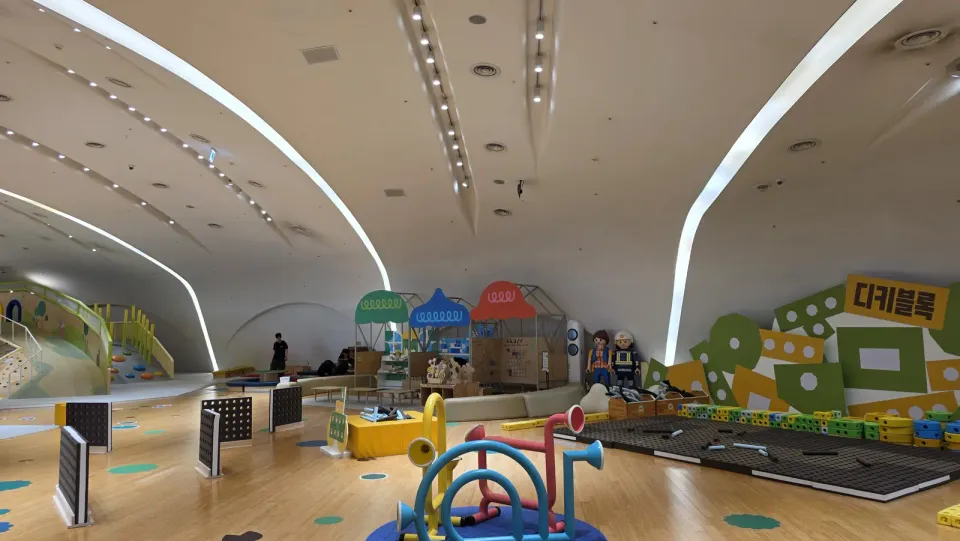
It is 35°C outside, or it has been raining since breakfast, and you have a four-year-old in a hotel room in Seoul. What Korean parents do at this point is go to a kids cafe (키즈카페, kideu kape) — an indoor playground you pay to enter by the hour. There is almost certainly one within two subway stops of you.
The concept is common enough here that nobody explains it, which is how foreign parents end up turned away at the door for reasons that had nothing to do with them.
What a kids cafe actually is
It is not a cafe with a play corner. It is a large indoor playground — slides, climbing walls, ball pits, building blocks, role-play areas — with a kitchen and coffee counter attached for the adults.
Three things make it different from a playground back home:
- You pay to get in, per child, for a fixed block of time
- The adult pays too, at a lower rate
- It is fully enclosed and air-conditioned, which is the entire point in August and in December
The bigger ones sit inside malls, department stores and cultural complexes, so you are never far from food, toilets and a place to park a stroller.
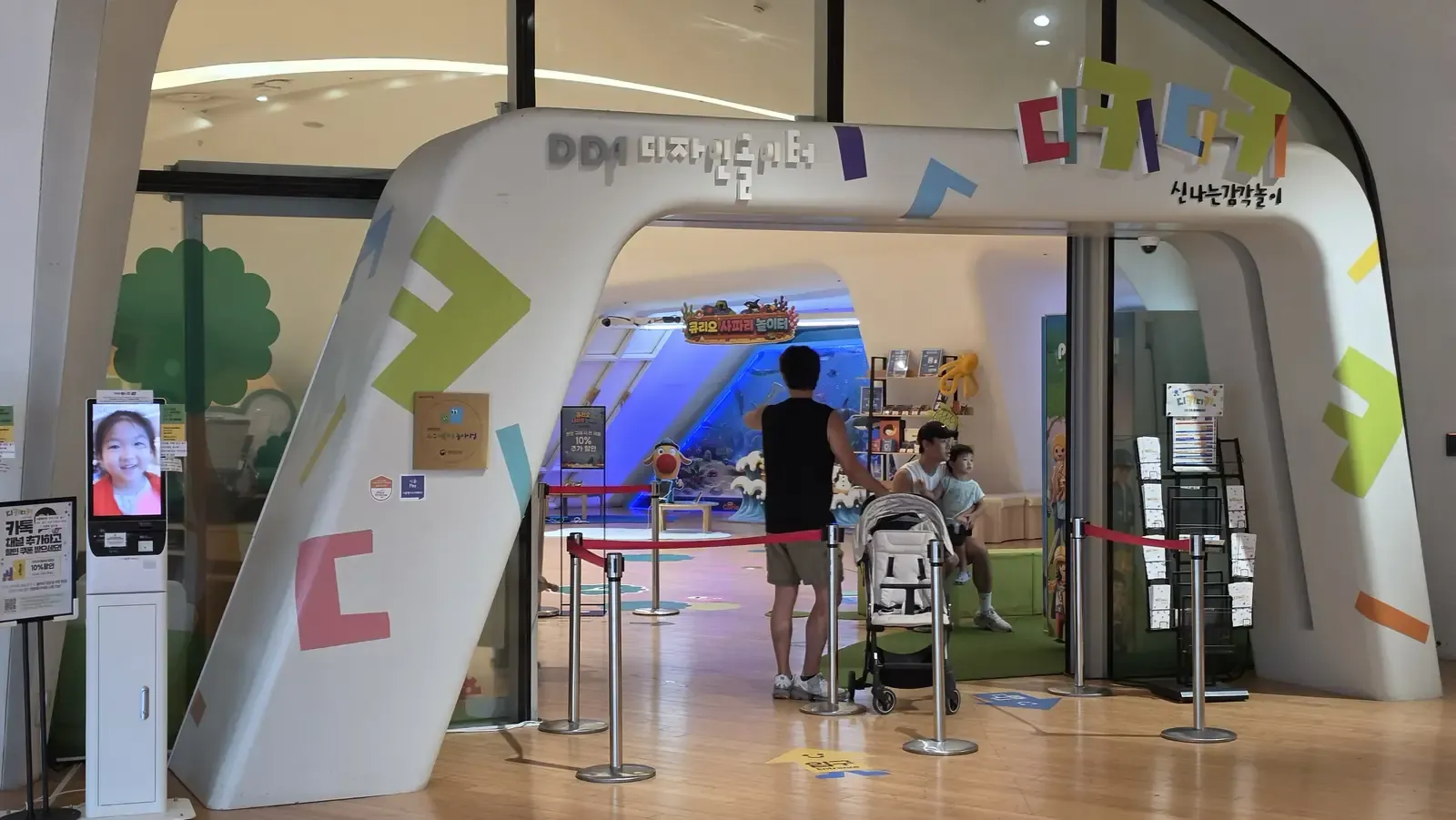
Most are tucked inside a larger building rather than standing alone · ⓒ @BalliBalliSeoul
The rules that catch foreign parents out
There is an upper age limit
This is the one that ruins afternoons. Kids cafes are licensed and insured for a specific age band, and staff enforce it. A typical band runs from around 24 months to 8 years old. If you have a ten-year-old, they are not getting in, however small they are.
There is a lower limit too — many places will not admit children who cannot yet walk.
Guardians buy a ticket, and there is a cap on guardians
You are not dropping the child off. An adult must stay, and that adult pays an entry fee of their own.
Less obvious: there is usually a maximum number of guardians per child — commonly two. If you have arrived as a family group of two parents plus grandparents, part of your group may have to wait outside. Worth knowing before everyone takes their shoes off.
Shoes off — and check the sock rule, because it varies
Shoes come off at the entrance and go into a shoe cabinet (신발장, sinbaljang). These cabinets frequently have no lock, and the notice on the wall will say plainly that the venue is not responsible for anything that goes missing. Do not leave your good trainers in one.
Then the part that surprises people: the sock rule is not the same everywhere. Many Korean play spaces require socks on at all times. Others require the opposite — the venue we photographed asks you to take the child’s socks off, in English on the sign, because bare feet grip better on wooden floors and climbing surfaces than socks do.
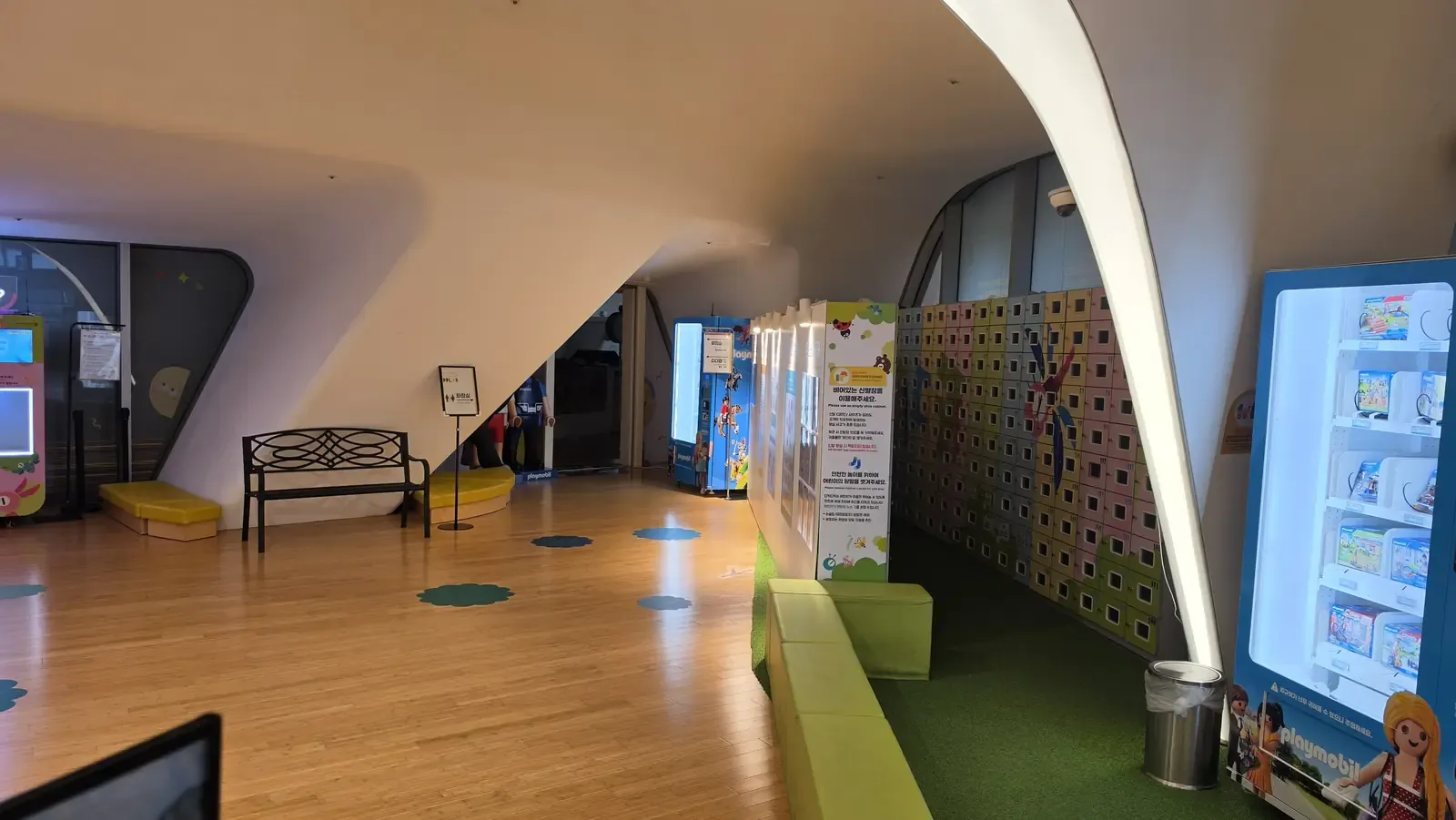
“Please remove children’s socks for safe play” — the opposite of what most parents expect · ⓒ @BalliBalliSeoul
Carry a clean pair of socks for the adults anyway. Some venues want grown-ups in socks even where children go barefoot, and no one wants to buy emergency socks at a convenience store.
How much does a kids cafe cost in Seoul?
Prices are per session, not per day, and the clock starts when you check in. Overtime is billed in small increments rather than being waved through.
As a planning number, two hours for one child and one adult lands around ₩20,000–₩30,000 across most of Seoul, with mall-based and premium venues higher. Food is extra, and so is anything past your booked block.
Two things quietly change what you pay:
- Discover Seoul Pass is accepted at some venues — if you are already carrying one for the palaces, check before you pay cash
- Messenger-channel discounts are everywhere in Korea. Adding the venue’s KakaoTalk channel for a percentage off is standard practice, not a scam
The DDP playground: prices, ages and hours
Here is one worked example, because a real price board beats a range. The Dongdaemun Design Plaza (DDP) — the Zaha Hadid building in Dongdaemun — has an indoor playground inside it, signed DDP 디자인놀이터 (DDP Design Playground) and run under the name 디키디키 (DiKi DiKi).
| Ticket | Price |
|---|---|
| Child, 2 hours | ₩18,000 |
| Each additional 10 minutes | ₩1,500 |
| Guardian | ₩5,000 |
| Detail | |
|---|---|
| Age band | 24 months to 8 years |
| Guardians | Up to two per child |
| Opening hours | 10:30–18:30 |
| Closed | Every Monday, plus the days of Seollal and Chuseok |
| Capacity | 170 children at a time |
| Payment | Cards; Discover Seoul Pass accepted |
Last verified: 2026-08-14. Prices and hours at any single venue change without much notice, so treat this as the shape of the market and confirm before you travel across the city for it.
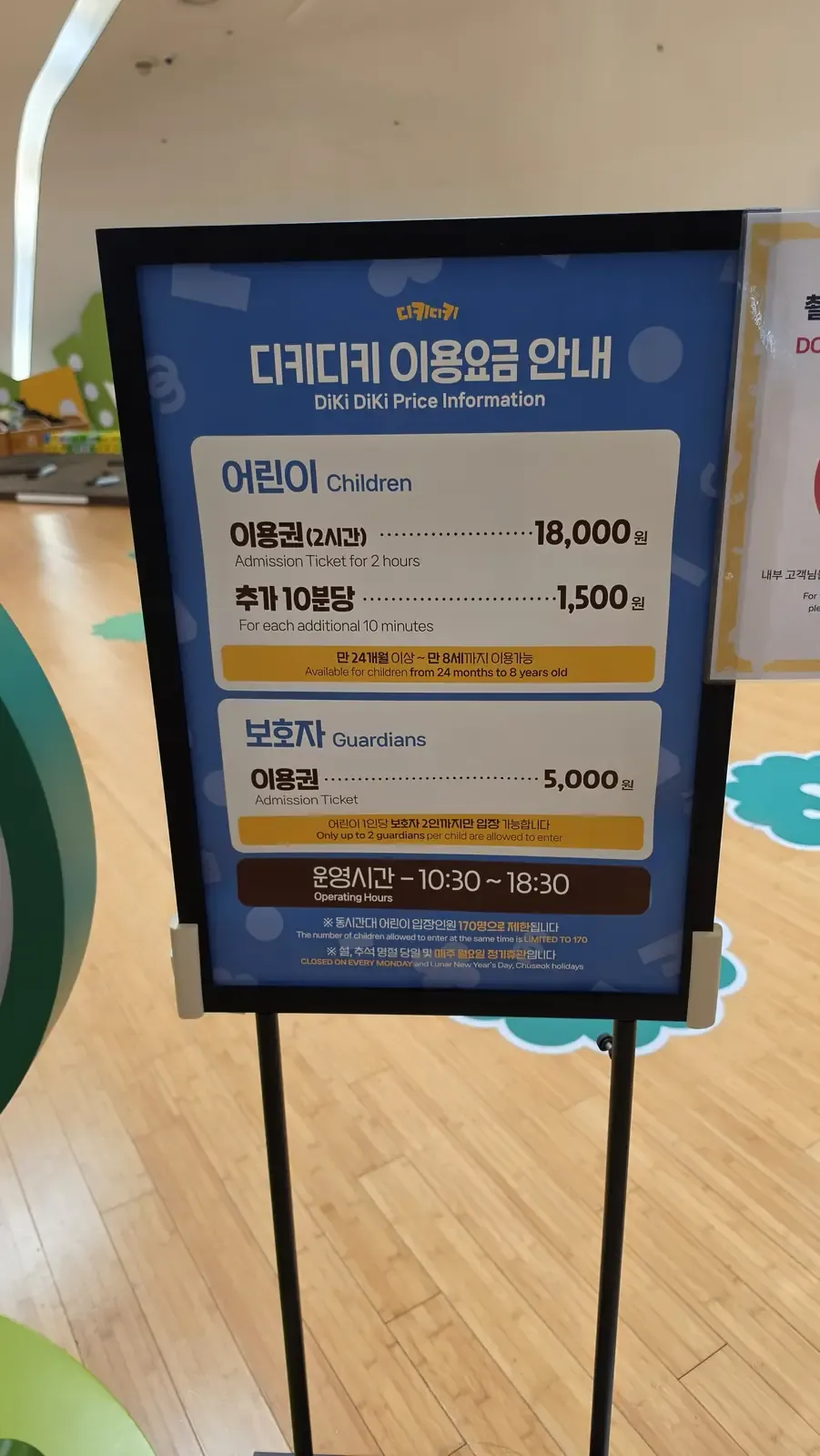
Price boards are often bilingual, even where nothing else is · ⓒ @BalliBalliSeoul
Getting there is the easy part: DDP has its own subway station served by lines 2, 4 and 5, and the colour-coded line system makes it one of the simpler places in Seoul to reach. The station exits bring you up inside the complex.
Come by subway if you can. Driving means the underground car park, and parking is charged separately from your admission ticket.
There is a way to avoid it, with a catch. The playground will issue a voucher for up to two hours of free parking — but only if you spend ₩50,000 or more on food and drink inside. That is a high bar for one family and one child, so the maths only works if you were already planning to eat a full meal there. Ask at the counter and hold on to your receipt.
On a busy weekend the garage fills, and once it does, simply getting in becomes the problem before you have reached the door. With a pushchair and a small child in the car, that is not the start to an afternoon you want.
Do you need to book, or can you just turn up?
Two operational details decide whether your trip works.
They cap how many children are inside at once. Fire and safety rules mean a hard ceiling at every venue. When it fills, a sign goes up at the counter reading 입장 마감 (ipjang magam) / Admission Closed, and that is the end of the conversation until someone leaves.
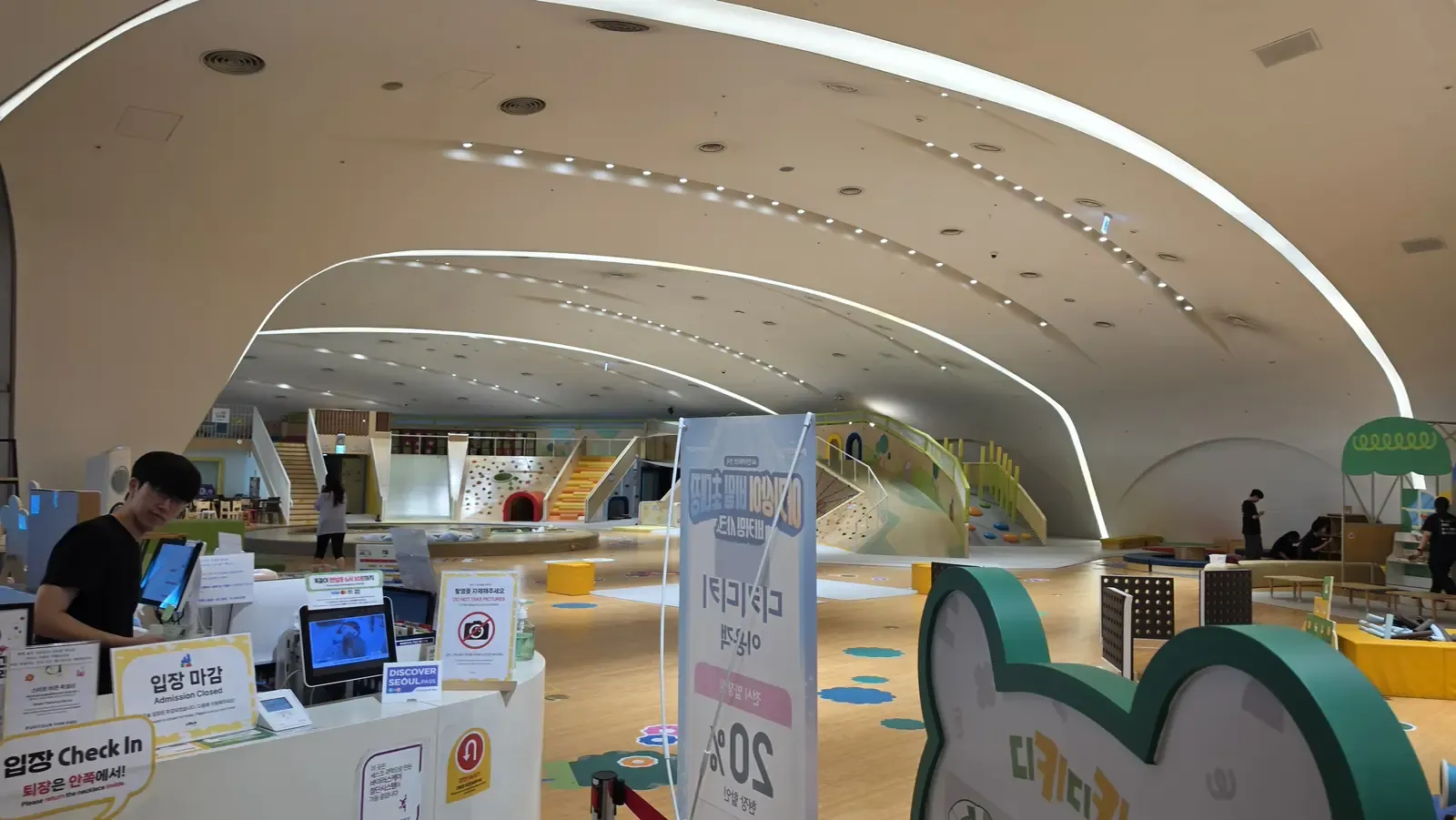
“입장 마감 / Admission Closed” — the sign you do not want to arrive to · ⓒ @BalliBalliSeoul
Weekends, school holidays and rainy afternoons are exactly when every other parent has the same idea. Go at opening time, or go on a weekday.
Many close one day a week, and Monday is the usual one. Museums and cultural venues in Korea overwhelmingly close on Mondays, and playgrounds inside them follow suit. Add the day-of closures for Seollal and Chuseok, the two big lunar holidays, when a large share of the country shuts entirely.
Can you eat inside a kids cafe?
Yes, and it changes the plan. Most have a real kitchen, and you order from the counter or a tablet at your table — so a two-hour session can absorb lunch or dinner instead of ending in a hunt for a restaurant with a tired toddler in tow.
What is typically on the menu:
- 볶음밥 (bokkeumbap) — fried rice. The reliable order for a child who is suspicious of everything else
- 치킨 (chikin) and chips — Korean fried chicken and fries, and the thing most foreign children will actually finish
- 떡볶이 (tteokbokki) — chewy rice cakes in a red sauce, and this one is usually spicy. Korean children grow up on it; children who have never met gochujang often cannot eat it. Ask before you order it for a four-year-old
- Ice cream and slush drinks — which is what the two-hour mark reliably turns into
Now the honest part: expect venue pricing. You are ordering inside a ticketed room with no competition on site, and the prices reflect that — noticeably more than the same dish at a normal restaurant down the street. It is the cinema-popcorn rule, applied to fried rice.
Whether that bothers you is a budget question, not a value one. Eat before you arrive and keep the in-house order to ice cream at the end, or accept the markup for the considerable luxury of feeding everyone without putting shoes back on.
You are not locked in, though. Kids cafes sit inside bigger buildings, and that works in your favour. DDP is the obvious example: there is a run of restaurants on the lower level of the complex itself, and Dongdaemun outside it is one of the densest eating districts in Seoul — food courts, chains, Korean places, and stalls that stay open long after the playground has closed. Two hours of play followed by a proper meal at normal prices is a perfectly sensible plan, and usually the cheaper one.
One exception worth doing the sums on: if you drove to DDP, the ₩50,000 spend that unlocks two hours of free parking is easier to justify when it also covers lunch.
The Korean part
Almost everything above is posted on a sign somewhere in the building. The problem is that the price board is bilingual and the rules board frequently is not, so the information you most need — age bands, guardian caps, whether today is a closing day, whether they are already full — is the part that stays in Korean.
The food menu is the same story. Ordering often runs through a Korean-only tablet or kiosk, and “is this spicy?” is exactly the question you cannot afford to get wrong for a small child.
Phone lines are worse. Small venues answer in Korean only, and “are you full right now?” is not a question a translation app handles well in a noisy room.
Not sure whether a place will take your child’s age, or whether it is open today? Send us the name or a link on WhatsApp and our anything-else concierge service will call and ask, in Korean, and tell you in English. Asking costs nothing — you pay only for the work you book.
For more ways to get a family out of the weather, our guide to escaping the heat at IFC Mall covers the same problem from the mall side.
Get it sorted
The one-line version: budget around ₩20,000–₩30,000 for two hours for one child and one adult, check the age band before you travel across town, expect to pay for yourself too, take shoes off and read the sock sign, do not turn up on a Monday, and know that you can eat there if you are willing to pay venue prices.
Get those right and the weather stops being your problem for an afternoon.