How to Learn Korean in Seoul: Free Classes and Tutors
Someone on r/Korean put it about as plainly as it can be put:
I’ve never studied a language before so I’ve been using Duolingo everyday for the past 3 months and I’ve learned almost nothing. What would you recommend?
Eighty-odd people upvoted that. The replies are not gentle about Duolingo, and they are mostly right — but the more useful thing is what the question exposes. Learning Korean is not one decision. It is four or five, taken in order, and most people take the easiest one first and then wonder why they have stalled.
Here is the order, and what each step costs in Seoul.
Start with Hangul — it takes a weekend
Before anything else: learn the alphabet. Not “eventually” — this weekend.
Hangul was designed to be learnable. The letters are shaped after the mouth positions that make them, and a motivated adult gets through it in a couple of days. There is no romanisation system worth the trouble, and every hour you spend reading Korean through English letters is an hour you will have to undo.
This is the one stage where the free apps are genuinely fine. Nothing can go badly wrong here — you are learning symbols, not register. Use whatever is nearest, get it done, and stop treating it as an achievement. It is the entry fee.
What about the apps?
Then comes the question the r/Korean poster was really asking.
The thread’s verdict on Duolingo, repeated by commenter after commenter, is not that it teaches you nothing. It is that it stalls. The sentences get strange, the grammar is never explained, and there is no obvious point at which you are supposed to graduate from it. One reply put the useful version of the criticism: it is a vocabulary drill wearing the costume of a course.
Two things worth taking from that thread rather than the app-list articles:
Check whether the free thing is still free. Several resources that a 2023 recommendation calls free have since moved behind a paywall, wholly or partly. That is not a scandal — people have to eat — but it does mean an old forum thread is a starting point for a search, not a shopping list.
The learners themselves keep landing on the same free institutions. The King Sejong Institute material comes up repeatedly in that thread, entirely independently of the Seoul city page we will get to in a moment. When a learner community and a government portal point at the same door, that is worth something.
And the limit on all of it, which no app has solved and none is about to: software cannot hear you. Hold that thought — it decides the last section of this article.
Which Korean class fits you, in one minute
If you read nothing else, read the table.
| If you… | Go with |
|---|---|
| Are new, on a budget, and free on a weekday | City free classes |
| Are disciplined and want grammar and reading | Free online (King Sejong) |
| Want structure and can give up your daytime for ten weeks | A university institute |
| Work full time but want a real course | A university evening or online course |
| Have a base and still cannot speak | A Korean tutor |
| Need Korean for your job — email, meetings, the register | A Korean tutor (workplace Korean) |
| Are outside Seoul, or not in Korea yet | A Korean tutor, by video call |
| Need proof for a visa, a university or an employer | TOPIK preparation, whichever route |
Now the detail.
One disclosure first, because it matters for how you read the rest: we have no connection to any of the programmes below. No partnership, no referral arrangement, nothing. We list them because for a lot of people they are the right answer. What we run is our own small thing — two teachers — and it comes at the end.
Free Korean language classes, run by the city
This is the part most people never find, and it is genuinely free.
Seoul Metropolitan Government and its partner organisations run Korean classes for foreign residents across the city:
- Seoul Global Center — 2 locations
- Global Village Centers — 7 locations
- Foreign Workers’ Centers — 6 locations
Contact: +82-2-2075-4180 · global.seoul.go.kr (the site runs in Korean, English, Chinese and Japanese)
What you get is a real classroom with a real teacher at no cost. What you give up is choice: fixed timetables, fixed locations, mixed-level groups, and terms that fill up. If one of the locations is near you and the schedule fits, this is unambiguously the best value in Korean education in this city and you should start here rather than reading on.
Free Korean classes online
Three no-cost options worth knowing, all government or university-backed rather than commercial apps:
| Platform | Site | Languages |
|---|---|---|
| Nuri–King Sejong Institute | nuri.iksi.or.kr | Korean, English, Chinese, Japanese, French, Thai, Vietnamese, Spanish, Indonesian |
| Cyber University of Korea | korean.cuk.edu | Korean, English |
| EBS DURIAN | ebs.co.kr/durian/us | Korean, English, Chinese, Vietnamese |
The King Sejong material in particular is the closest thing to an official national curriculum, and it is free in nine languages.
These are excellent for reading, listening and grammar. They are structurally incapable of telling you that what you just said sounded rude, because nobody hears you say it.
Churches, and the trade-off nobody states
There is a fourth free route that guides tend to either skip or sell, and it deserves the plain version.
A number of Korean churches offer free Korean lessons to foreigners. If you have ever met missionaries teaching English in another country, this is the same arrangement running the other way: a religious organisation with people, rooms and time, using language teaching as a way to meet newcomers.
The trade-off is not hidden, but it is rarely stated: the lessons are free, and there is usually an expectation that you will come to services. That is not a criticism — it is the deal. Some people are entirely happy with it and get a social circle out of it as well as a class. Others would rather pay.
We have not attended one, so we are not recommending or warning you off. We are telling you it exists, and that the arrangement is worth understanding before you walk in rather than after.
University Korean language institutes
The serious, structured option. Most Seoul universities run a Korean language centre open to the public.
Contacts as listed by the Seoul Metropolitan Government, as of August 2026 — check the institute’s own site before you plan around any of it:
| University | Phone | Site |
|---|---|---|
| Korea University Korean Language Center | 02-3290-2971 | klcc.korea.ac.kr |
| Konkuk University Korean Education Dept. | 02-450-3075~6 | kli.konkuk.ac.kr |
| Kyung Hee University Institute of International Education | 02-961-0081~2 | iie.khu.ac.kr |
| Dongguk University International Language Institute | 02-2260-3471~2 | interlang.dongguk.edu |
| Sookmyung Global Language Institute | 02-710-9164 | lingua.sookmyung.ac.kr |
| Soongsil University Office of International Affairs | 02-820-0783~4 | language.ssu.ac.kr |
| Sungkyunkwan (SKKU) Sungkyun Language Institute | 02-760-1341 | koreansli.skku.edu |
| Sogang Korean Language Education Center | 02-705-8088~9 | klec.sogang.ac.kr |
| Seoul National University Language Education Institute | 02-880-8570 / 5488 | lei.snu.ac.kr |
| Yonsei University Korean Language Institute | 02-2133-3465 / 8550~1 | yskli.com |
| Ewha Language Center | 02-3277-6958 | elc.ewha.ac.kr |
| Hankuk University of Foreign Studies — Korean Language & Culture | 02-2173-2262 | korean.ac.kr |
| Hanyang Institute of International Education | 02-2220-1449 | iie.hanyang.ac.kr |
| Hansung University Language Education Center | 02-760-4433 | hansung.ac.kr |
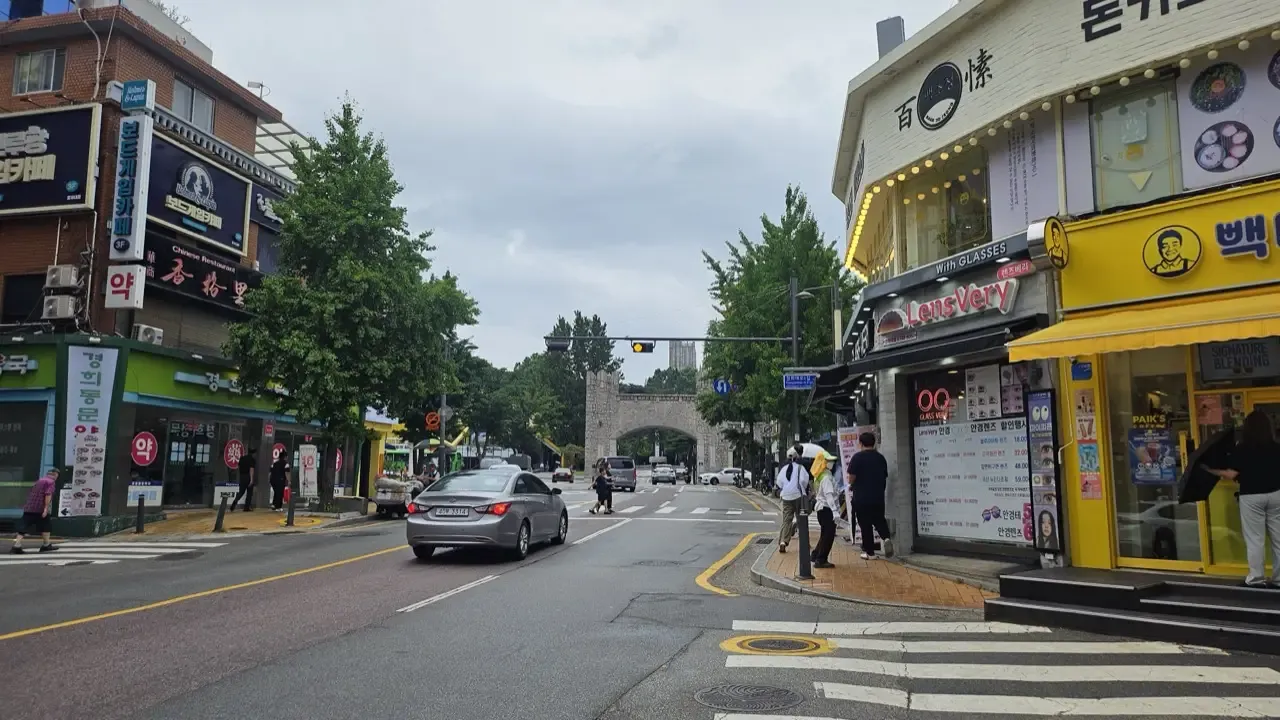
Most of these sit in a university district, which is its own reason to go · ⓒ @BalliBalliSeoul
Most publish in Korean, English, Chinese and Japanese, so the enquiry itself is manageable without Korean.
The evening course nobody mentions
The standard advice is that a university institute is impossible if you have a job. That is not quite true any more, and it is the most useful thing in this article.
Yonsei, for example, runs an online course by Zoom, three evenings a week — Monday, Tuesday and Thursday, 18:30 to 21:05 — ten weeks, ninety hours, levels 1 to 8. It costs roughly half what the daytime course costs.
There is a real catch, and it is not the price: that course cannot get you a visa or extend your stay. If you are here on a student visa built around language study, the daytime programme is the one that counts. If you are here on something else and simply want to learn, the evening route is open.
Ask each institute whether they run one. Not all of them do, and none of them advertise it at the top of the page.
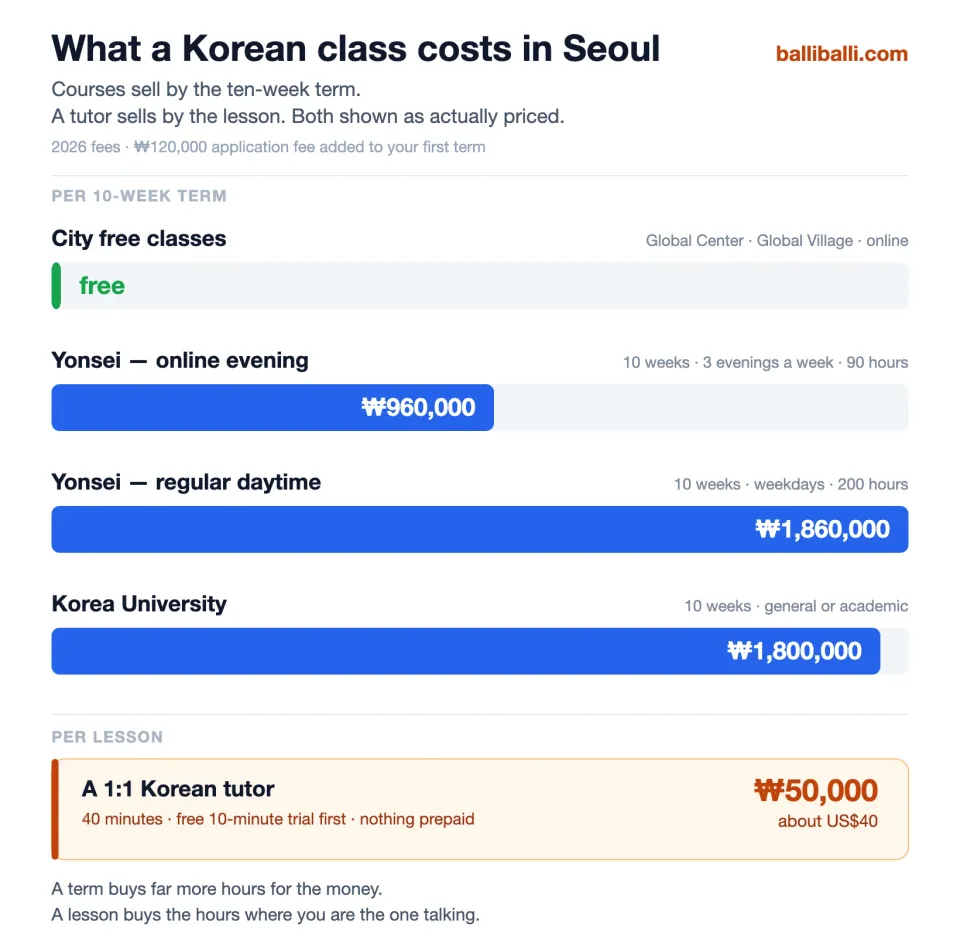
What a Korean class actually costs
Numbers, because everyone dances around them. These are 2026 figures published by two institutes — Yonsei and Korea University — and the other twelve will differ, so treat them as the shape of the thing rather than the price list.
| Route | Term | Hours | Fee |
|---|---|---|---|
| City free classes · free online | — | — | ₩0 |
| Yonsei, online evening course | 10 weeks | 90 | ₩960,000 |
| Yonsei, regular daytime course | 10 weeks | 200 | ₩1,860,000 |
| Korea University, general or academic | 10 weeks | — | ₩1,800,000 |
| Yonsei, 3-week short course | 3 weeks | 60 | ₩1,080,000 |
| Yonsei, 5-week summer course | 5 weeks | 100 | ₩1,580,000 total |
Add ₩120,000 to your first term. Both institutes charge a non-refundable application fee on top, and it is easy to miss when you are comparing.
A private tutor is sold differently — by the lesson, not by the term. Ours is ₩50,000, about US$40, for a 40-minute one-to-one lesson, with a free ten-minute trial first and nothing paid in advance.
Those two things do not divide neatly into each other, and we are not going to pretend they do. A term buys you far more hours for the money. Two hundred hours of teaching for ₩1,860,000 is excellent value and no tutor can match it on volume.
A lesson buys you something else: the hours where you are the one talking. In a class of a dozen people, most of your speaking is done by someone else. That is the entire difference, and it is why the two are priced the way they are.
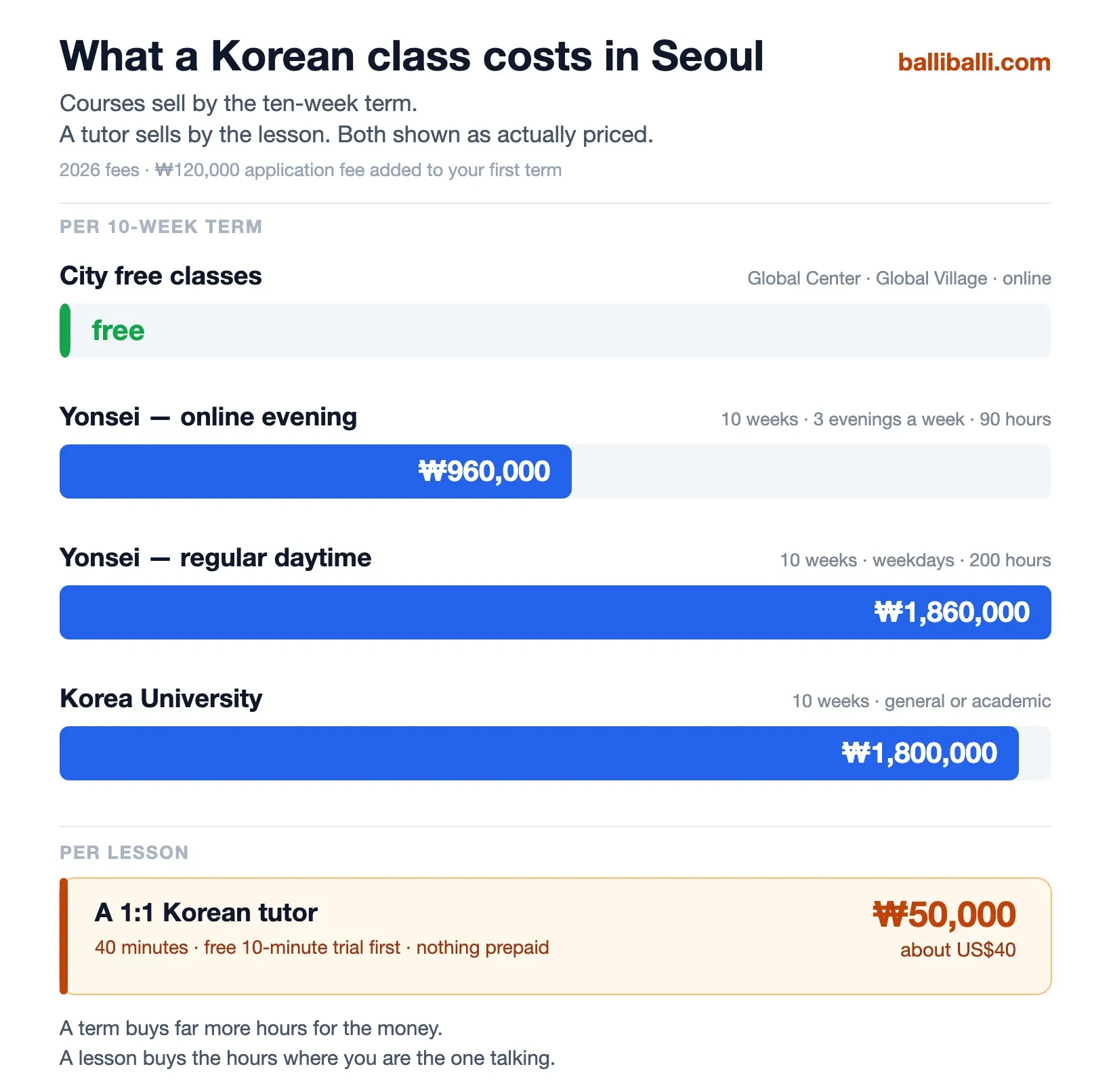
Courses are priced per ten-week term; a tutor per lesson · ⓒ Balli Balli Seoul
If a free class or an institute fits your schedule, take it. Genuinely. Come back to this next bit when it doesn’t.
What a Korean teacher does that a class can’t
Look down the list and notice what is missing from every free and institutional option: someone correcting your speaking, on your schedule, about the things you personally have to say.
City classes and university courses teach a syllabus to a group. Online platforms cannot hear you. Both are the right tool for building a base — and neither can rehearse you through the conversation you are dreading at the building office on Thursday.
There is a beginner’s worry that comes up on r/Korean again and again, and it is the sharpest version of this: what if I get fairly far and then find out that everything I learned is slightly off — too formal, or not formal enough — and I never knew?
That instinct is correct. No app will ever tell you that you have been mildly rude to a shopkeeper for six months. The gap between fine and faintly impolite in Korean is a verb ending, and only a person who hears you say it can close it.
So the case for a tutor is a narrow one:
- You work, and even the evening course is more than you can commit to
- You have a base already and cannot get from reading to speaking
- You need specific situations — the landlord, the clinic, the workplace — rather than chapter four
- You need workplace Korean — email, meetings, and the register people actually use in a Korean office
- You are aiming at a TOPIK level and need the writing section marked by a human
🇰🇷 Want a Korean tutor? We can introduce you

Rim — came to teaching from the working world, so workplace Korean is her ground · ⓒ Balli Balli Seoul

Elli — a career teacher, and the one to ask for patient beginner work · ⓒ Balli Balli Seoul
We match you with a Korean teacher — conversation, the Korean for specific situations, workplace Korean, or TOPIK preparation.
- Free 10-minute trial, then ₩50,000 (about US$40) for a 40-minute 1:1 lesson
- Online by video call — Zoom, KakaoTalk or Teams — so your country and time zone do not matter. In person in Seoul is available too
- Booked as you go. No package, nothing prepaid
Both teachers, and what each is best for, are on our Korean lessons page. Or message us on WhatsApp or KakaoTalk — first answer is free.
Not in Seoul, or not in Korea yet? Everything above this line — the city classes, the institutes, the churches — is Seoul only. Video lessons are the one option on this page that does not care where you are, which is why people who are still planning the move tend to start here.
To be straightforward: we make the introduction and handle the arrangement, the teaching is the teacher’s, and we do not promise a test result.
And TOPIK, briefly
If the reason you are learning is paperwork — a university, a visa points table, an employer — the thing being measured is TOPIK, the official proficiency test. Your score picks the level rather than you: TOPIK I awards levels 1–2, TOPIK II awards 3–6, and it runs six times a year.
Dates and requirements change, so use topik.go.kr rather than any blog, including this one. We wrote up how the test actually works, with the cut scores separately.
And if your goal is not a certificate but simply being able to speak, that is a different plan and a more common one.
The Korean part
The irony of learning Korean here is that signing up for it often happens in Korean. Free class registration runs through district and centre websites, university institutes want documents, application windows close months ahead of the term, and the popular slots go to whoever could read the announcement.
Not sure which of these fits you? Message us on WhatsApp with your level, your schedule and what you are aiming at — our anything-else concierge service will tell you honestly which route makes sense, including when that route is a free class rather than us.
Get it sorted
Many of these rooms are run by churches and community centres, which are also where an English-language Sunday service is easiest to find: English mass in Seoul.
Another way to be in a Korean-speaking room every week, with almost no Korean required to start: K-pop dance classes, which run on counts and demonstration.
The one-line version: learn Hangul this weekend, then pick by schedule rather than by app — the city runs free classes, King Sejong runs free online material, the universities run the serious courses and quietly run evening ones too, and a tutor exists for the people none of that can fit.
Institute contacts compiled from the Seoul Metropolitan Government’s English site; fees from the institutes’ own 2026 pages. All as of August 2026. We have no affiliation with any of them.