Why Is Everything in Korea a 'Cafe'?
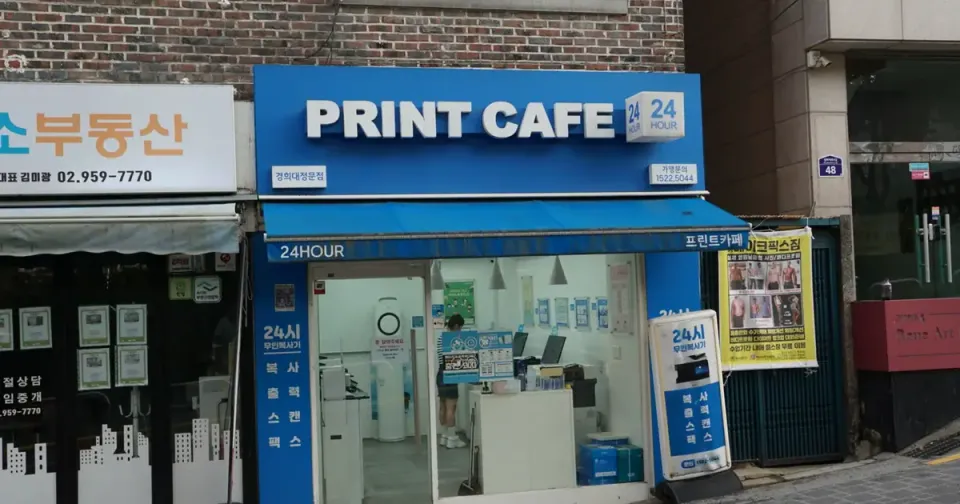
Walk one Seoul block and you’ll pass a PRINT CAFE, a building with PC glowing on three floors, a Coin Wash 24, and a study cafe. None of them sell coffee as the main event. At some point you realise the word isn’t doing the job you think it’s doing.
In Korea, “cafe” mostly means: a room you rent by the hour. Once that clicks, a whole category of shopfront becomes legible.
Why the city is built this way
The underlying reason is space. Homes here are small and expensive, especially the ones young people can afford, so the functions that would live inside a house elsewhere have been unbundled and sold back by the hour: a desk, a washing machine, a printer, a big screen, a room to be loud in.
That’s not a hardship story — it’s a genuinely good deal. You get a better desk, a better machine and better air conditioning than you could fit in your room, and you pay only for the hours you use.
Two suffixes: 카페 and 방
You’ll see both, and the difference is mostly branding and vintage.
- 방 (bang) literally means room — PC방, 노래방 (karaoke), 찜질방 (bathhouse), 만화방 (comics). The older, plainer word.
- 카페 (cafe) is the newer, tidier label applied to the same idea — 스터디카페, 프린트카페, 만화카페, 보드게임카페.
Same economics, different decade of signage.
PC방 — the gaming room
The most famous one. Rows of high-spec PCs, big monitors, deep chairs, and a keyboard that has been used a great deal.
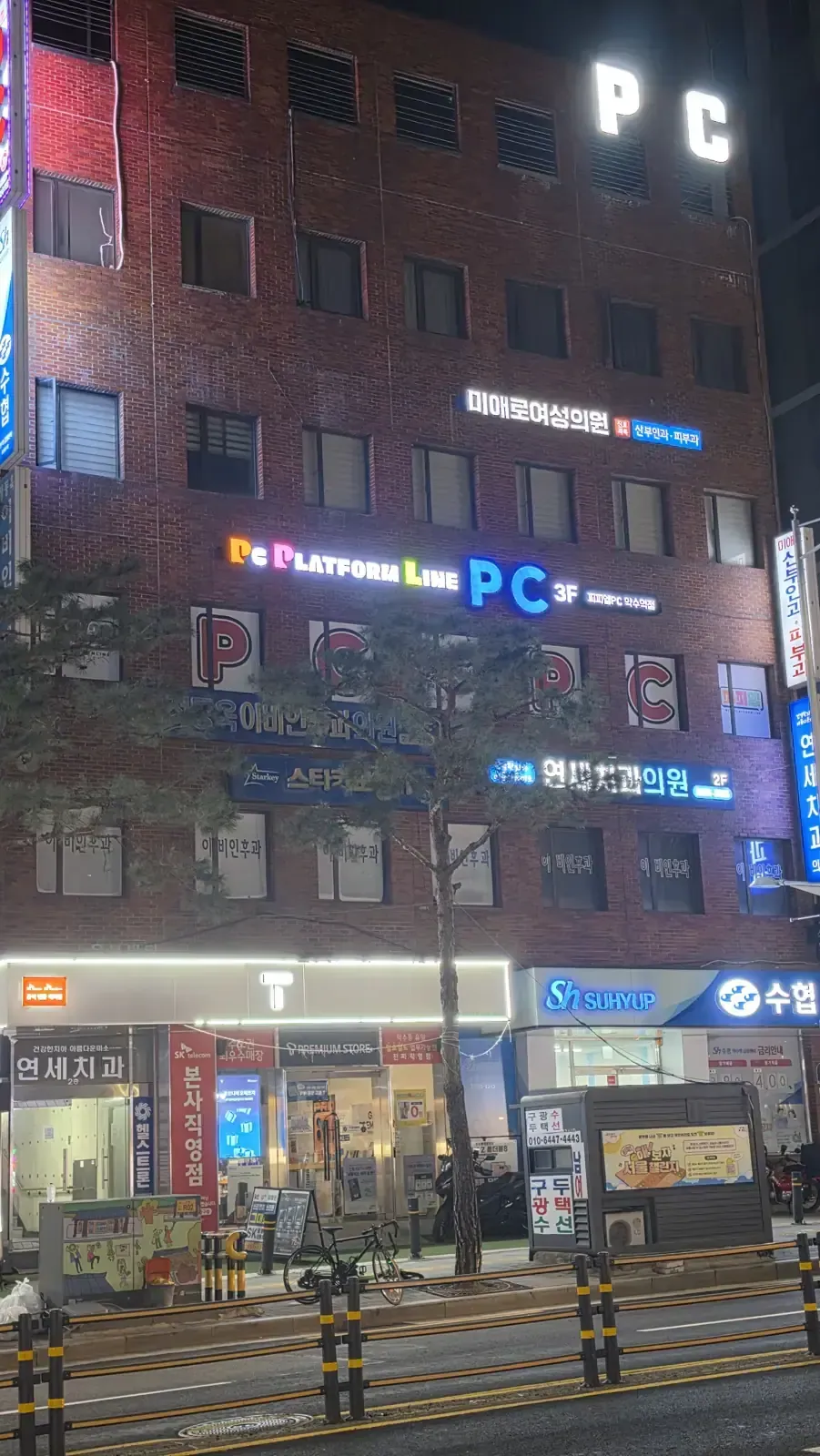
PC on the third floor, and the fourth · ⓒ @BalliBalliSeoul
What surprises visitors:
- It’s cheap — roughly ₩1,000–2,000 an hour, often less overnight.
- There’s a real kitchen. You order food from the screen at your seat — ramyeon, fried rice, dumplings — and someone brings it to you. The PC방 meal is a genre of its own.
- You log in at the seat. Staff can set up a guest or temporary account; you may be asked for ID.
- Minors have curfews. Under-16s aren’t allowed late at night, so ID checks are normal and not aimed at you.
Study cafe (스터디카페) — a desk, by the hour
A silent room of individual desks, sold by the hour — roughly ₩2,000–3,000 — often running 24 hours with a door code instead of staff. You pay at a kiosk, it prints a code, you let yourself in.
This is the paid tier of a habit that already runs through ordinary coffee shops here, where one americano buys you the table all afternoon — which we covered in Korean cafe culture.
Print cafe (프린트카페) — the one you’ll actually need
Sooner or later you’ll need to print a contract, a visa form or a boarding pass, and you don’t own a printer. This is the answer, and it’s usually open 24 hours.
Bring the file on a USB stick, or send it to yourself and open it on the shop PC. The machines do printing, copying, scanning and fax — and yes, Korean bureaucracy still occasionally wants a fax.
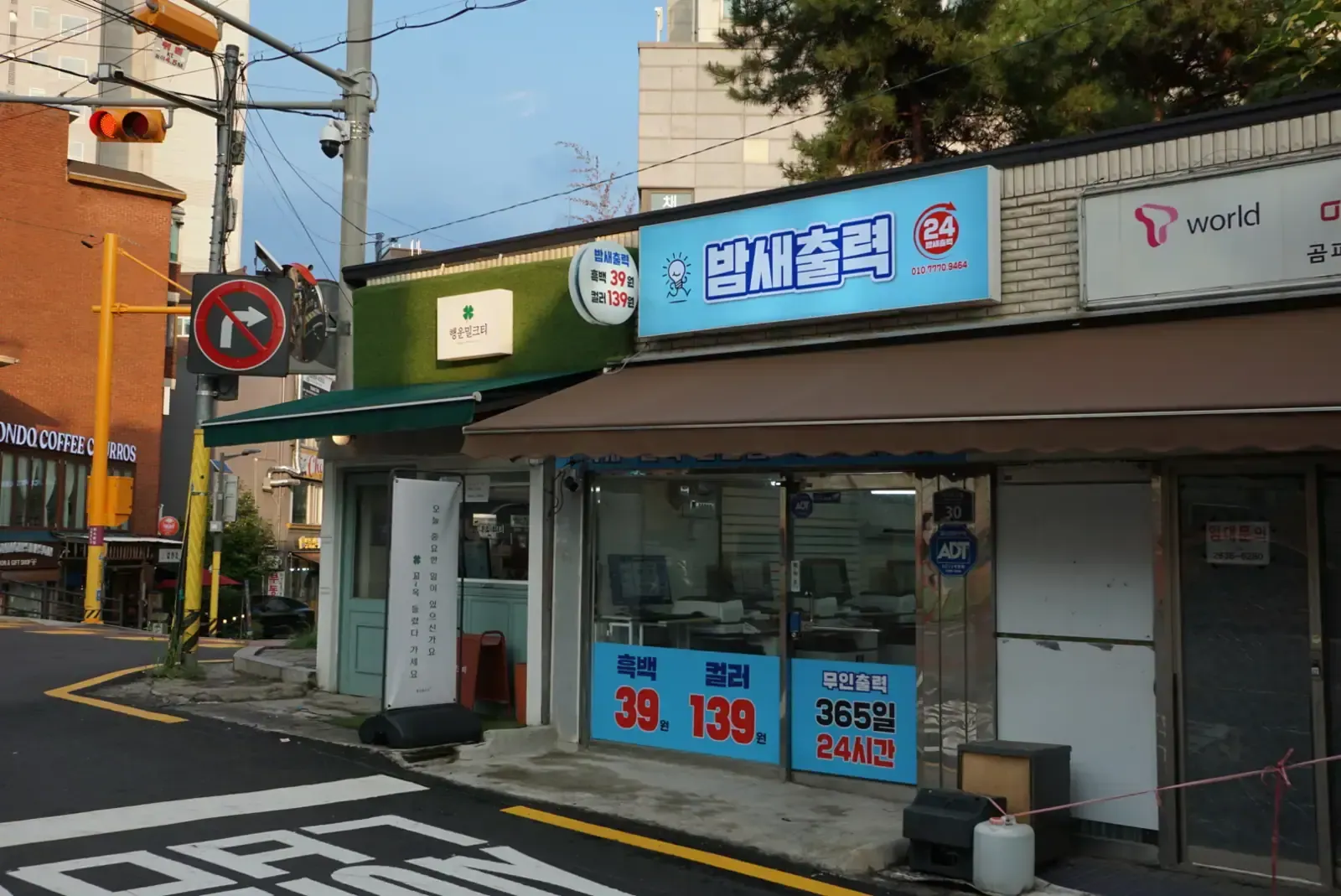
₩39 mono, ₩139 colour, 365 days · ⓒ @BalliBalliSeoul
The prices on that sign are typical: around ₩39 a page in black and white and ₩139 in colour. Printing thirty pages costs about as much as a bus ride.
Coin wash (코인워시 · 빨래방) — laundry by the load
Self-service laundromats, open around the clock, unstaffed, with machines that take cards or coins. Wash and dry are priced separately per load, and the big machines take a duvet — which is the real reason to go, since home machines here are small.
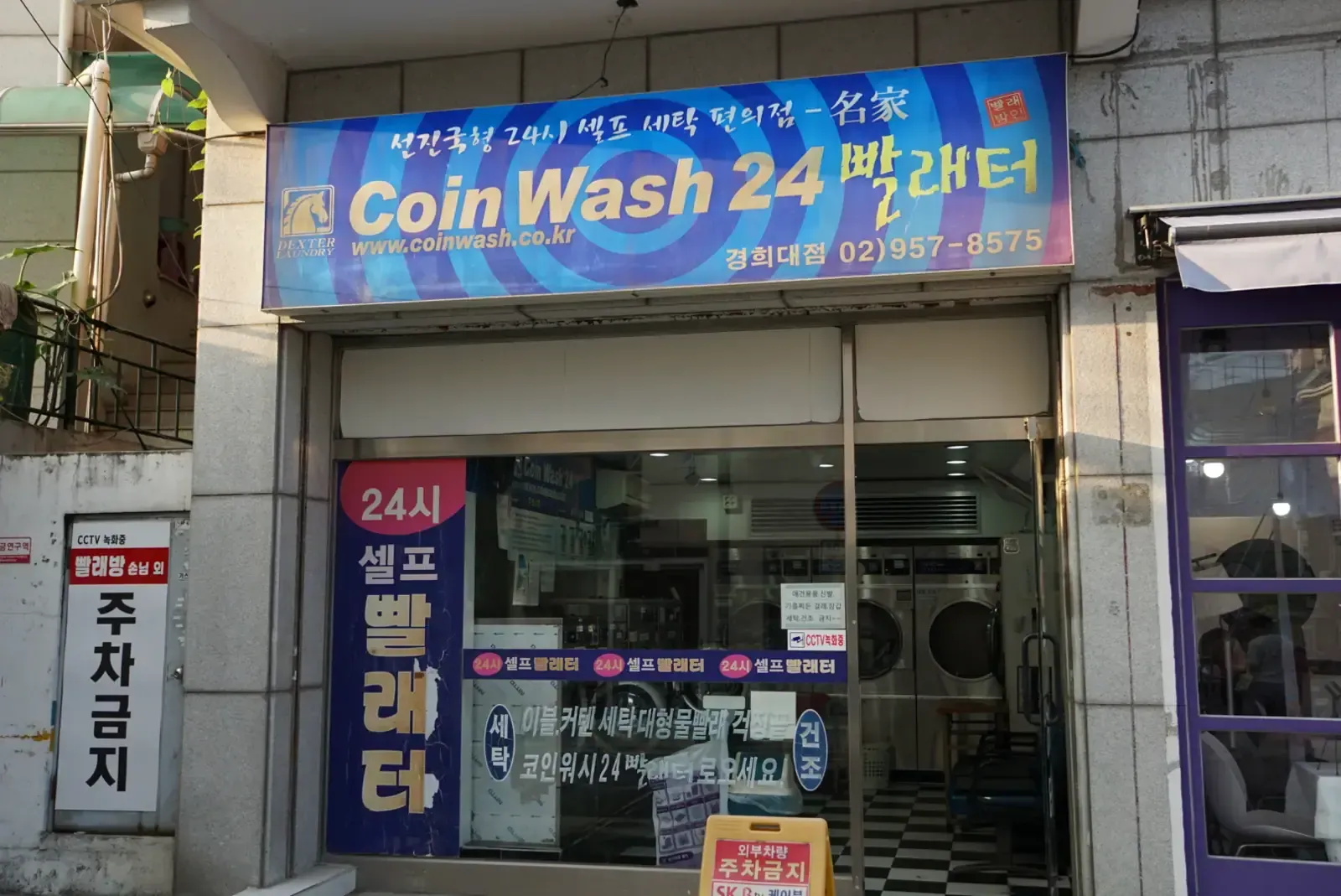
Unstaffed, open all night · ⓒ @BalliBalliSeoul
Many are deliberately built as laundry plus lounge: seating, Wi-Fi, sometimes a coffee machine, so the hour your washing takes isn’t wasted. Which is, once again, the same idea — you’re renting a room and a machine.
And the rest of the family
- 만화카페 (comic cafe) — walls of comics, cushions, blankets, hourly rate. Some people nap.
- 보드게임카페 (board game cafe) — hundreds of games, staff who explain rules, hourly rate.
- 노래방 (karaoke) — a private room, by the hour, no stage and no audience. A 코인노래방 charges per song instead.
- 찜질방 (jjimjilbang) — bathhouse plus communal sleeping room, open overnight.
What each one costs, roughly
| Place | What you rent | Typical rate (2026) |
|---|---|---|
| PC방 | A gaming PC and a seat | ₩1,000–2,000 / hour |
| 스터디카페 | A silent desk | ₩2,000–3,000 / hour |
| 프린트카페 | A printer, per page | ~₩39 mono · ~₩139 colour |
| 코인워시 | A washer, then a dryer | Per load, priced separately |
| 만화카페 | Comics, a cushion, a blanket | Hourly |
| 코인노래방 | A karaoke booth | Per song |
Rates vary by neighbourhood — university districts are cheapest, and overnight packages are usually better value than the hourly rate.
How to use any of them, without asking
The pattern repeats almost everywhere:
- Pay first, at a kiosk, usually by card. Choose hours or a package.
- Take the printed code or seat number. For 24-hour places the code opens the door.
- Everything else is self-service — machines, screens, ordering, and often no staff on site at all.
- Clean up and leave. Sort your rubbish into the marked bins on the way out.
If a place is unstaffed and the kiosk is in Korean, that’s the one moment you’re stuck. Which brings us to the usual disclaimer.
The Korean part
Reading the kiosk is the easy half — your camera does that. The half that stops people is paying: many of these machines want a Korean card, a phone number for the receipt, or a membership you can’t register for. Unstaffed at 2 a.m., there’s nobody to ask either. We book and pay for it and send you the door code.
Get it sorted
Kiosk won’t take your card, or won’t let you register? Message us on WhatsApp — we’ll book and pay for the hour and send you the code. Asking costs nothing — you pay only for the work you book.
The one-line version: “cafe” here means a room by the hour — gaming, studying, printing, washing, singing — you pay at a kiosk before you use it, and most of them never close.