How to Book Movie Tickets in Korea (CGV, Lotte, Megabox)
Here’s a scene that plays out every blockbuster season. A traveler planning a December Seoul trip wants to see Avatar: Fire and Ash on a big Korean screen — and hits a wall weeks before the flight: CGV and Megabox both demand Korean phone verification to make an account, and even reaching customer service requires… a Korean phone number. Panic sets in: will it be sold out before I even land?
The answer — and it surprises everyone — is mostly no, and the parts that do sell out have workarounds. Movie night in Korea is a premium experience at a reasonable price: recliner seats, famous IMAX screens, popcorn flavors you’ll write home about. The catch is upstream, in the booking system that assumes you’re Korean. Here’s the whole thing.
The three chains
- CGV (cgv.co.kr) — the biggest, with the famous special formats: the giant Yongsan IMAX (the one film fans fly in for), 4DX motion seats, and ScreenX wraparound screens.
- Lotte Cinema (lottecinema.co.kr) — everywhere, often inside Lotte malls, with its own premium halls and comfortable standard seats.
- Megabox — the third player, strong on Dolby Cinema and cozy boutique-style branches.
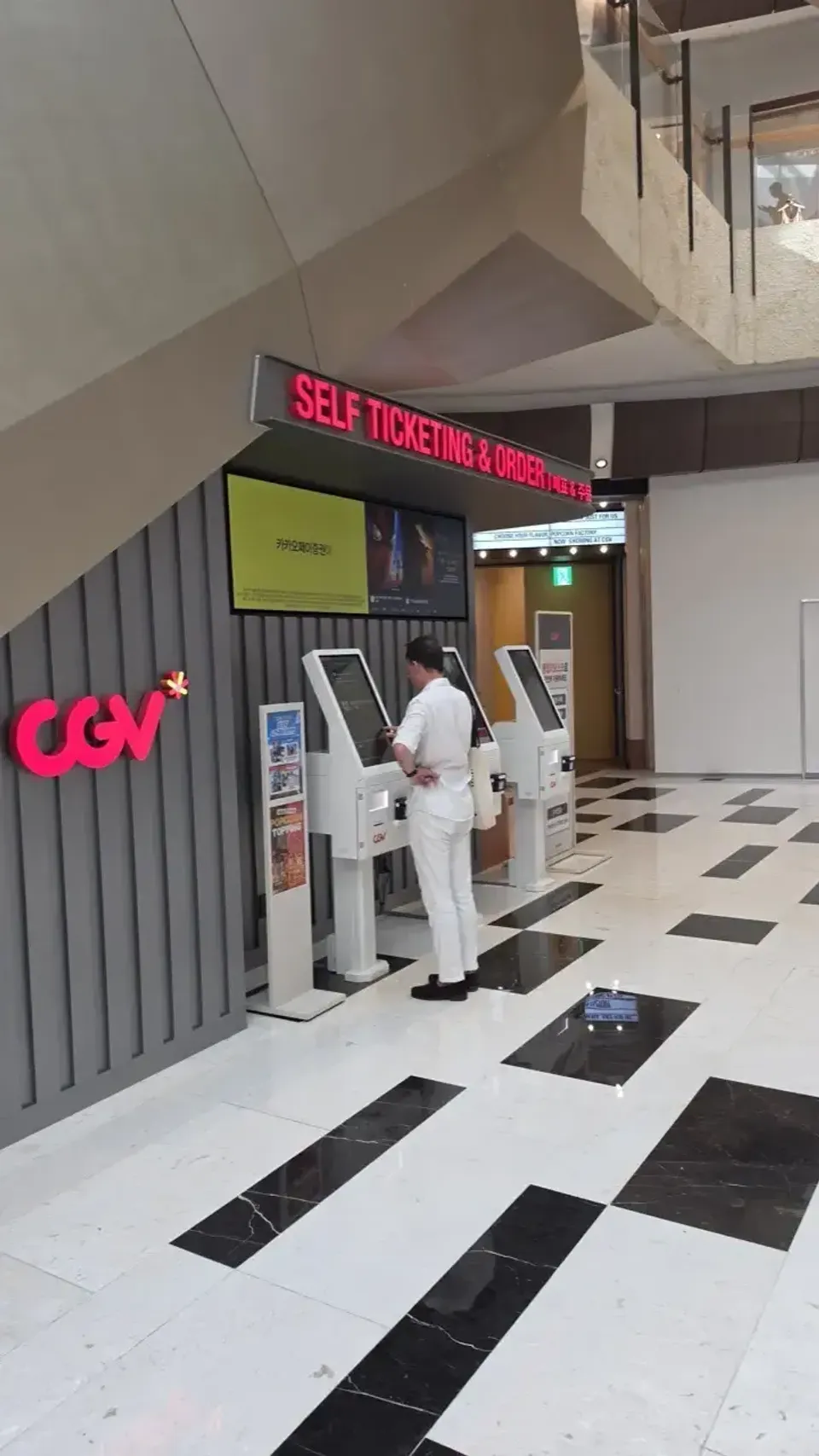
The chains keep their branches sharp, too — the photos in this guide are from CGV Yeouido in the IFC Mall, which reopened on July 31, 2026 after a full renovation (we shot these the following week):
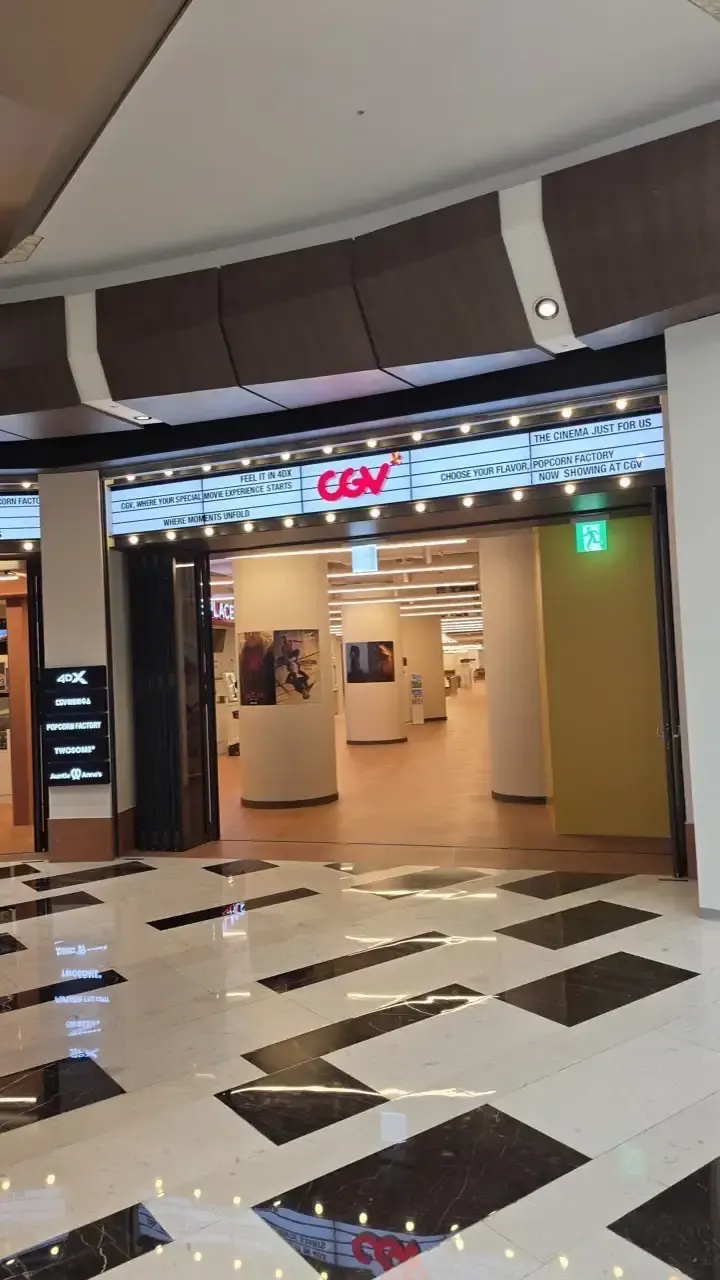
CGV Yeouido, a week after its 2026 reopening · ⓒ @BalliBalliSeoul
Quality is high across all three; in practice you pick by what’s near you and which special format you’re chasing. All seating is assigned — you choose your exact seat on a map at booking, and people respect it.
The one label that matters: 자막 vs 더빙
Foreign films screen in their original language with Korean subtitles by default — so Hollywood releases are fully watchable with zero Korean. The trap is animation and family films, which often screen in two versions: 자막 (jamak, subtitled — original audio) and 더빙 (deobing, dubbed in Korean). That one word in the showtime listing is the difference between Pixar in English and Pixar in Korean. Korean films, meanwhile, generally have no English subtitles — though CGV and others occasionally run English-subtitled screenings of big Korean hits, worth hunting for when one is having a moment.
What it costs in Seoul
As of 2026, rough figures:
| Ticket | Typical price |
|---|---|
| Standard 2D, weekend evening | Around ₩14,000–16,000 |
| Early-morning (조조) shows | Several thousand won cheaper |
| Culture Day — last Wednesday of the month | Discounted evening shows (around half price) |
| IMAX / 4DX / Dolby / recliner halls | ₩20,000–30,000+ |
Two savings habits locals use: 조조 (jojo) early-bird screenings before roughly 10–11 AM, and Culture Day (문화가 있는 날) — the last Wednesday monthly, when evening tickets drop steeply. Telecom memberships (SKT, KT, LG U+) also carry standing cinema discounts if you have a Korean plan.
How to actually book
The apps and websites (CGV, Lotte Cinema, Megabox) are the full-feature route — real-time seat maps, special format schedules — but they lean Korean: membership sign-up, phone verification, and payment steps are the usual foreign-card lottery. CGV and Lotte both run limited English versions of their sites that cover the basics for major branches.
First, the reassuring math. Blockbusters here screen at a density that makes sell-outs rare: when Avatar: Fire and Ash was peaking last winter, COEX alone ran it about 21 times in a single Thursday — and that’s one multiplex among dozens in Seoul. For regular 2D screenings, even in opening weeks, a same-day seat has almost always existed. The traveler above didn’t need an account at all.
The kiosk is your friend. Every theater lobby has self-service kiosks with an English mode. Walk in, tap English, pick seats, pay by any card — no membership, no Korean phone. For a normal movie night this is honestly the easiest route. (The catch is direction-specific: kiosks happily sell you a walk-up ticket, but picking up an online reservation can require the Korean-verified account that made it — so for tourists the kiosk is a buy-here machine, not a pickup counter.)
The English switch is one tap, bottom of the home screen:
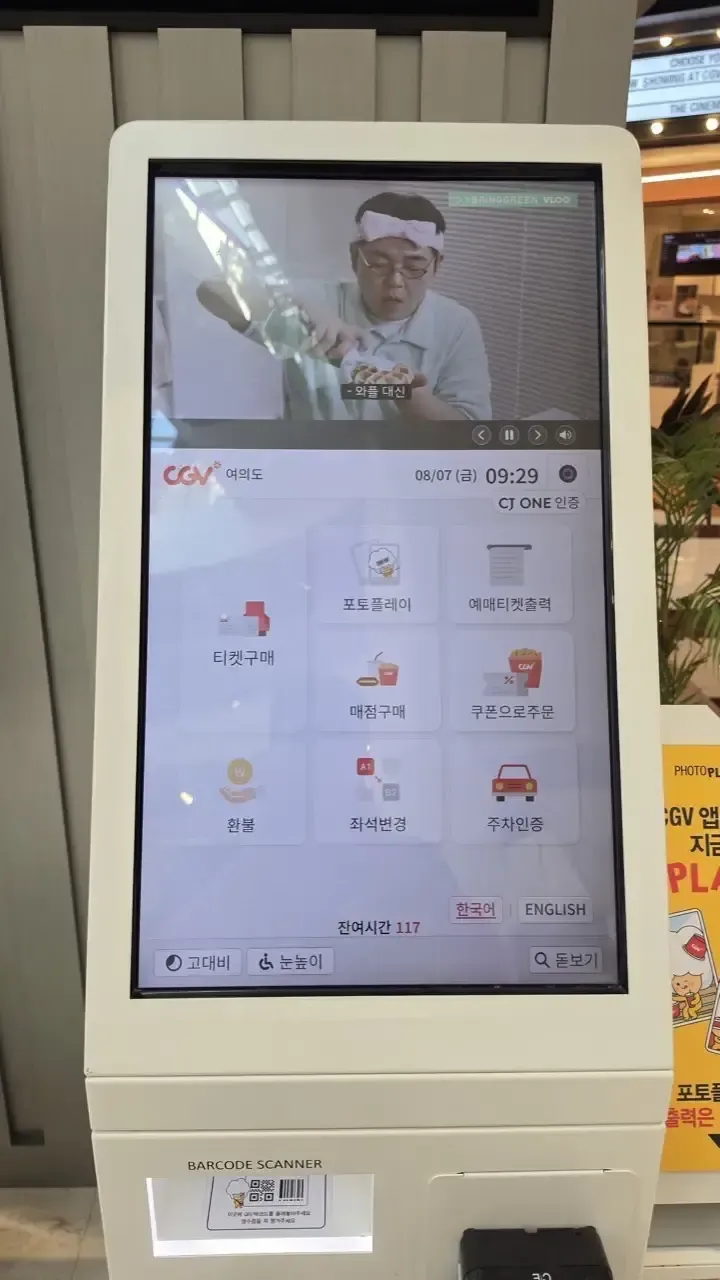
The ENGLISH button is right there on the Korean screen · ⓒ @BalliBalliSeoul
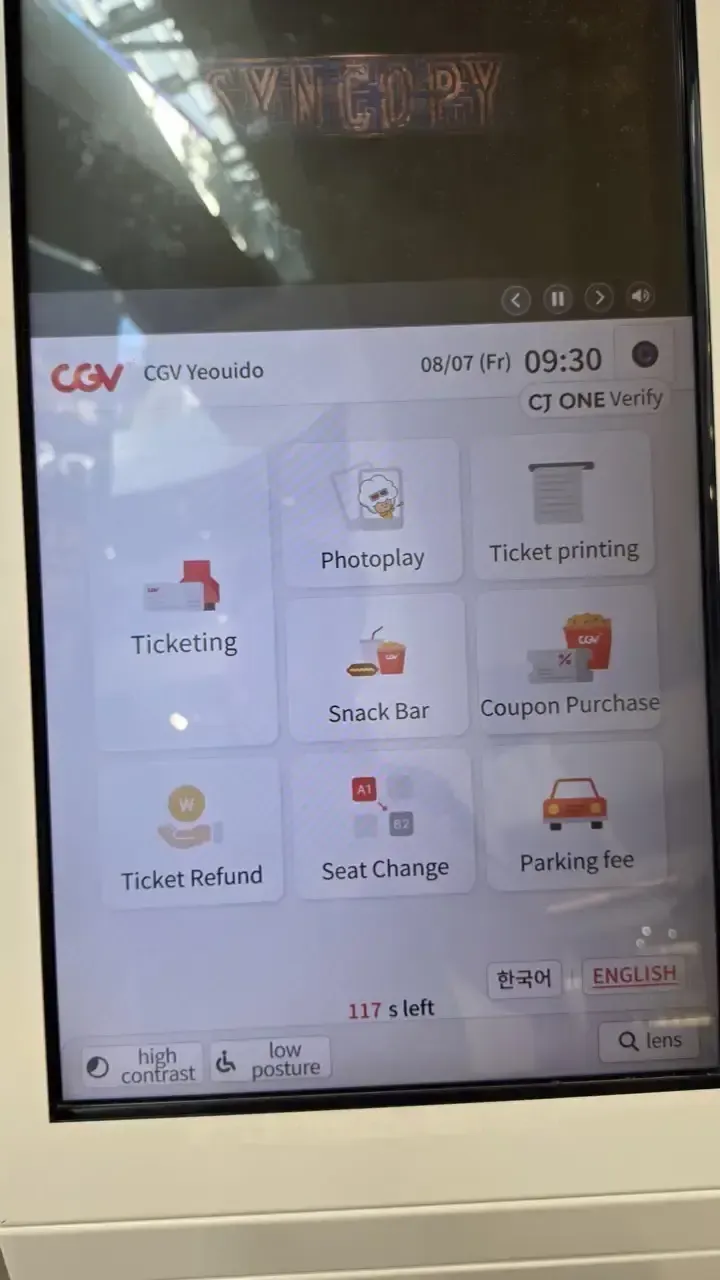
And the whole machine follows — ticketing, refunds, even parking · ⓒ @BalliBalliSeoul
And here’s the kiosk trick most people — including plenty of locals — don’t know: the kiosk isn’t limited to the theater you’re standing in. Tap “Change Theater&Date” and you can buy tickets for any branch of the chain nationwide, any date — the full list comes up in English:
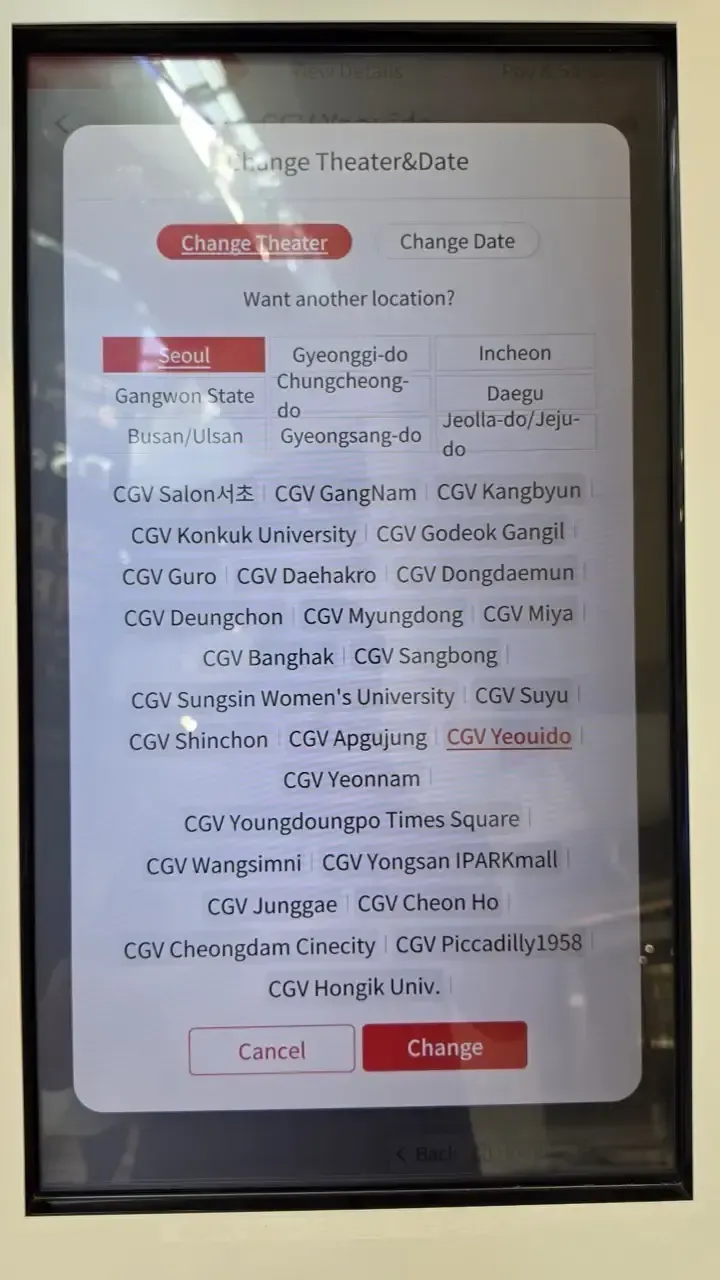
Buy here, watch anywhere — the whole chain in English · ⓒ @BalliBalliSeoul
That turns any nearby branch into a booking office for your whole trip: drop in while passing a mall, buy Saturday’s show at the branch near your hotel, and walk out with the tickets sorted — no app, no verification, no race.
The flow is the same everywhere: branch → movie → showtime (check that 자막/더빙 label!) → seat map → payment. If you booked online, the kiosk prints your ticket from the booking number or the card you paid with — no membership required for that part. One cultural note: pre-show ads run long, so the actual film starts around ten minutes after the printed time, but don’t push it — assigned seating means latecomers shuffle past people in the dark.
The special-format exception: Yongsan IMAX and other famous halls for a big release sell out the moment booking opens, days ahead — for the Avatar opening that race was over in minutes. It’s an app-only contest, and exactly the kind that Korean verification walls make unfair for visitors. (The same wall we’ve mapped in our Korean apps guide.) That specific case — “I need the famous screen on a specific night” — is when you can’t kiosk your way out, and the realistic options are a Korean friend, or us (below).
The art-house bonus most visitors never hear about: Seoul’s indie cinemas — Emu Cinema near Gyeonghuigung and KU Cinema by Konkuk University are the names regulars trade — program Korean and world cinema, and English-subtitled screenings of Korean films turn up here far more often than at the big chains. If your trip wish is “watch a Korean film in a theater and actually understand it,” start there.
Concessions, briefly
Korean cinema popcorn is a genre of its own — caramel and onion (yes, onion; order half-half) — plus dried squid, hot dogs and beer at many branches. Combos are cheap enough that smuggling snacks isn’t the sport it is elsewhere.
The Korean part
Reading 자막/더빙 labels, racing an IMAX booking window through a Korean membership flow, or finding the one English-subtitled screening of the Korean film everyone’s talking about — that’s where a movie night dies in the planning stage. Through our anything-else concierge service, tell us the film, the format and the night, and we book the seats — center block, subtitled version confirmed — and send you the ticket. Asking costs nothing — you pay only for the work you book.
Get it sorted
Chasing IMAX seats or just want Friday sorted? Message us on WhatsApp with the movie and your preferred time — we’ll confirm the subtitled screening and book the good seats before they’re gone. Asking costs nothing — you pay only for the work you book.
And for a first taste of why Korean cinema culture is special: book a recliner hall for a film you already wanted to see, order the half-caramel half-onion popcorn, and thank us later.