Flying a Drone in Korea: The Rules, and Where to Check
You packed the drone. You pictured the shot — the palace roofs, the Han River at dusk, Bukhansan from above. And then somebody told you that you cannot fly it in Seoul, and you could not work out whether they were right.
They were mostly right, and the reason is not what most people assume.
This page is not legal advice and it is not permission. It is the shape of the system, the words you will need, and the one website that actually decides things — so that you can check your own case before you travel rather than after you have been stopped.
Why is so much of Seoul closed to drones?
Korea is a country with an active security situation, and its airspace rules reflect that rather than a dislike of hobbyists.
The restrictions stack. There is airspace closed because of national security and military installations, airspace closed around airports and airfields, and rules that apply anywhere — not over crowds, not at night, not when you cannot see the aircraft with your own eyes.
Seoul sits under several of those at once. The city government’s own guidance to residents is blunt about it: Seoul and the surrounding metropolitan area are restricted or prohibited airspace, and anybody wanting to fly is told to apply through the national portal rather than to assume.
So the working assumption for a visitor should be the opposite of the one you are used to. In much of Europe or North America you may fly unless a map says otherwise. Here, in and around Seoul, assume you may not, and find out whether your specific spot and date are an exception.
What does your drone’s weight decide?
Two things, at two different thresholds, and they are easy to confuse because most countries only have one.
| Maximum take-off weight | Pilot certificate | Register the aircraft |
|---|---|---|
| 250g or under | No — treated as a toy | No |
| Over 250g to 2kg | Class 4 (4종) | No |
| Over 2kg to 7kg | Class 3 (3종) | Yes |
| Over 7kg to 25kg | Class 2 (2종) | Yes |
| Over 25kg | Class 1 (1종) | Yes |
250g is the certificate line. 2kg is the registration line. A drone of 1.5kg needs a Class 4 certificate but no registration; one of 3kg needs both.
Class 4 is the lightest requirement and the one most travel drones fall into: from age 10, with an e-learning course run by the Korea Transportation Safety Authority. The classes above it need that authority’s own certificate and a minimum age of 14.
And one rule that overrides the whole table: if the flying is commercial, the aircraft must be registered whatever it weighs. “Commercial” here means flying for somebody else, for payment — the obvious case being paid photography. Filming your own trip is not that. Filming somebody’s wedding for a fee is.
This is why the sub-250g category exists at all. A good deal of consumer drone design has been aimed at sitting just under that line, here and elsewhere. Check your own model’s figure with the battery you actually fly — it is the take-off weight that counts, not the body.
What it costs to get this wrong
The penalties are not uniform, and the worst of them is not a fine.
| Flying without the required certificate | Up to ₩4,000,000 (항공안전법 §166②) — and where the airframe also lacked safety certification, up to a year’s imprisonment or ₩10,000,000 (§161②) |
| Flying an unregistered aircraft that needed registering | Up to six months’ imprisonment or a ₩5,000,000 fine (§161③). This is a criminal penalty, not an administrative one |
| No registration number displayed | Up to ₩1,000,000 |
| Flying in approval-required airspace without approval | ₩1,500,000 for a first offence, per the portal’s own notice |
Being under 250g exempts you from the certificate. It exempts you from nothing else. Weight and airspace are separate questions, and the second one is what ends most Seoul plans.
Flight approval and filming approval are two different things
This is the single most useful thing on this page, and it is where people who have read an old article go wrong.
| 비행승인 — flight approval | 항공촬영 — aerial filming | |
|---|---|---|
| What it covers | Being in the air at all | Recording while you are there |
| Whose rules | Ministry of Land, Infrastructure and Transport | Ministry of National Defense guidance |
| In prohibited airspace | The controlling authority — Joint Chiefs, Capital Defense Command, Air Force — approves separately | Same |
Neither one substitutes for the other. Permission to film is not permission to fly, and permission to fly is not permission to film. The official guidance says so explicitly, because the mistake is common.
The part that changed, and that old articles get wrong
If you find an English or Korean article from a few years back, it will probably tell you that all aerial photography in Korea needs Ministry of National Defense approval, submitted in advance, sometimes with a military escort present during the shoot.
That is no longer how it reads. Under the current guidance, aerial filming of ordinary areas — anywhere that is not a designated no-filming facility — does not require Ministry of National Defense permission or approval.
What remains prohibited is filming these, for anybody:
- National security and military security installations
- Airfields, naval ports, missile bases and similar military facilities
- Defence-industry sites and other facilities of national security importance
And if you do not know whether your location includes one — which is the normal situation for a foreign visitor, since the whole point of some of these sites is that they are not advertised — you can ask. The portal below takes a request to confirm whether a no-filming facility falls inside your area. That request must go in at least four working days before you film.
Four working days is the difference between asking from your sofa the week before and asking from a hillside on the morning you wanted the shot.
Where do you actually apply?
One place, for all of it: 드론 원스톱 민원서비스, the Drone One-Stop civil service portal.
drone.onestop.go.kr
Check the address ends in .go.kr, which is reserved for Korean government
bodies — the habit that protects you across every Korean government
site.
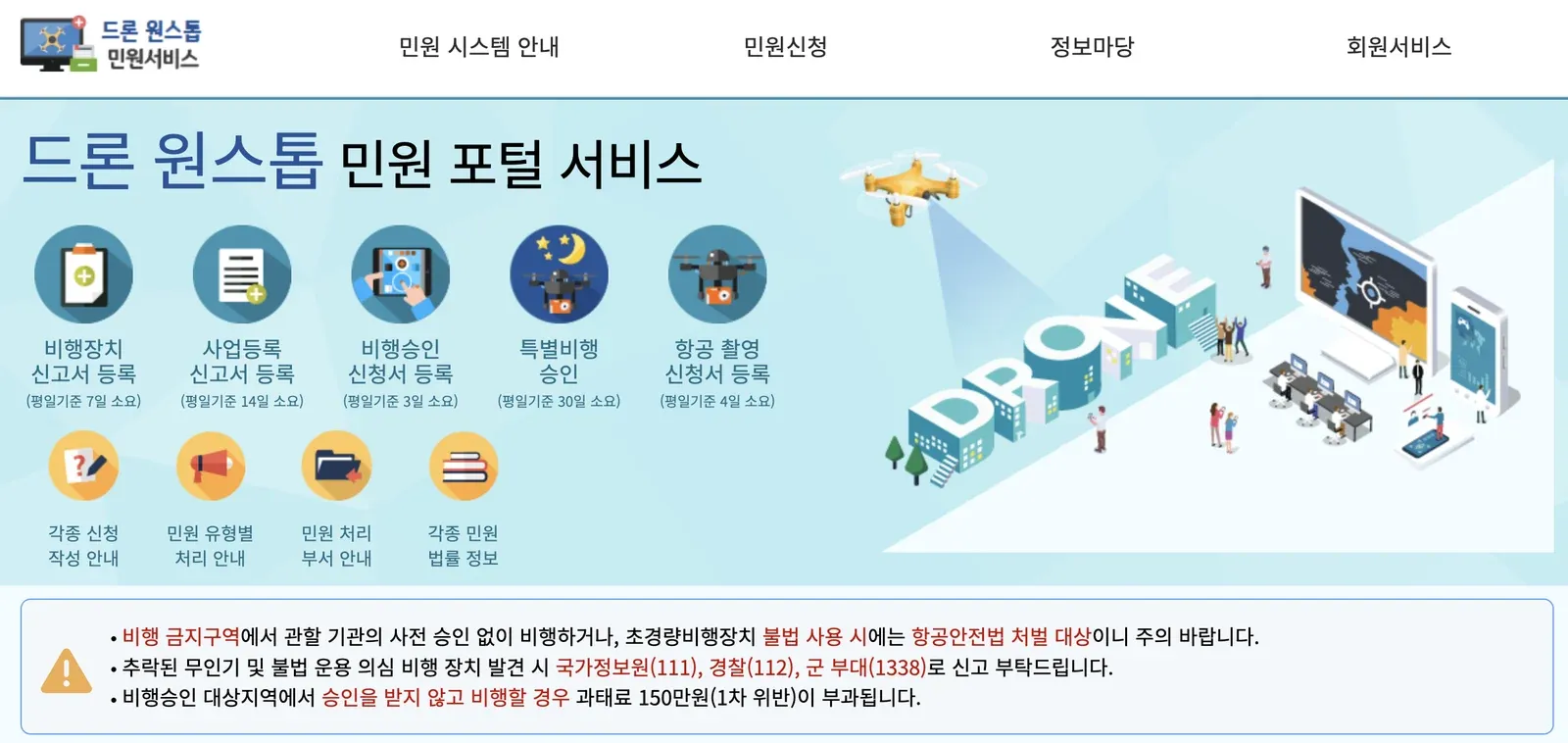
Five tiles, five waiting times, and no English anywhere · drone.onestop.go.kr, October 2026 · ⓒ @BalliBalliSeoul
Look at the red box along the bottom of that screen. The portal states its own headline rules there: flying in prohibited airspace without the controlling authority’s prior approval, or using an ultra-light aircraft unlawfully, is punishable under the Aviation Safety Act; and flying in approval-required airspace without approval draws a ₩1,500,000 fine on a first offence.
It also prints the numbers for reporting a crashed or suspicious drone — 국가정보원 111, 경찰 112, 군 부대 1338. Worth knowing which way that runs: if your aircraft goes down somewhere awkward, those are the people who will be told about it.
Start with the map, not the form. The homepage carries a 지도로 확인하기 (“check on the map”) link into a searchable map of where flight is and is not possible. For most visitors that map answers the real question in two minutes, and it answers it before you have filled anything in.
Five different applications, five different waiting times
The portal publishes its own processing times on the front page, in working days, and they are not the same:
| Application | Korean | Working days |
|---|---|---|
| Aircraft registration | 비행장치 신고 | 7 |
| Business registration | 사업등록 신고 | 14 |
| Flight approval | 비행승인 신청 | 3 |
| Aerial photography | 항공촬영 신청 | 4 |
| Special flight approval | 특별비행승인 신청 | 30 |
Special flight approval is the one that catches people out. It is what covers flying at night or beyond visual line of sight — the shots people most often come to Korea wanting — and it is a thirty working day process. That is six weeks of calendar time.
There is also a 비행/촬영 원스톱 신청 menu that files flight approval and the photography request together. The two approvals remain separate things; the portal just lets you ask for both in one sitting.
The honest part: there is no English
We checked, because the post would be useless if we were guessing.
The portal has no language toggle. Not a partial translation, not an English section that runs out halfway — there is no English option on it at all. Every menu, every form, every notice and every reply is in Korean, and much of it in administrative Korean rather than everyday Korean.
Machine translation will get you through the menus. What it will not reliably do is tell you which of the five applications your situation needs, or what a refusal means when it arrives.
Treat it as something you start before you book the trip, not something you do on the day.
Where can you buy, repair or get parts for a drone in Korea?
If your plan is to buy here rather than fly something you brought, DJI runs an official retail and after-sales network through department stores. As listed by DJI Korea in October 2026:
| Where | Branches |
|---|---|
| Flagship | 더 게이트 신사 1F (02-514-1543) |
| Shinsegae | 본점 · 강남 · 센텀시티 · 대구 · 대전 · 광주 · 경기 · 의정부 · 하남 · 천안 · 김해 · 마산 |
| Hyundai | 압구정본점 · 더현대 서울 · 무역센터 · 목동 · 울산 · 더현대 대구 · 판교 · 킨텍스 |
| Lotte | 본점 · 잠실 · 부산본점 · 인천 · 동탄 |
| Galleria | 광교 · 센터시티 |
| Starfield | 수원 |
| Duty free | 현대 · 신라 · 신세계 · 롯데 |
| DJI Boutique | 강남 (02-545-1544) · 일산 (031-906-1543) |
Department-store counters matter more than they sound here, because they are where a repair or a warranty claim goes. A drone bought online from abroad and broken in Korea is a harder conversation than one bought at a counter in Gangnam.
Two that fly, two that do not. Left half — drones. Both are built to sit under the 250g line, which is the line that decides whether you need a pilot certificate at all: DJI lists the Mini 4 Pro at a take-off weight under 249g on its standard battery, and the Neo 2 is lighter again. Watch the battery — the Mini's larger "Plus" flight battery pushes the aircraft past 249g, which in Korea turns a flight that needed nothing into one that needs a Class 4 certificate. Right half — the same handheld camera in two bundles, standard and vlog. Neither is a drone, and that is the whole point: no certificate, no registration, no flight approval, no filming request, no four-working-day wait. It works on the days and in the places where none of this article applies, which in Seoul is most of them.


Affiliate links — we earn a small commission if you buy through them, at no extra cost to you. Weights are as published by the manufacturer; check the spec sheet for the exact configuration you buy, because in Korea that figure has legal consequences.
이 포스팅은 쿠팡 파트너스 활동의 일환으로, 이에 따른 일정액의 수수료를 제공받습니다.
Two practical notes if you are buying. Duty-free branches are for departing travellers and the goods go with you out of the country, which may or may not be what you want. And if your foreign card is declined at checkout, that is an ordinary Korean payments problem rather than anything about you — the same thing that catches people buying phones here.
What if you are only here for a week?
Add up the portal’s own waiting times before you pack.
| If you need… | Working days |
|---|---|
| To register the aircraft (over 2kg) | 7 |
| Flight approval | 3 |
| The photography confirmation | 4 |
| Night flight or beyond line of sight | 30 |
Those run against working days, so a weekend adds two. A drone over 2kg that needs registering, flight approval and a filming check is fourteen working days of process — most of three weeks — and none of it can start after you land, because registration is tied to the aircraft rather than the trip.
Even the easy case is not same-week. Under 2kg, no registration needed, just flight approval and the filming check: that is still seven working days if you file them separately, and they are assessed, not rubber-stamped.
So there are two versions of a drone trip to Korea that actually work:
- Plan it from home, weeks ahead, with specific dates and specific coordinates, and accept that some will come back as no.
- Leave it at home and treat Korea as a place you photograph from the ground, which it is extremely good at.
The version that fails is the one most people attempt: bring it, decide on the day, and discover that the viewpoint you drove to sits inside something you were never going to be allowed to overfly.
The Korean part, and what we will not do
Let us be precise about the line here, because this is an area where being vague would be worse than useless.
What we do not do. We do not file flight approvals or filming requests on your behalf, we do not tell you that a particular place or date is permitted, and we do not interpret aviation or military-facility law for you. Submitting government applications for other people as a business is regulated work in Korea, and aviation compliance is not our field. Anybody who offers you a guaranteed drone permit for a fee is selling you something they should not be.
What we can do, and it is a real part of the problem:
- Read the portal with you and tell you in English what each screen is asking for.
- Translate what came back — approvals, refusals, and requests for more information are written in administrative Korean.
- Make the phone call when a form has produced a question rather than an answer, and tell you what was said.
- Ask the venue. A great many drone plans fail not on national law but on the fact that the park, the temple or the building has its own rule, and that rule lives with a manager who answers the phone in Korean.
Holding a drone and a plan, and stuck at a Korean form? Send us the screen on KakaoTalk — or WhatsApp — and we will tell you what it is asking and what your options are. We will also tell you plainly when the answer is that you should not fly, which is often. The first answer is free, and we take no commission from anybody.
Last verified: 26 October 2026. Based on the Korean government’s 생활법령 guidance for unmanned aircraft (항공안전법 as in force 17 September 2026) and the Ministry of National Defense 항공촬영 지침서 dated 1 January 2026. Airspace designations and thresholds change.
drone.onestop.go.kris the authority; this page is not.
The one line to carry: weight decides your certificate, the map decides your flight, and the two approvals are separate. Everything else is detail you can look up once you know which question you are asking.